


Each year Gartner analysts identify the top disruptive tech and emerging categories. For 2026, they picked 12 and I ran each of them through the Four Waters audit, built from a library of deep analysis on 202 companies across 19 categories. (Free for you to use, too.)
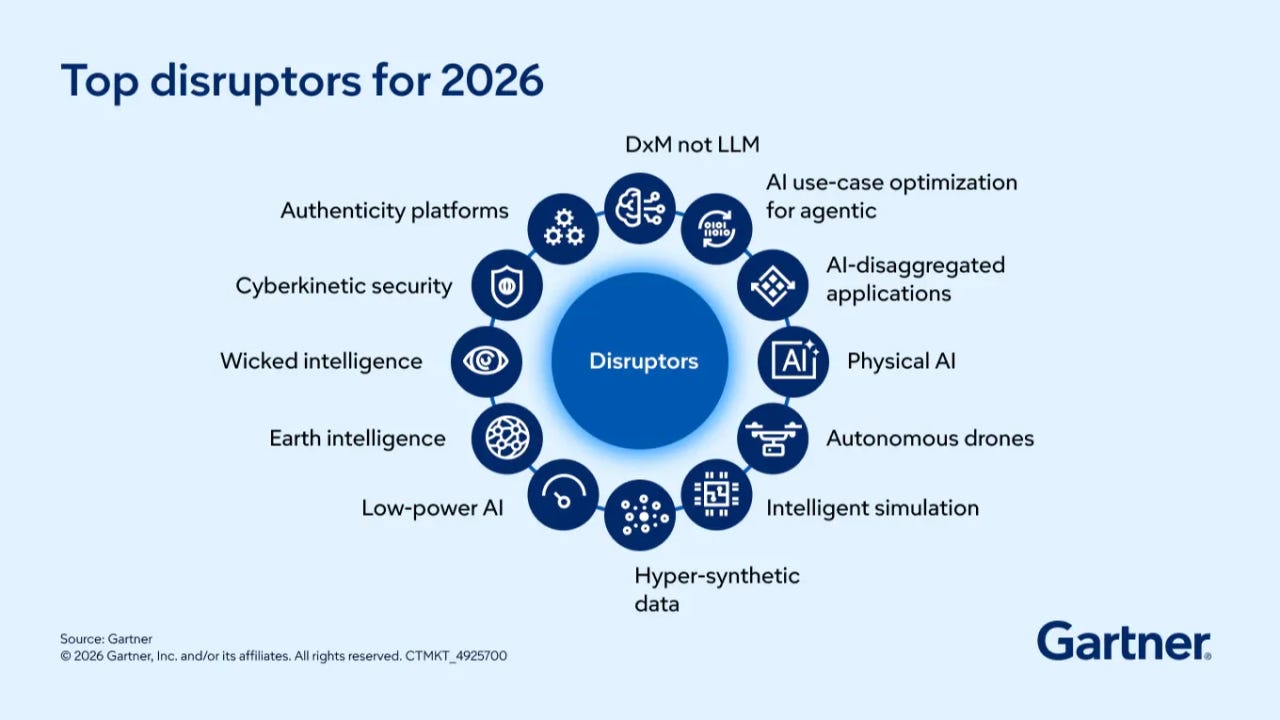
Gartner’s 12 for 2026:
DxM not LLM is domain-specific AI models.
AI use-case optimization for agentic is (a mouthful for) frameworks to govern AI agents.
AI-disaggregated applications is an array of agentic micro systems or services.
Physical AI is AI inside robots, machines and industrial systems.
Autonomous drone is an aircraft without human oversight.
Intelligent simulation is AI-driven digital twins used to simulate scenarios.
Hyper-synthetic data is artificially generated training data.
Low-power AI is models that are light enough to run on-device.
Earth intelligence is AI applied to satellite and geospatial data.
Wicked intelligence is AI aimed at stubborn problems like global warming.
Cyberkinetic security is focused on defending physical and autonomous systems.
Authenticity platforms is largely deepfake detection right now.
The audit begins by placing each category in one of four stages from the Four Waters Framework then uses its maturity signals to plot the next steps and potential missteps:
Uncharted Waters is where people don’t think the problem is worth solving yet. You’re selling belief and your top competitor is doubt.
First Voyage is where early adopters validate the product, and there’s a race to define the category before rivals set the terms.
Charted Course is when the category is real and mainstream buyers enter. It’s a land grab.
Crowded Waters is when everyone gets it, so you fight for market share on execution, price and unit economics.
Comparing Gartner’s 2026 disruptors against the library of 10+ year-old categories identified lots of trends, but one big takeaway was that the competitor that beats you usually isn’t the one selling what you sell.
It’s a budget that doesn’t exist.
It’s a platform that turns you into a feature.
It’s an analyst rewriting your category thesis.
It’s your own GTM motion fighting your buyer.
Here are six early-category competitors that you’re probably not watching.
1. The budget that doesn’t exist yet
Deepfake detection has some basic ingredients for a category gold rush: real threat, scary headlines, complicated technical problem. Reality Defender, Truepic, and GetReal have all raised money on that, but no pure-play unicorns have emerged.
Compare those to legal or healthcare AI, born during the same years and built on the same models.
Harvey is valued at over $11 billion.
OpenEvidence is $12 billion.
Abridge is $5 billion.
A big difference between them and deepfake detection is how they are funded. A hospital already paid for the hours a doctor spends writing notes. A law firm already tracked and optimized billable hours. That meant Abridge and Harvey got to tap into a budget line item that already existed, and the ROI math was basic arithmetic.
That’s not the case for deepfake risk.
The same is mostly true with answer engine optimization (AEO). Marketing teams already have budgets for SEO and content tools, and every “What’s your AEO plan?” headline makes it easier to siphon from them. AEO startup Profound reached a billion dollar valuation in only a few years.
The pattern holds as I look back through the mature categories, too. Applicant tracking (Greenhouse, iCIMS) pulled from a recruiting budget that predated ATS by decades. Help desk software (Zendesk) pulled from a support budget line. None of them asked their buyers to totally invent a new line in the budget.
Lesson: If your prospects aren’t already paying to solve that or a related problem, you’re selling a behavior change in addition to selling your product. That takes extra time.
Test it: Ask your early customers how they are funding your product or service. Where does the money come from and who signs for it?
Common misstep: Don’t worry about potential competitors or differentiation until you help customers find the budget authority to pay for you.
2. The platform that turns you into a feature
“Synthetic data” is doing two things at once that usually happen years apart: It’s maturing and consolidating. Gartner just named it as a 2026 disruptor, but the startups that pioneered it are mostly gone.
Synthetic data is a horizontal capability that makes a bigger platform stickier: better training data sells more NVIDIA compute and more Databricks contracts. The platforms either built or acquired early and the category largely landed as a feature inside existing tools.
From what I can tell, the remaining independents mostly niched down or shut down:
Tonic refocused on data for engineering teams.
Parallel Domain refocused on data for self-driving.
Mostly AI and Datagen faded away.
Lesson: If your product and emerging category are horizontal and make a bigger platform stickier, the familiar land-grab window may not open before the platforms absorb it.
Common misstep: Don’t be so committed to creating the category that you miss the early exit opportunity. See: Gretel.
3. Your buyer’s calendar
How fast your category matures comes down to two things with outsized influence:
How long your product or service takes to implement
How long it takes to deliver value
When a single user can adopt in an afternoon and experience value immediately, the whole category matures faster. Granola reached a $1.5 billion valuation in “AI note-taking” in about three years.
When the product depends on long implementation, the pace is slow but the moat is deeper. A hospital’s procurement schedule, a regulator’s sign-off, an OEM’s manufacturing calendar are all mostly out of your control.
But the time it takes to deliver value is often more in your control and it’s getting shorter. As Santosh Sankar of Dynamo Ventures explained to me about the emerging physical AI category, “AI is compressing that implementation cycle, shortening time to ROI.” For a startup burning through venture and debt funding, compressing time-to-value can be the difference between sinking and swimming.
Lesson: You can’t fight your customer’s buying cycle, but you can cut time-to-ROI to accelerate your momentum and category maturity.
Common misstep: If you’re new to your customer’s industry, don’t convince yourself that you can shift their timelines. Put in the time up front to understand and align with them.
4. The fight for naming rights
In a young category, the market hasn’t settled on what it’s called or where its edges are. That means everyone with a stake starts pushing their version of it.
Incumbents want to fold the new thing into a category they already lead. When agentic tooling got hot, Datadog and New Relic started promoting “agent observability” and “AI observability,” stretching “observability,” the word for the monitoring category they already lead, to cover the new potential one.
Startup competitors rush to get their labels adopted, solidifying their position as thought leaders, if not new category leaders. Answer engine optimization (AEO) also gets packaged and sold as “GEO,” “AI SEO,” “LLMO,” and “AI visibility,” each vendor hoping it can influence the direction.
Analysts may look like neutral referees, but writing a new category name, definition, and the company shortlist is an attractive product. (Who do you think licenses Gartner’s Magic Quadrant?) Gartner pushes to define “CTEM” and “intelligent simulation” and “wicked intelligence” for a reason.
The point isn’t that the analyst or incumbent or loudest competitor takes your category. It’s that all of them are trying to, and the only defense is guiding your buyer’s language before someone else does.
Lesson: You don’t name your category alone. Incumbents, competitors, and analysts are all authoring it with you, so the goal is to rally them around a label that still tilts the category your way. Start with your buyer’s language because that’s often the strongest current.
Common misstep: Think through the implications before dropping an incumbent’s or an analyst’s category label on your own homepage.
5. Your go-to-market motion
Your buyer controls your GTM motion more than you do. If a single person can start using your product without asking anyone’s permission, bottom-up growth tends to work. If purchases must go through procurement, security reviews or regulators, the motion skews top-down whether you like it or not.
Of Gartner’s 12 disruptors, two-thirds sell top-down: drones, industrial AI, edge silicon, Earth intelligence, simulation, cyber-physical security, deepfake detection, and domain LLMs. Prompt-to-app (Replit, Lovable, Vercel) is the one that’s truly product-led.
In the audit library, every pure product-led winner could be adopted by a single user: AI coding (Cursor), AI meeting notes (Granola), collaborative whiteboards (Figma, Miro). Every category with a committee or a regulator in the loop is sales-led or hybrid (CRM, applicant tracking, legal, authenticity).
Freemium is similar because it’s almost universal where the user is the buyer, but rare where a committee signs.
Lesson: Your buyer picks your GTM motion.
Test it: If you have a B2B product, map out the chronological steps for a customer to fully adopt your product. I’ve surprised founders by doing this on the back of a napkin because it’s often more complex in practice than it is in their head.
Common misstep: Don’t assume PLG or freemium is on the menu. For many categories and buyers, it isn’t.
6. The missing flywheel
After 202 audits, the companies started to blur together and look similar. One stark trend that kept appearing was that some companies compounded, seemingly getting stronger with each new customer, while others did not.
That compounding can take many shapes.
Figma and Miro grow on a multiplayer loop where every user drags in collaborators, and the shared files create lock-in.
Clay grew on a community flywheel where users are naturally incentivized to share their own tactics and every shared playbook pulls in the next wave of users.
Gong and Granola use every conversation to get more useful, and harder to rip out, with every customer they land.
Different compounding loops, but the same trait: customer #20 makes customer #21 cheaper and easier to win.
Lesson: A compounding advantage is one of the strongest indicators of future success in an emerging category. As your competitors focus on who they want to be when they grow up, compounding loops help you get better each day.
Test it: What mechanism makes you noticeably better (faster, cheaper, smarter) to each customer as you grow?
Common misstep: Don’t confuse compounding with incrementality. Moats are built from exponential compounding.
The competitor you’re not watching
The rival with a similar product is often the least of your problems in an emerging category.
If you want to see which of these you’re facing, run your own company and category through the Four Waters audit. It’s the same tool I used on the 12 from Gartner, backed by data from 202 companies across 19 categories.
Analysts will never stop filling your inbox with hot takes on the latest disruptors. This audit will tell you who your real competitors are.
That’s all for this week. Thanks to Santosh Sankar from Dynamo Ventures for sharing his wisdom with us.
The naming of a problem or entire category is a theme that keeps coming up in your coverage. The AEO vs GEO vs LLM visibility is a solid example of a fight for naming rights underway. One that didn't stick or hasn't yet was a bunch of SEO's saying it's really SEO, just shifted a bit to search everywhere optimization. That had my vote, but I don't get to decide!
I agree we land on a name together as an industry, but what can a company do to drive adoption of their terms and become the de-facto thought leader on it? Like you've talked about, Gong popularizing revenue intelligence.
Yes! And this is true even for an existing category. When I was building Shezaar, I always kept track of any new competitor that popped up. Every time that happened I would panic a little too. But it took me too long to realise that what I was solving was not a hair on fire problem for my customers. So they were doing well with their existing patchwork of a system.