


Granola gets attention for product elegance in a category of clunky meeting bots. It’s well earned. But it deserves more attention for using UGC to convert people before they ever sign up.
Every AI notetaker has some version of user generated content as a growth channel. Otter, Circleback and Fireflies all encourage users to share meeting recaps with participants.
Notetaker grabs emails from calendar invite
Sends the meeting recap to demonstrate product value
Loads up on CTAs and remarketing to drive new adoption
It’s interesting but not new.
Granola’s iteration found a way to make that moment more powerful by front-loading the product’s aha moment for non-users. Existing users are actually delivering it to people who haven’t signed up, don’t know who you are, and aren’t even in the market for a solution.
It’s something I think about (and am actively borrowing) at Recurrent. We create vehicle insights that EV owners share when selling a car or helping fellow owners. Our product reaches non-users constantly, and we think a lot about user generated content, but I’ll admit we haven’t fully engineered sharing to front-load the most impact.
Adam Fishman called it user-distributed content. That’s helped me reframe how I think about it, so here’s a framework to help you turn your outputs into potent acquisition channels.
The Distributed Demo Framework
1. Design the Artifact
Every company has at least one output that reaches non-users. That’s true across sectors for both product and service providers.
Granola’s artifact is the shared meeting note. After every call, the user gets an AI-enhanced summary with action items, key decisions, and a prompt bar to go far beyond a TL;DR.
They didn’t have to create a new sharing behavior. They helped users by embedding in a behavior that already existed.
This is what separates strong distributed demos from forced ones.
A counter example is something I noticed when onboarding Fyxer. They prompt users to invite coworkers at every opportunity you could imagine, and a few that you couldn’t. (Their growth team said the tactic won an A/B test.)
But that’s not a demo, not an aha moment.
Test it: Make a list of outputs that reach non-customers through customers. Don’t prioritize by frequency or expected impact, but document some of that:
How often does that happen?
Is the output valuable on its own or does it require context?
What’s the best possible reaction you could expect?
What’s the likelihood of that reaction happening as it stands?
Lesson: The highest impact artifacts align with existing, frequent user behaviors. If we can focus less on creating the habit, our energy can go into upgrading an existing one.
Common misstep: I think marketers and growth teams are particularly prone to thinking about what people should be doing, rather than what people are actually doing. People should floss each day, but there’s a reason we call it the Toothbrush Test instead.
2. Front-Load the Aha
People who attend a meeting with an Otter or Fireflies bot get a readout. It’s useful, but predictable and static.
Non-users who get notes from Granola get an interactive page. They can use “Ask Granola” to query far deeper than the transcript: “Where in the meeting did I demonstrate the most leadership?”
Since Granola researched you based on your contact info, and can tailor responses to your role and professional context, the insights tend to be incredibly impressive.
That’s an aha moment for a non-user.
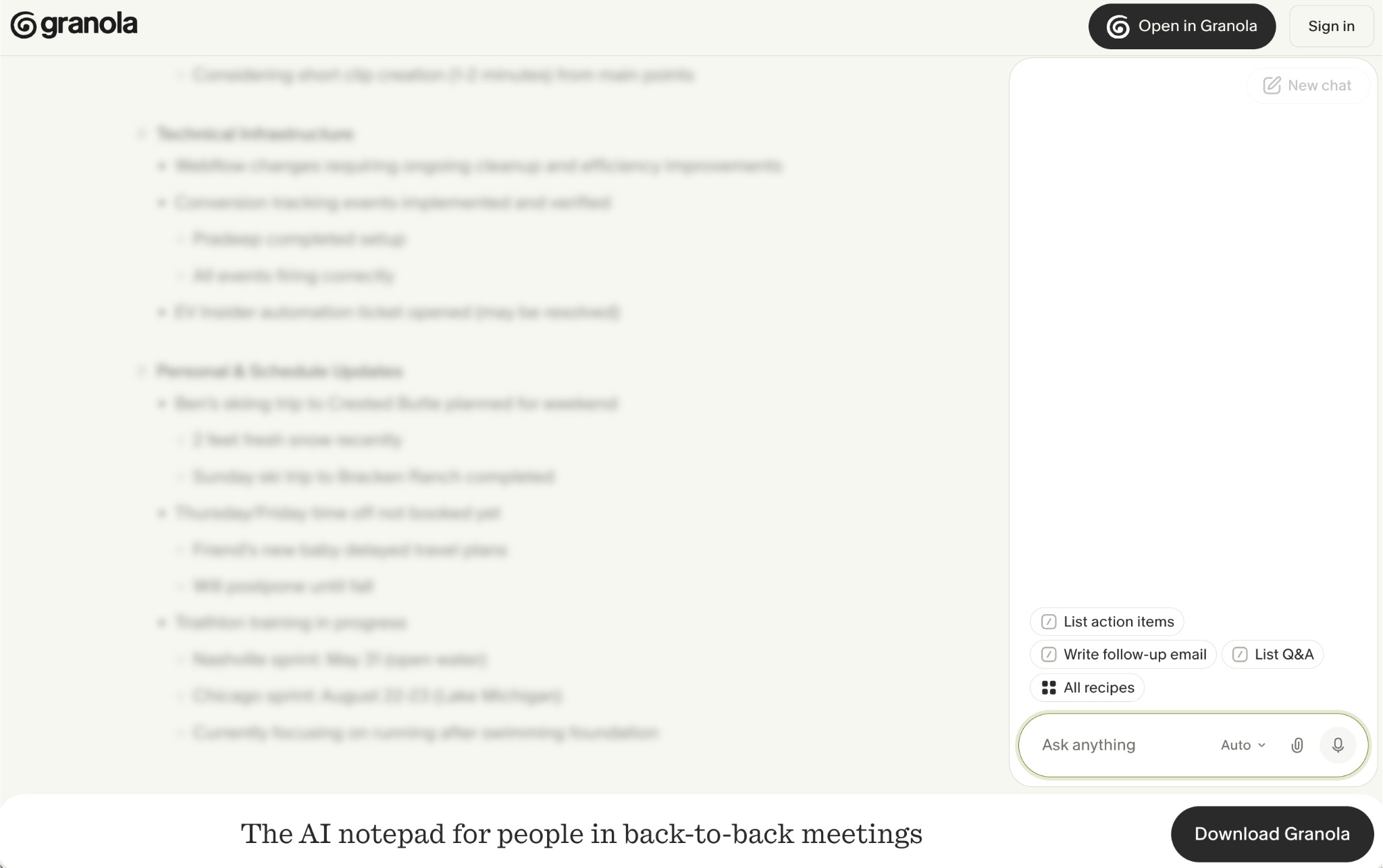
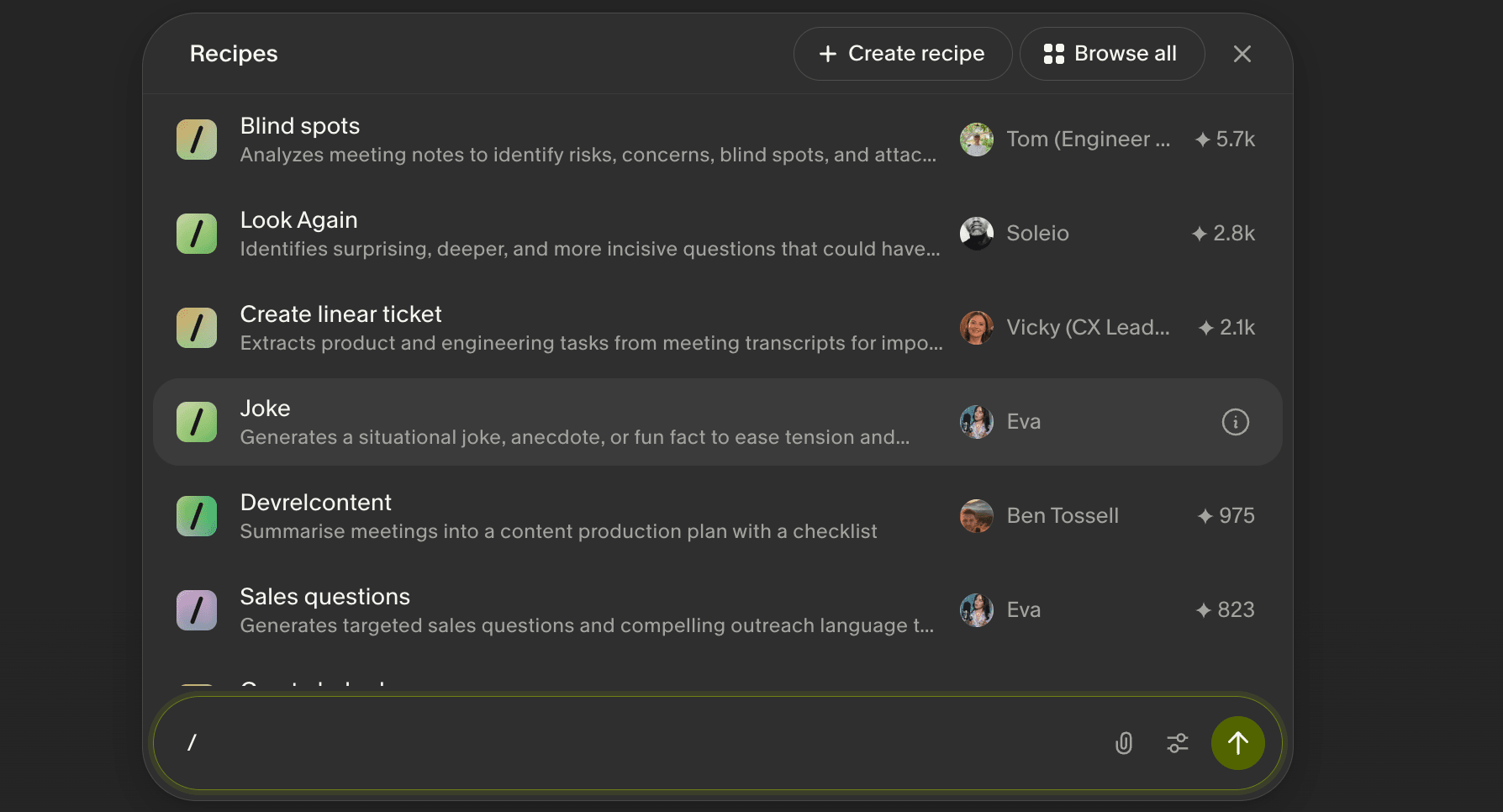
Test it: Go back to the list you made in Step 1. For each opportunity, revisit the questions with a focus on the aha moment:
Is the output value tangible and impactful on its own?
What’s the best possible reaction you could expect?
What’s the likelihood of getting the best possible reaction?
Common misstep: Don’t gate it. Granola deliberately lets non-users interact with shared notes without an account.
3. Remove Sharing Friction
Most collaboration tools default to private. That protects privacy, but it also adds friction at the exact moment where distribution happens.
Granola optimized for distribution because meeting notes are inherently collaborative for the people who were in the room.
Beyond sharing links, Granola prompts to integrate with team tools. Notes can be pushed to Slack, Notion or your CRM.
That is different than “click to email” or “copy and paste,” which are both opportunities for the growth loop to die.
Test it: Decide up front how you’ll evaluate the impact of your new growth channel. A few ideas:
Share rate: What percentage of your artifacts get shared?
Signup rate: What percentage of non-users who view an artifact take steps toward conversion?
Retention rate: Of those who convert from a shared artifact, how does retention compare to other channels or averages?
Time to distribution: How long does it take a new user to share their first artifact with a non-user and continue the loop?
Lesson: The distributed demo loop is measurable, but only if you’re looking at the right part of the funnel (which is often before the funnel starts).
Common misstep: It’s easy to add more Share buttons. It won’t move the needle if you’re not removing the friction around them at the same time.
Building Your Distribution Loop
It’s tempting to read this framework and think it only applies to software products.
A consulting firm’s slide deck is an artifact.
A financial advisor’s portfolio summary is an artifact.
An agency’s campaign brief is an artifact.
Any time your IP lands in front of a member of your target market that isn’t your customer, I think there’s a distributed demo opportunity.
Most companies have the raw materials. What they’re missing is the intentional design.
Granola didn’t invent meeting note sharing. They engineered the moment when a non-user receives a shared note and thinks, “Daaaaang, I need this.”
That’s the distributed demo doing its thing: a product experience that happens before signup, delivered by your existing users, with zero marginal cost.
Audit your outputs. Front-load the aha. Remove the friction. Measure the handoff.
Your users are already distributing something. The question is whether you’ve made it worth receiving.
i’ve been uneasy about signing up as the tools, generically speaking, wanted full calendar access and weren’t providing sufficient value to trade privacy. Now, I’m tempted to try your recommendation