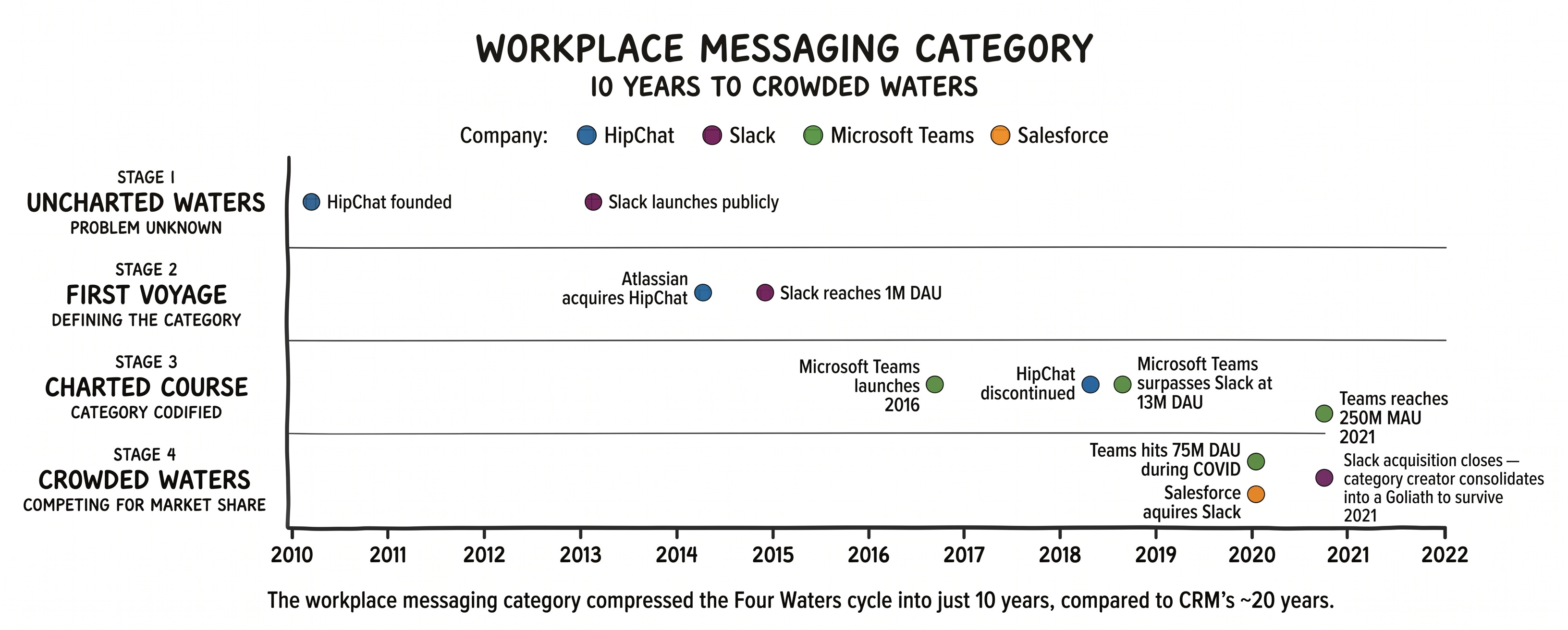
The Four Waters Framework is a category maturity model that is a field guide for recognizing category maturity and running the right playbook at each stage. As many companies have found, including Slack, the tactics that keep you afloat in one stage can capsize you as the category matures.
Most founders overestimate their category maturity because they spend their days surrounded by customers who already get it. This framework helps you read the actual conditions to plot the best course.
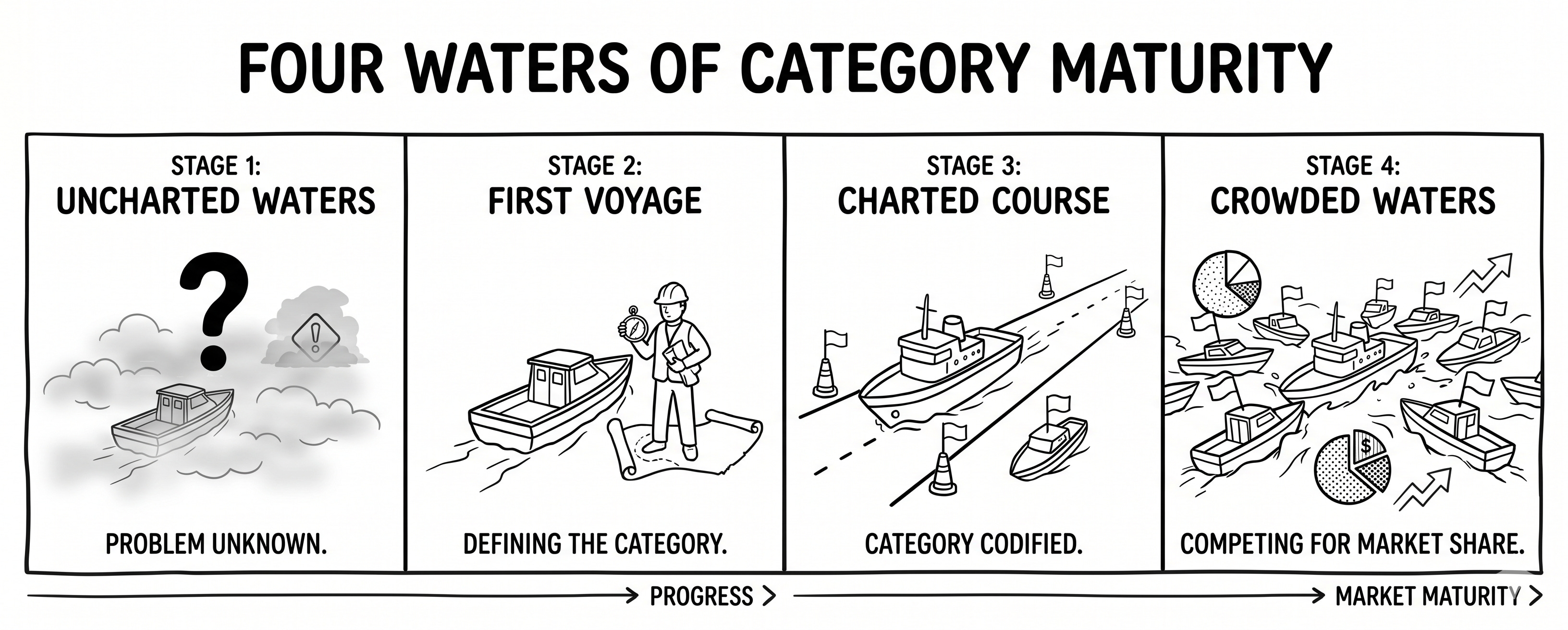
Stage 1: Uncharted Waters
The market doesn’t recognize your problem as either solvable or worth solving. Your primary competitor is doubt that a product category should even exist.
You’re here if:
It’s difficult to summarize your business case in one sentence without losing people.
Prospects may not know that they have a problem that needs to be solved.
You are not replacing an existing product for your early customers.
Any competitors use completely different language to describe what they do.
The playbook: You are building belief, rather than demand, by focusing on the problem and the pain it causes. The priority is recruiting early adopters who will become visible and vocal proof that the category should exist.
The trap: Pivoting too early into an adjacent existing category can be tempting when initial traction is slow.
Stage 2: First Voyage
You’ve proven the category can exist with positive validation signals from early adopters. Now you’re racing to define the category and set the boundaries before competitors do.
You’re here if:
You have paying customers who can articulate the value in their own words.
Competitors have emerged with similar (but not identical) positioning.
The industry recognizes the problem, even if the solution is still being debated.
Education remains a meaningful part of the sales process.
The playbook: Define the category before someone else does. If you own the language, your brand will be synonymous with the problem and solution. Building strategic partnerships will also reinforce your position as the obvious leader.
The trap: It’s tempting to scale growth channels before the category is defined. Spending too much money on market education could create shortcuts for competitors to harvest what you’ve grown. (a.k.a. 2nd mouse gets the cheese)
Stage 3: Charted Course
The category is real. Customers understand the problem you’re solving and that they have options for the remedy.
You’re here if:
Mainstream customers are buying, in addition to the early adopters.
Sales teams are spending more time on differentiation than education.
You begin losing sales to competitors rather than “doing nothing.”
Recognizable brands are entering or are circling the market.
The playbook: Build your moat to capture the majority of growth as the market expands. Network effects, ecosystem lock-in, switching costs and proprietary data matter more now than new features. The land grab is happening.
The trap: Relying too much on your first-mover status or early leadership can distract from long term defensibility. The competitors entering now probably have advantages in capital and/or distribution that you can’t match.
Stage 4: Crowded Waters
Everyone knows the category and why they need it. Now you’re fighting for share of a defined market.
You’re here if:
Feature parity makes it easy for buyers to comparison shop.
Price plays a more prominent role in differentiation.
Sales cycles are shorter, but win rates are lower.
CAC is rising as paid channels reach diminishing returns.
New entrants position as cheaper or better versions.
The playbook: Optimize relentlessly. Things like operational excellence, unit economics and strategic positioning win here. The companies that survive Crowded Waters do it with execution advantages or corporate development (e.g. M&A) to recast the playing field.
The trap: Be very hesitant to invent a new category as an escape hatch. It has worked, almost exclusively with small and nimble brands that can totally reset, but more often it’s a distraction that only lets competition compound.
Reading the Transitions
It’s helpful to know your maturity stage, but it’s essential to know when you’re about to leave it. Here are some signals that a transition is coming.
Uncharted -> First Voyage:
Customers begin explaining your value without prompting.
Inbound inquiries use your language back to you.
A prospect says: “We’ve been looking for something like this.”
First Voyage -> Charted Course:
A brand incumbent announces a competing product or acquisition.
Less category education is required in sales and onboarding.
Customers are asking about integrations rather than standalone value.
Press coverage includes the category.
Charted Course -> Crowded Waters:
A credible competitor leads with price.
Sales cycles shorten noticeably.
Analysts or research firms (e.g. Gartner) are publishing about the category.
Four Waters Framework is an analytical pillar of First to Market. The newsletter maps companies against these stages to illustrate what the right moves look like in practice and what happens when teams operate with playbooks for the wrong stage.
See it applied in the Slack case study or try the free Four Waters Audit.