

The Four Waters of Category Creation with Slack
A tactical framework for understanding where you are today and how your growth playbook must evolve at each stage.

The tactics that keep you afloat in the early days of a new category can drown you as the environment matures. Being able to spot where you are in the journey is what keeps you going in the right direction.
The path that Slack took from category pioneer in 2013 to today is a helpful parable. It reveals how dramatically what you should do (and what you should not) changes at each stage of maturity.
Let’s break it down with this framework to make it easier to navigate category maturity.
Four Waters Framework
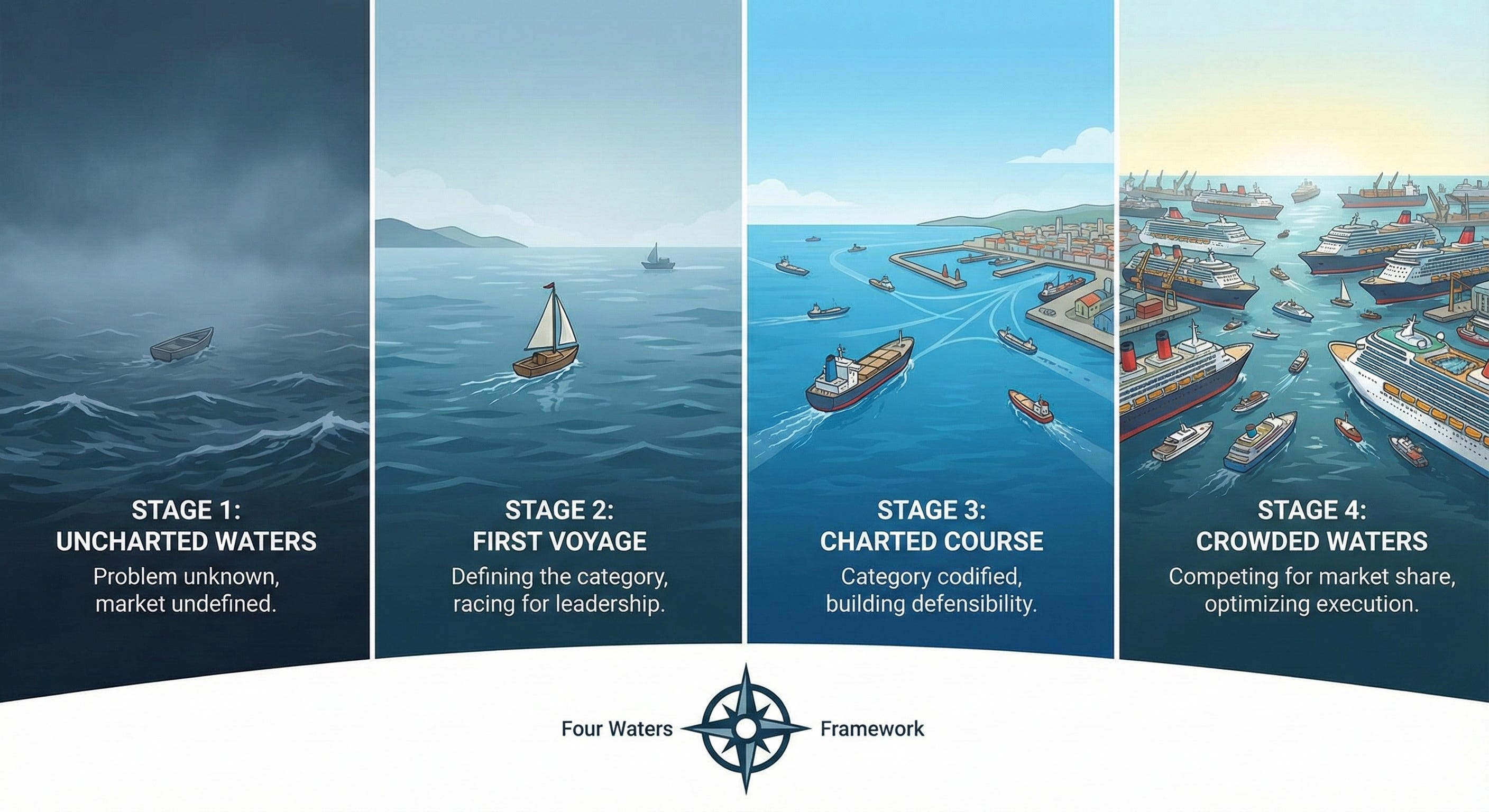
Think of creating a new product category as an ocean voyage. While founding teams likely obsess over their course (market factors) in the early stages, it’s common for that focus to drift to keeping their ship afloat (the product) after venturing away from the safety of the dock.
This framework helps us read the conditions.
Stage 1: Uncharted Waters
Definition: The market doesn’t recognize your problem as either solvable or worth solving. Your primary competitor is the doubt that a product category should exist.
You’re in Uncharted Waters if:
It’s difficult to summarize your business case in one sentence.
Prospects may not know that they have a problem that needs to be solved.
You are not replacing an existing product for your early customers.
Any competitors are tangential and use completely different language.
Key challenge: Creating urgency for a remedy when prospects don’t know they’re in pain.
Key opportunity: You can define the entire category on your terms. The narrative, language, and success metrics are yours to establish. First-mover advantage is real.
Key message: Focusing on the problem and the pain it causes, not your solution.
Where to capitalize: Recruiting early adopters to be your future army of vocal evangelists.
Common misstep: Pivoting too early to compete in a different existing category.
Slack in Uncharted Waters
The idea that companies would pay for team chat was unproven when Slack launched. Existing platforms had chat products (AIM, Google Hangouts) but they were seen as places for casual, 1:1 and unstructured messages.
Enterprise communication happened through email.
That meant there was no existing budget or line item for team messaging, outside of some small dev-focused tools. But this also gave Slack permission to deviate from other startup playbooks:
No MVP: The early product was so good that initial users helped peers see the potential and create the business case.
No IT: Focusing on end users allowed Slack to skip the IT leaders, who didn’t have dedicated budget anyway and could quickly kill adoption.
Ecosystem: Slack invested in integrations early, positioning themselves as a multiplier rather than another standalone tool.
The lesson: In Uncharted Waters, the traditional channels, demand tactics and growth signals may not help you. You’re building belief, not capturing demand.
Stage 2: First Voyage
Definition: You’ve proven the category can exist with positive validation signals from early adopters. Now you’re racing to define the category and set the boundaries before competitors do.
You’re in First Voyage if:
You have paying customers who can articulate the value in their own words.
Potential competitors have emerged using similar (but not identical) positioning.
The industry recognizes the problem that you’re working to solve.
Your customers are still limited to early adopters, not mainstream buyers.
Education remains a crucial part of the sales process.
Key challenge: Defining and owning the category before someone else does.
Key opportunity: Becoming synonymous with the new category.
Key message: Writing the category narrative to position yourself as the obvious leader.
Where to capitalize: Building strategic partnerships that reinforce your category definition.
Common misstep: Creating shortcuts for competitors by scaling GTM too aggressively.
Slack in First Voyage:
Slack reached 1 million daily active users within 2 years. At that point, tech company prospects got it immediately. That drew attention from serious competitors, who reacted with product pivots (Microsoft Yammer) and bolt-on acquisitions.
Slack used its head start to iterate with rapid releases (emoji, threading, integrations) while competitors had to focus on maintaining core product parity.
By the end of this stage, ‘slack’ had morphed into a verb and corporate FOMO created market demand, presenting itself as meaningful inbound growth.
The lesson: First Voyage is when you make it clear to the market who is winning the race and making sure that competitors are focused on your taillights. Get this wrong and you’re simply educating the market for your competitors to harvest. (Think: 2nd mouse gets the cheese.)
Stage 3: Charted Course
Definition: The category is codified as customers understand the problem you’re solving and that they have options for the remedy.
You’re in Charted Course if:
Mainstream customers are buying, not simply early adopters.
Sales teams are spending more time on differentiation than education.
You’re losing sales to competitors, not to “doing nothing.”
Key challenge: Maintaining clear category leadership as recognizable brands enter the market.
Key opportunity: Capturing the majority of growth as the market expands. This can look like a classic land-grab moment.
Key message: Trust and leadership signals to the market.
Where to capitalize: Using your data or benchmarks as the leader to deepen your moat.
Common misstep: Resting on category leadership and not building defensibility.
Slack in Charted Course
The category was undeniably real as mainstream companies across sectors adopted structured real-time communication solutions. In an Empire Strikes Back moment, Microsoft launched Teams with aggressive bundling that made it a “free” alternative.
No one at this point was saying, “we’ll just stick with email.”
The lesson: Charted Course is when you must build defensibility fast. Network effects, ecosystem lock-in, and brand moats begin to matter more than feature velocity. Slack built some of these but didn’t have an answer for Microsoft’s bundling opportunity.
Stage 4: Crowded Waters
Definition: Everyone knows what the category is and why they need it. Now you’re fighting for market share of an increasingly crowded space.
You’re in Crowded Waters if:
Increasing feature parity has made it easy to compare options.
Price plays a more prominent role in differentiation.
Sales cycles are shortening, but win rates are lower.
Customer acquisition costs (CAC) rise as paid channels reach diminishing returns.
Customer churn due to switching becomes more common.
New entrants position as cheaper or better alternatives against category leaders.
Key challenge: Competing on delivery and efficiency on a defined playing field.
Key opportunity: Uncovering advantages in conversion rates, retention, or unit economics that translate into meaningful wins.
Key message: Proving differentiation or customer ROI.
Where to capitalize: Optimizing unit economics and operational efficiency.
Common misstep: Trying to create a “new category” instead of winning on execution. The winners optimize the machine, not reinvent it.
Slack in Crowded Waters:
COVID accelerated adoption of all workplace tools — one of the happiest professionals I ever met was a Zoom sales manager on a golf course in 2022.
As Microsoft Teams exploded its daily active users (DAU) through bundling, Slack needed to bulk up to survive in the saturated market. This led to Slack selling to Salesforce to reorient the fight between two Goliaths.
Slack’s category creation advantage was completely gone at this point.
The lesson: In Crowded Waters, operational excellence and strategic positioning (including M&A) matter more than innovation.
What This Means For Your Category
I’ve noticed founders overestimate their category maturity because they spend their days surrounded by customers who “get it.” But if your prospects still need education, you may be in an earlier stage than you thought.
Which growth playbooks should you run?
Uncharted Waters: Build evangelists through product excellence, not a scalable sales machine. Market education and community building are your primary GTM motions.
First Voyage: Lock in a category definition and yourself as the leader of it. Invest in brand, own the language, and build differentiation from user experience.
Charted Course: Build or deepen your moats. Fast. Network effects, integrations, switching costs, and ecosystem lock-in matter more than feature velocity.
Crowded Waters: Optimize relentlessly. Operational excellence, unit economics, and strategic positioning win.
Slack’s biggest mistake was that they didn’t build defensibility fast enough in Charted Course. Microsoft’s bundling advantage was predictable, but Slack didn’t have the switching costs or ecosystem lock-in to counter it.
By the time they reached Crowded Waters, Slack was already on its heels.
Understanding which stage you’re in is essential to running the right playbook. The tactics that work in one stage will kill you in another. Slack nailed the early stages (Uncharted Waters and First Voyage), but they had missteps in Charted Course and got squeezed in Crowded Waters.
Now you’ve got the framework to avoid the same mistake.
