


Welcome Julia, Thomas, Ian, Tina, Rob and the others who subscribed this week. First to Market stays free thanks to our sponsor Clarify, the full-stack AI CRM, so please check out their platform. (It’s excellent and I use it each day.)
Prices have a way of being relative. A number can look affordable in one context and expensive in another.
Blaze (marketing automation) costs $1000 per month. That sounds expensive for marketing software until you compare it to an agency retainer.
11x (AI SDR) costs $3000 per month. That sounds expensive for a sales tool until you compare it to the cost of a sales hire.
Wynter (market research) costs $1700 per month. That sounds expensive for research software until you compare it to the cost of a research agency.
You see where I’m going here: each company intentionally picks what prospects compare them to, and determines how prospects interpret the price.
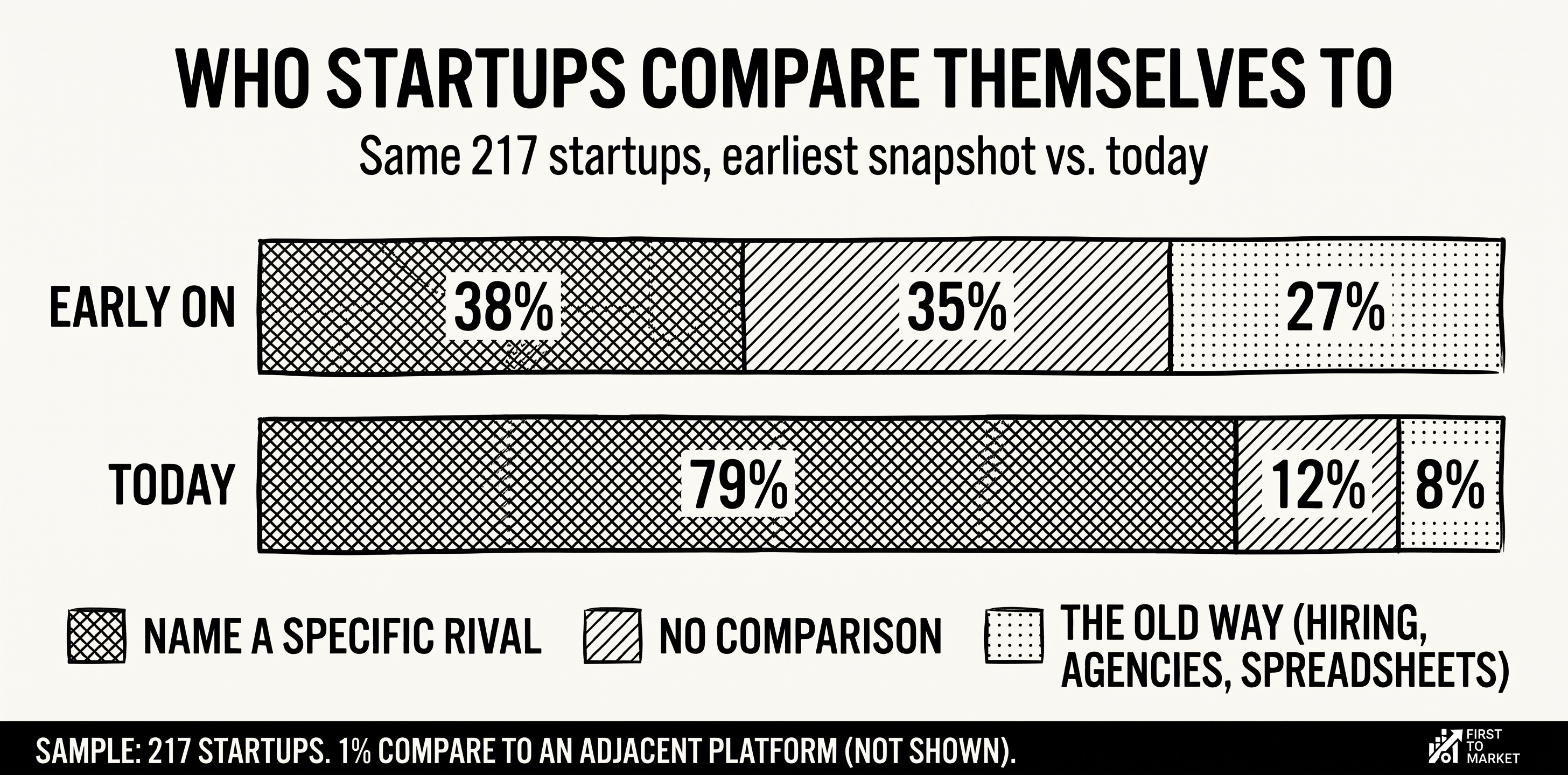
It’s common for that comparison to evolve as a company grows. Over 70% of companies in the category database that started out positioning their product or service against the old/manual way (hiring people, paying an agency, working in spreadsheets, etc.) are now encouraging prospects to compare them to a specific competitor.
I’m working through this right now with a new consumer product at Recurrent, where I lead marketing. Here are the four questions I’m using as a guide.
1. What does the prospect spend on this today?
Our future customers are already paying something to address the problem we solve. In a mature category, comparing options can usually be simple: Product A vs. Product B.
In an emerging category, the comparison isn’t as easy: adding a junior sales hire, paying agency fees, wasting too much of their own time. That cost is what they’ll use to compare our price.
Think about customer research: a $5000 platform is a lot of money next to a $50 survey tool, but it’s less than teams would spend on a formal agency study. That’s why half of the research companies in the database position themselves against service providers ($$):
Wynter positions against market research agencies.
Evidenza positions against traditional B2B research agencies.
Zappi positions against mega agencies like Kantar and Ipsos.
I wrote about this after Gartner’s disruptors list came out: the competitor that beats us usually isn’t the one selling what we sell. It’s the status quo that bites us. In an emerging category, the status quo usually has a cost, like a salary, an agency’s fees or hours of someone’s time, and that cost is what prospects hold our price up against.
Test it: Think about the last 10 prospects who considered your company then didn’t buy. How many chose another product vs doing it the “old way” instead? If most of them didn’t choose another product, your real competitor isn’t a one-to-one match, and that’s the comparison to address first.
Common misstep: Don’t pick a comparison you can’t live up to. If you say you replace a salesperson or an agency… then the product falls short, you’re the first cut when it’s time to renew. Artisan (AI SDR) started out positioning against hiring human BDRs. Its headline now says the product works “alongside your team.” (I wonder why?)
2. How crowded is the category?
In the early stages of a new category, it’s natural for prospects to think about the “old way” since there probably aren’t other similar products for comparison. That changes as categories mature and more competitors show up. Prospects stop asking “Is it better than hiring someone?” and start asking “Is Product X better than Product Y?”
The AI SDR category shows how quickly this can happen:
11x started out comparing itself to hiring human employees. It now compares itself against Artisan and Outreach.
AiSDR started out against hiring human SDRs. It now compares itself against 11x and Artisan.
Patrick Thompson described how Clarify (CRM) was one of about three new entrants when it started. Now there’s a dozen so the common question is “Why us?”
Test it: Look for trends in the brands mentioned on sales calls, support chats, subreddits or wherever you talk to customers. Those are the ones prospects are comparing us to, whether we picked them or not.
Common misstep: Drop old-way pitch after you find that prospects have a shortlist of competitors. A prospect deciding between us and another startup already believes the “old way” is broken so telling them again doesn’t help them choose us.
3. Who is the better comparison?
The competitor we name also sets the price range that prospects expect. Of the companies in the database that named a rival early on, 95% still name one today. But about half of them pick a different rival that tends to be a closer peer in the category:
Exa (agent web access) first compared itself to Google. Today it compares itself to Perplexity.
Parallel (agent web access) first compared itself to OpenAI. Today it compares itself to Exa.
Framer (CMS) first compared itself to prototyping tools like InVision. Today it compares itself to Webflow.
Plain picked its comparison without naming someone. Laura Mighdoll told me the change that made the biggest difference was describing Plain as support infrastructure instead of a help desk. Prospects put every support product in the help desk category, she said, and “once they do, they compare us on the same feature checklist as everyone else.”
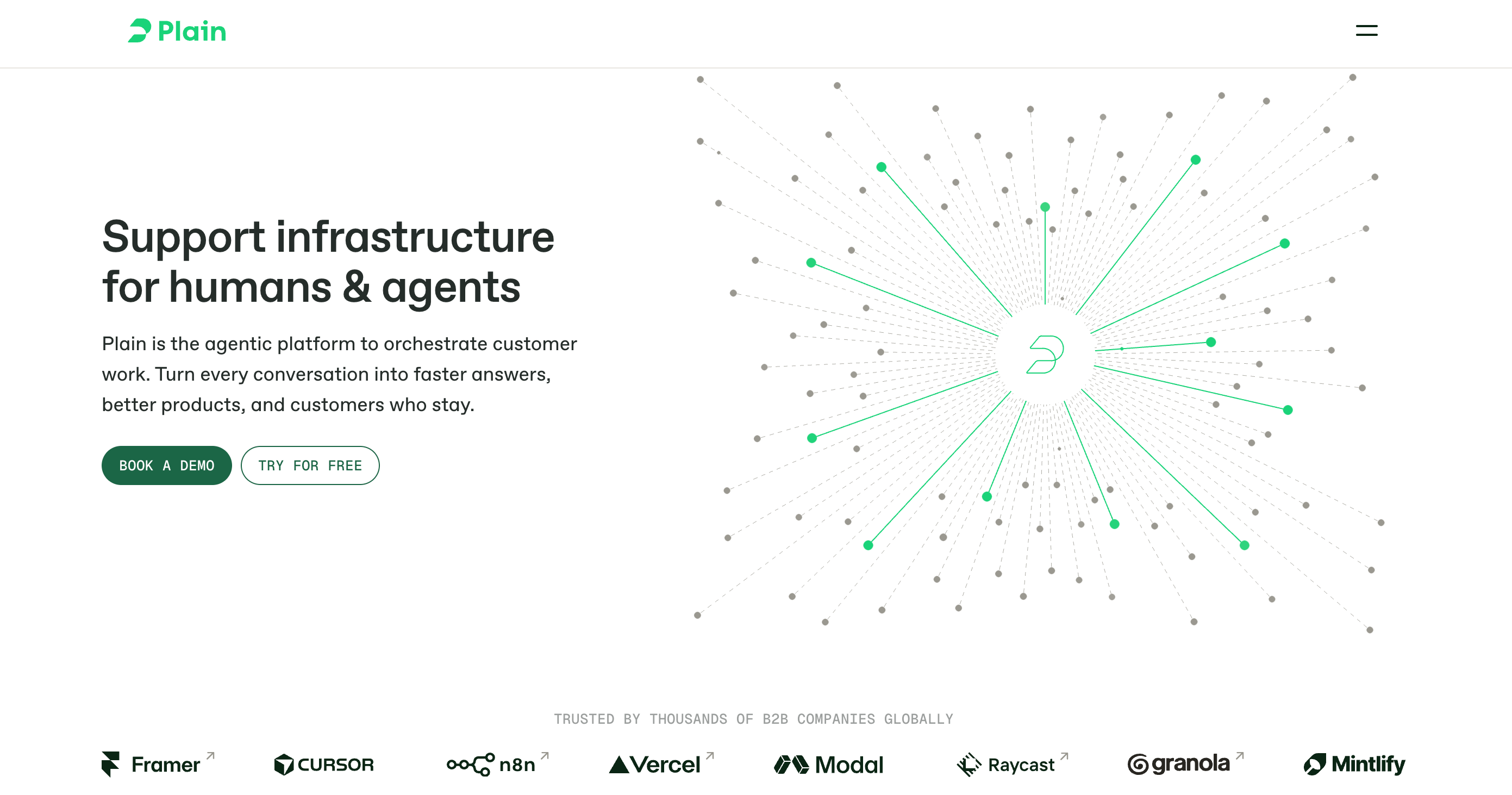
Plain then backed it up with a workflow library of templates for support teams. Laura said it made infrastructure concrete “in a way a tagline couldn’t.”
Test it: Of the brands that came up on those calls and chats (from the previous step), pick the one that solves the same problem for the same kind of customer. Then ask whether we’d win that comparison. If we wouldn’t, look for a different comparison.
Common misstep: Don’t only target the biggest company in the category because it’s the most recognizable. Exa didn’t need to beat Google to win. It just needed to beat Perplexity.
4. How far does the comparison need to go?
There’s a difference between comparing yourself to a rival and positioning yourself as its alternative.
Supabase went all the way. Its homepage headline read “The open source Firebase alternative” for its first ~5 years, and it worked for them as a challenger attacking a single dominant incumbent.
You probably don’t need to go that far. A comparison page has a much narrower task: it helps a prospect who already has a shortlist. The homepage (and other pages) don’t have to change.
Several companies in the database do it this way:
Profound (AEO) positions itself as an “AI marketing platform” and has comparison pages for more than a dozen AEO tools.
Wynter (market research) positions itself against research agencies and has comparison pages for Qualtrics, Ipsos and Kantar.
Amperity (CDP) positions itself as an “AI agent for every customer decision” and has comparison pages for other popular CDPs (Segment, mParticle, Hightouch).
Test it: Is there one dominant competitor that most of your prospects already use? If not, keep the comparison on comparison pages and out of the headline.
Common misstep: I love how aggressive Supabase was with its incumbent positioning, but that is a commitment. A comparison page can be updated or deleted in 5 seconds. A brand positioning built on a rival ties your whole brand to that other company: their pricing, feature set, future pivots, everything. It could take years to unravel the association.
But these comparisons aren’t a one-and-done decision. The right comparison evolves: what works at launch in a new category usually stops making sense as your company gets bigger and the category matures.
Wherever you and your brand are right now, I hope this research helps you as much as it has helped me lately. If it does or there’s anything you’d add, hit reply or leave a comment.
From the Workbench This Week
Q4 is always a balancing act at Recurrent. The auto industry has its seasons, and we run something of a 2-sided marketplace: individuals looking to sell their car on one side, dealerships trying to acquire those cars on another side, then also helping those dealerships sell those cars to individuals. Keeping every side (1) in balance and also (2) successful takes lots of TLC.
On top of that, advertising rates on most platforms are almost impossible to predict in the US as the country ramps down election season and ramps up holiday buying season. But that’s part of what keeps a marketing team entertained (and employed).
I’ve also been recording videos when time allows. Here are three recent ones if you’d rather watch than read:
Have a beautiful weekend.
Intriguing. I do find substitution impact's vectors also influence my decision thereby making price one of the three important variables. How much a proposed solution costs relative to the current, how much effort its adoption and continued use will require, and will stakeholders be negatively affected by my choice.
Your point 1 applies inside checkout too. I tore down LinkedIn's Premium trial: a sales tool at €1,088.88 a year, and the checkout gave me nothing to hold that number against. No sales hire, no agency, no rival. So the only comparison left was free. One line like "less than one month of an SDR" would have picked the comparison for me. Screens here: https://freetopaid.substack.com/p/linkedins-premium-upgrade-nails-the