


It’s universal that people get a bit awkward talking about their biggest competitor. For startups competing against an incumbent, there’s even more baggage.
We don’t acknowledge their size because it’d make us look small.
We don’t accept their feature breadth because it’d make us look behind.
We don’t admit to their market dominance because it’d make us look weak.
Instead, we position away from the Goliath: a different feature, an unbundled price, some angle they won’t match. Maybe if we can find ways to avoid talking about them, people won’t think about them.
But buyers are already thinking about the incumbent.
The category leader is the default choice. Pretending they don’t exist doesn’t eliminate the comparison, it just makes our relation to them fuzzier.
Supabase could have called itself “a modern backend platform for developers.” Instead, the top of their homepage read “The open source Firebase alternative” for its first five years and something north of $100M in annual revenue.
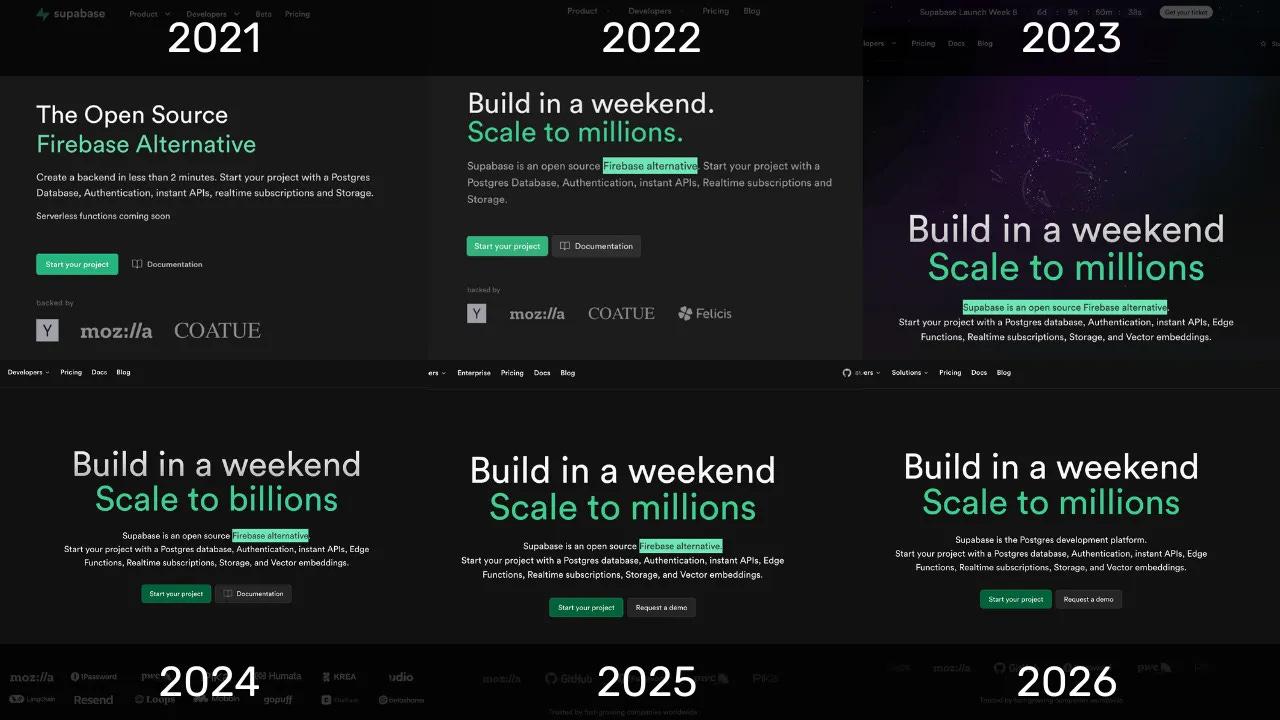
Then they moved away from it. As they became a leader, the alternative positioning no longer made sense.
I originally published this post in February, but a more complete arc is visible now. Supabase shared new information with its $500M Series F in June and I got some great data from comparing their playbook to 202 category leaders in the First to Market audit database.
Here’s the updated playbook.
The Alternative Positioning Framework
Step 1: Name the Giant
When Supabase said “open source Firebase alternative,” they answered three buyer questions in four words:
What is it? A backend-as-a-service, like Firebase.
Compared to who? Firebase, the industry standard.
Why is it different? Open source.
How they arrived at that is equal parts interesting and lucky, based on an interview with CEO Paul Copplestone:
“Originally, we weren’t really thinking of building an open source Firebase alternative. It’s just that we changed the tagline on the website one day, and it went straight to the top of Hacker News that day… And we kind of had to run with it.”
My audit database backs him up. RudderStack at launch called themselves “an open-source platform for collecting and routing your customer event data.” No mention of Segment. People in Hacker News threads quickly made the comparison and within 6 months there are brand and founder mentions of RudderStack as an “open-source CDI (a.k.a. open-source Segment).”
In both cases the market helped to write the positioning and the founding teams listened.
Test it: Ask 10 prospects to describe what you do in one sentence. If they use a competitor’s name to explain you, it opens an intriguing door that you get to choose to walk through or not.
Lesson: Naming the incumbent can be a shortcut to product clarity and market confidence. It says “Yeah, we know they exist, and here’s why you should still pick us.”
Common misstep: Keep in mind that the comparison is not really in your control. Your buyers are already making associations.
Step 2: Claim the Wedge
Supabase designed its whole offering around something a loud minority of Firebase users already wanted: ownership and control.
They weren’t trying to resonate with Firebase’s whole customer base. They gave one specific segment permission to leave.
As the Supabase CEO acknowledged: “Firebase is the tool that developers love to hate, because it’s Google now.”
Freshworks is a similar case study. Its founders kept reading Zendesk customer complaints about the pricing model, revealing a clear wedge into the category and customer list: “Whenever I read something like this I can’t help but think ‘Here’s a potential customer to whomever can get this right and at the right price’. Here was an opportunity sitting right in front of me.”
Both wedge examples were responses to documented and quantifiable complaints from incumbent customers.
Test it: Let incumbent customers shape your wedge opportunities by reading Reddit, Hacker News, support forums.
Lesson: A good wedge needs to fuel a fire that’s already burning.
Common misstep: It’s easy to confuse preferences with wedge opportunities. “Faster” or “cheaper” or “easier” are common complaints but not always strong enough to be wedges.
Step 3: Prove the Difference
Lots of startups break down on the offramp of Open Source Alternative. It isn’t novel or durable by itself.
Supabase made it a structural piece of their product that was visible in the codebase, the community, the GitHub responses, and throughout the marketing site. That let skeptics verify the claim without talking to a salesperson.
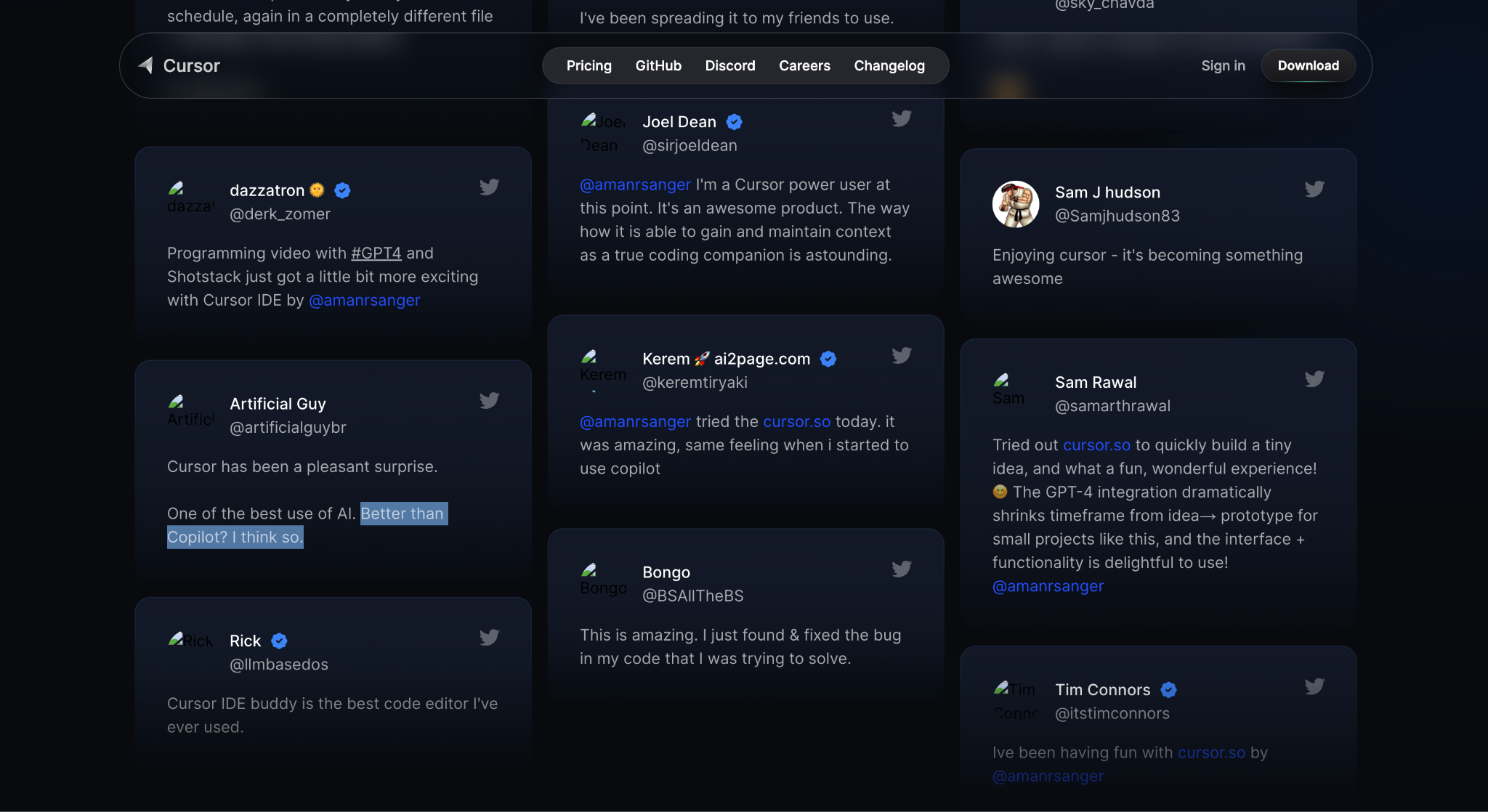
Amplifying the voices of early customers can be a good way to do this, too. Cursor used its testimonial wall to make the point with quotes like: “Cursor has been a pleasant surprise. One of the best use of AI. Better than Copilot? I think so.”
Test it: Can a skeptical prospect verify your wedge without a demo or a sales call? An unverifiable wedge is just a claim that easily crumbles under pressure.
Lesson: Make the wedge easily checkable with comparisons, docs, benchmarks or testimonials.
Common misstep: The standard of ‘proof’ is different to different people. One customer quote on a landing page probably won’t cut it.
Step 4: Lower Switching Costs
Selling someone on a solution to a problem that they’ve already solved (with a competitor) means you are partly responsible for overcoming the switching costs. If you’re a marketer, think about migrating a CRM: there’s the technical migration, the downtime, the ramp up and time to value, and the risk of picking the wrong vendor. That’s a lot to overcome.
Supabase used generous free tiers to start new projects rather than migrate old ones. They also made resources for partial migrations or running both in parallel, then used the community to help solve the weird edge cases in public.
Lightfield created a CRM migration agent to ingest exports from HubSpot and other legacy CRMs.
Gorgias tried to pre-empt the switch by getting in front of prospects the moment that a competitor product was installed.
Test it: List every friction point between an unhappy incumbent customer and the complete adoption of your product or service. Approval, training, migration, downtime, the risk of looking dumb if it fails. The best at alternative positioning help their prospects with each one.
Lesson: Status quo bias means doing nothing is always easiest. Every piece of switching friction compounds against you.
What the Data Says About Alternative Positioning
In my audit of 202 company profiles across 19 categories in the First to Market database, I found only two that positioned themselves against an incumbent at launch.
1. It is more common to see startups position against incumbents after a couple years when the new-kid-at-school buzz fades or the hyper-niche focus needs to expand to meet growth goals:
tldraw started naming Miro.
Otter started naming Fireflies.
Rippling started naming ADP and Gusto.
2. Companies that named an incumbent tended to be self-serve or PLG led. That makes sense. If your product requires a six-month enterprise cycle, the incumbent comparison is a more tailored response to a specific question.
3. For B2B sellers, that could mean that alternative positioning has an expiration date when you decide to sell upmarket.
For Supabase and Freshworks, who stopped naming the former incumbent as they approached incumbent status, helps to cement a key lesson: a startup should view the incumbent’s angry customers as the beachhead or a wedge into the market. It’s not an evergreen brand strategy.
Should You Run This Play?
If you’re still nodding along with me, here are the four tests I’d use to decide if this strategy is for you.
1. Is there one dominant incumbent?
This should take less than a second to answer. The strategy only works when there’s a single default choice your buyers already know.
Fragmented markets with heavy feature overlap aren’t a fit. An easy example of that is marketing automation with too many leaders, lots of product parity, and many serving their own niche. If you can’t name a clear incumbent, the market is either too fragmented or you’re creating a new category.

2. What’s the wedge?
Complete this: “We’re like [incumbent] but [meaningful difference].”
Then: Is the difference tangible? Does it solve real pain for a segment you can actually target? How hard is it for the incumbent to copy?
You’re biased here. Get someone to check your work.
3. Can you prove it without a sales call?
Ideally you become the wedge, the way Supabase became synonymous with open source. A skeptic should be able to verify it alone.
The Takeaway
Positioning as the alternative means tying yourself to someone else’s narrative. You boom when they boom. You stumble when they stumble. If they pivot, you must adapt.
In exchange, you inherit their existing demand and budget line. Supabase never had to convince developers that backend-as-a-service was valuable because Firebase already did that. They only had to convince one segment that open source and SQL were worth the switch.
But the data suggests that this is a phase. See it as the opportunity that it is without confusing it for the evergreen business plan that it isn’t.