


Welcome Rob, James, Marija, Valerie, Paul and the others who subscribed this week. First to Market is a free newsletter with lens on business for people building in emerging categories. Please share it with someone else who would find it helpful. They can subscribe here.
Competitor pages are having a renewed moment thanks to AI search. They came up while I was writing an AEO piece last month when one founder told me AI tools cite them more often than you’d expect. One study even found that these Us-vs-Them pages predicted AI search performance, so that helps to explain their prominence.
Replit (AI coding) has one for Lovable.
Squarespace (CMS) has one for Wix.
Otterly.AI (AEO) published pages against 9 other brands in the last few weeks.
The category database actually tracks this, and over 40% of the companies in it have at least one page comparing themselves to a competitor. That’s not super surprising in later-stage crowded categories, but the ratio doesn’t really change in newer categories:
38% in First Voyage
39% in Charted Course
45% in Crowded Waters
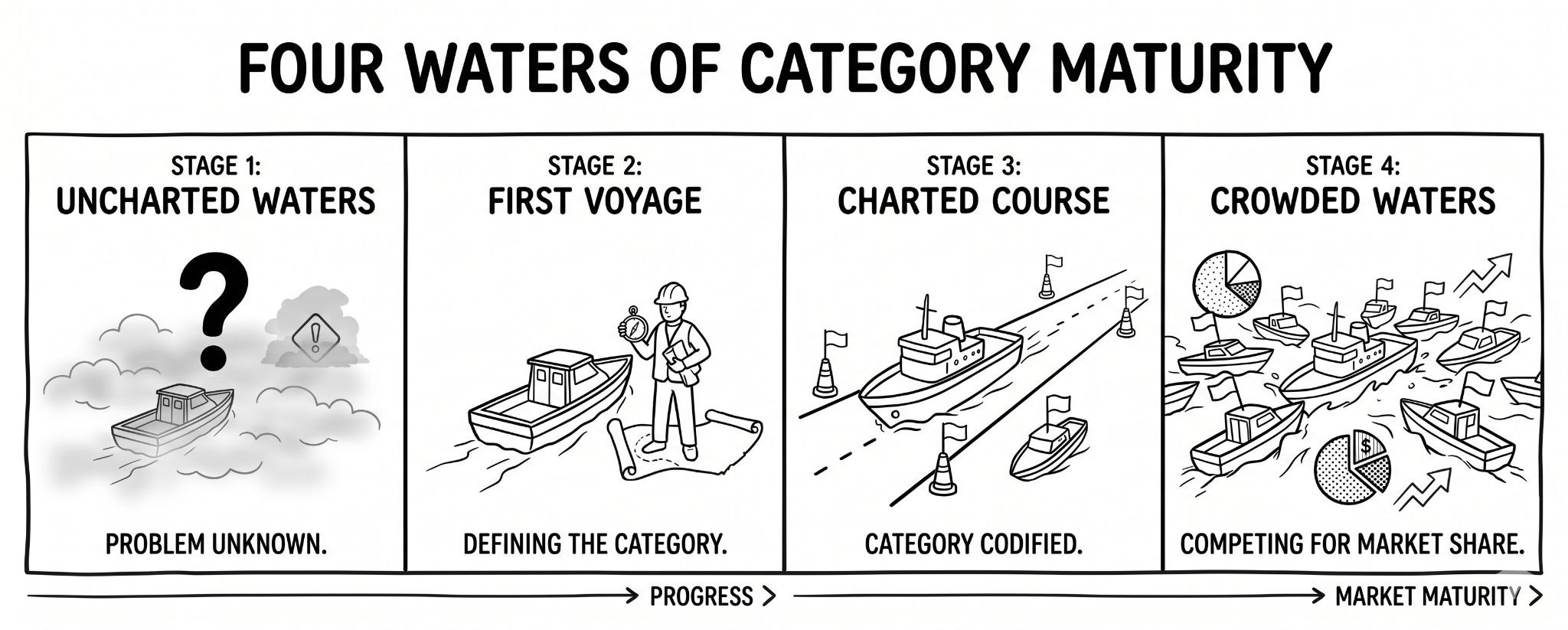
The big difference is what a company chooses to compare itself against. That varied quite a bit by category stage.
For me at Recurrent, where I’ve been head of marketing for years, these pages weren’t something I considered. But our new consumer products have started to change that. Now we’re bumping into potential competitors from adjacent categories and a few new upstarts. It felt like time to get smarter on this topic.
After a week of studying the category database and interviewing AEO experts, here are the four lessons I’m taking back to the office on Monday.
1. Leaders skip competitor pages.
A company’s position in its category predicts competitor pages better than the category’s stage does. Of the companies the database tags as incumbents, 21% have a page naming a competitor. For challenger brands, it’s 43%.
The challengers mostly aim up:
Attio (CRM) has pages for Salesforce, HubSpot and Pipedrive.
Ashby (ATS) has pages for Greenhouse and Lever.
The challengers also seem to get more out of them. Mack Grenfell, founder of Trakkr, studied how AI tools recommend brands: “Once a brand’s own page started getting cited, it got recommended about 3 points more often, and challenger brands got closer to 5.5.”
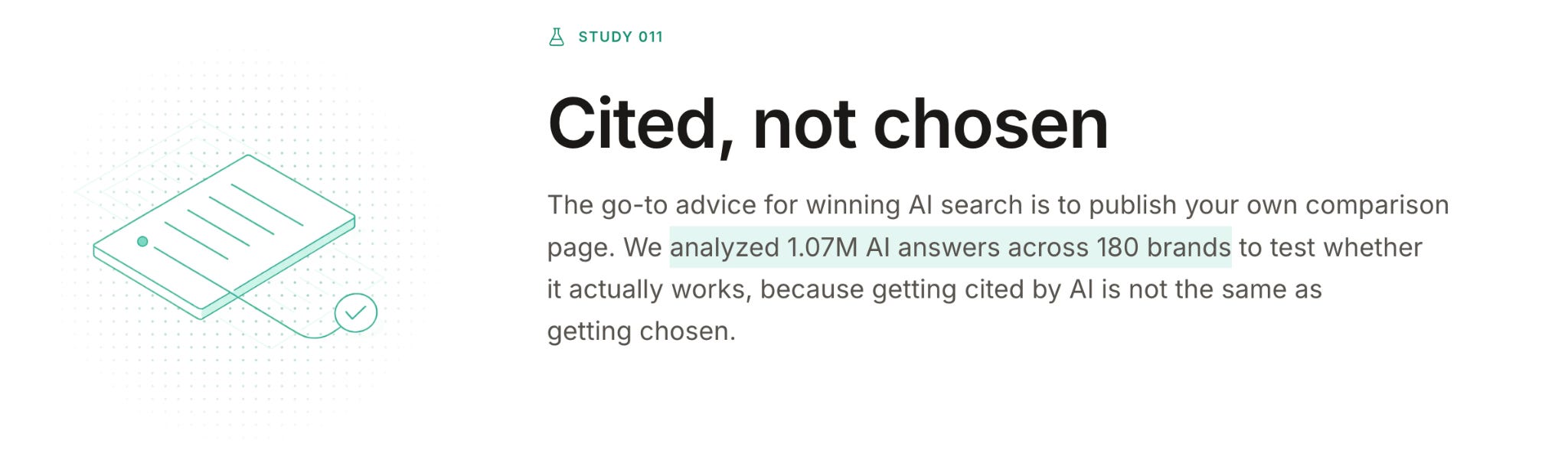
That sounds logical to me. If a bigger competitor is already included in the AI answers, a page about them helps the challenger appear next to them, too. But creating a page on a smaller company could be what introduces that competitor to the LLM, actually elevating the competitor to our level. That’s what I’m weighing at Recurrent since we’re the brand to beat in our space. (More on that in the Workbench section at the end.)
Test it: For each company you’d write a page about, ask whether your prospects know them better than they know you. Yes = consider building the page. Attio has one for Salesforce (who everyone knows) but not for Clarify (CRM), which was founded five years later.
Common misstep: Don’t treat upstarts as peers. When category leaders do build these pages, they shrink the challenger: HubSpot has a page that belittles Attio as “a good sales CRM” while positioning itself as a “complete customer platform.” Zendesk has a page that refers to “Decagon’s bolt-on approach.”
2. New categories compare to the old way.
Younger categories may not have established competitors so their “biggest competitor” could be the old way of doing something (e.g. Excel sheets, copy & paste, calling customer service). For companies in First Voyage, 12% have a page comparing their category with that old way, whatever it may be.
But that basically disappears (2%) with companies in Crowded Waters. Buyers there have plenty of competitors to choose from, and they’re mostly comparing feature lists.
Lyzr (AI SDR) compares its AI agents to rigid workflows and traditional bots.
AthenaHQ (AEO) compares its platform to traditional SEO.
Boston Dynamics (physical AI) compares its automation to manual inspections.
Imper.ai (authenticity) compares impersonation detection to traditional identity verification.
Jonathan Bree, founder and CEO of Fabric, shared some similar insights with me last month. “Nobody googled ‘self-writing wiki’ or ‘personal cloud’ before we existed.” He recommends comparing to something that buyers already know: “Reference + differentiator does a huge amount of conceptual transmission when you are creating a category.”
The Fabric page on Notion calls Notion “a construction kit” and describes Fabric as the tool that understands your content without being told how.
Test it: “Before us, our customers ___.” If the answer to that is a workaround (e.g. “used an Excel sheet”) then a page against the old way may be worth building. If the answer is “did nothing,” a comparison page could be premature because you’re still educating around the problem.
Common misstep: Don’t mock or belittle the old way. It comes off condescending. Something like this CRM vs. spreadsheet page is the better way to do it.
3. Pick rivals from the category you want to lead.
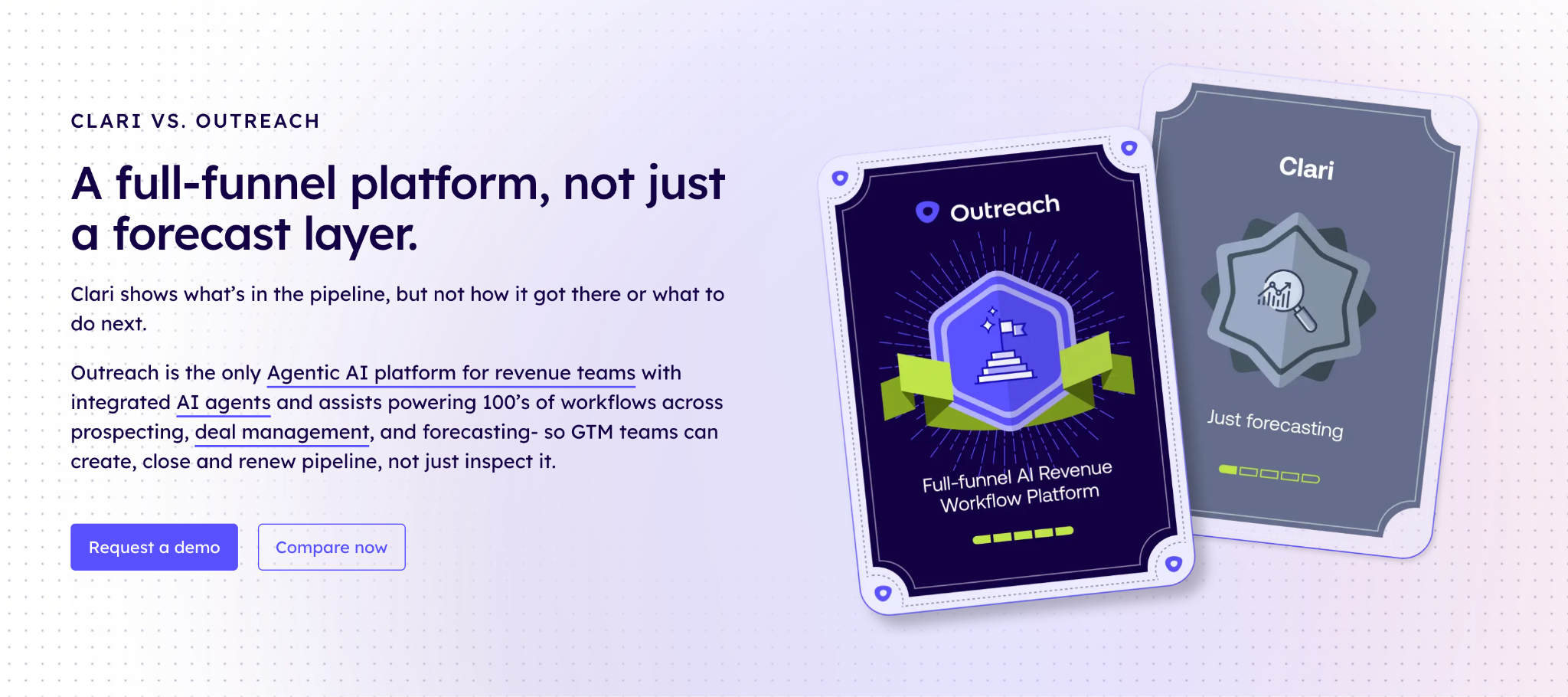
Outreach (AI SDR) has competitor pages for Salesloft, Gong, Clari and Apollo — a wide swath of tools. But their platform offers sales engagement, conversation intelligence and forecasting, so it does compete with each of them.
They use the competitor pages to pigeonhole the competitors as narrower solutions:
One page limits Apollo to being a data provider that isn’t designed to support the workflows that modern sales teams need.
Another page reinforces that Clari was only built to monitor pipeline rather than “move it.”
These competitor pages are also more than cheap copy to feed AEO. Eli Schwartz, who writes The Future of SEO & AEO, told me they pay off when a buyer is already weighing their options: “Those are incredibly successful assets to build when it’s top of mind for a customer… It may or may not drive search traffic but a customer in the funnel will benefit from it.”
Pulled all together, looking at the Outreach competitor pages reveals the category that it wants to lead. The Clari page says that Outreach is “the only Agentic AI platform for revenue teams that combines prospecting, engagement, pipeline management, and forecasting in one connected system.” The competitor pages are creating evidence for the broader category story.
One of the founders I interviewed for the AEO piece explained why that matters for AI search: “Models have to file you somewhere. If you don’t decide where, they decide for you.” Your competitor pages are a way that you can influence the outcome.
Test it: Write the one-sentence story you want prospects to believe about your category. Then list the options a prospect might consider, including adjacent tools and the “old way” of doing it. Your short list for competitor pages is the options that are both (1) a real alternative for prospects and (2) a comparison that helps to tell your category story.
Common misstep: Don’t limit pages to the competitors you lose to most often. If Outreach had only written about Salesloft, the other sales engagement provider, prospects and LLMs would still limit Outreach to “sales engagement tool.”
4. Every rival you name joins the AI’s shortlist.
“I’d keep the list short,” Mack at Trakkr told me. “Pick the one or two competitors people actually compare you with (usually the same ones AI already brings up), and make the page about why you’re the better fit for a certain kind of buyer. Every competitor you name is one more option you’re handing the AI, so a page covering ten rivals ends up working more like a shortlist for them than a pitch for you.”
Ann Smarty, who writes the SEO & AI Newsletter, told me: “LLMs may use your comparison but still omit your solution, so many SaaS founders find those comparison pages help their competitors! But if the competitors are big enough, it’s still a tactic I’d recommend.”
Conceptboard (whiteboards) only uses competitor pages for Miro and Microsoft.
Metronome (usage-based billing) has one for Orb.
Test it: Write one sentence for each competitor that tells prospects when to pick the competitor instead of you. Metronome says that Orb is “great for simple self-serve pricing models.” Forcing ourselves to write that line helps us position the page for a specific persona.
Common misstep: “Don’t try to fake the benefits of one business over the competitor,” Ann told me. “As long as you make them factual, you are good!” Competitors read these pages, and so do their lawyers.
Poking the Bear
I came up through search marketing so I’ve got some experience with comparison pages. As a consultant, my advice to clients was always to make “poking the bear” a calculated risk: As soon as we poke a competitor, they start copying what we’re doing, and sometimes they have the budget or more flexible morals to do it better than we can.
I think that calculus depends on you and your category:
A challenger “pokes up” because a leader copying back only makes the challenger look more like a peer.
A leader that “pokes down” shares attention with a company that prospects might never have found.
An early category’s biggest competitor may be the old way or workaround approach, and “the old way” doesn’t generally punch back.
Let’s be honest here: our prospects are already comparing us to other options, and AI models are already making their own comparisons. A competitor page is a chance to curate our place in the category. That’s a great opportunity. Just remember that bears don’t love to be poked.
From the Workbench This Week
This whole post started with a decision I’m making at Recurrent.
We were early enough in our automotive analytics space that we didn’t need competitor pages. The more important job for us was teaching the auto industry and car shoppers that they should be asking questions, and we were there to provide answers.
Our new consumer products are changing that. But it’s the classic leader decision: We don’t need to draw comparisons to the upstarts, and every page I’d write would point buyers and AI models toward a company they might not have found otherwise.
We’re starting to dip our toes in this space, so I should have more to report later.
If you’ve built competitor pages as the category leader, or decided against them, reply and tell me how it went. I’m building the plane while flying it.
Have a beautiful week.