


Pricing in a new category often means there’s no incumbent to replicate or undercut. It’s just you picking a number, and lots of founding teams have confessed to me that they are basically throwing a dart at a board to pick it.
Let’s see if we can improve on that.
A few weeks ago I talked to Fynn Glover for a post on pricing models. He had mentioned a B2B willingness-to-pay method that he uses so I called him back this week to talk me through it. I’m going through this right now as head of marketing at Recurrent so it was a (partially) selfish ask — more on that at the end.
Fynn is co-founder and CEO of pricing platform Schematic, before that led pricing at Automox, and wrote a book called The Pricing Playbook for AI & SaaS. (Get a free copy here.) His view is that pricing is the clearest statement of strategy a company makes, which is why he treats it as a research problem. He built his willingness-to-pay framework since he thinks that other popular methods (e.g. Van Westendorp) miss critical factors for B2B brands, like:
Total cost of ownership
Multiple decision makers
Gaps in understanding about the product category
The format is an interview with 5 to 15 customers or prospects. This is his process and the company examples come from the category database to illustrate key points.
Step 1: Make Sure They Understand
“No willingness-to-pay exercise can be productive without ensuring the person you’re interviewing actually knows what the product does,” Fynn told me. “If that doesn’t happen, the interviewee is far less capable of giving you useful feedback.”
He gives them a few carefully crafted bullets or a recorded demo of 2-3 minutes that is identical across interviewees.
He also opens by telling them exactly what they signed up for: 8 questions over 30-45 minutes to help him understand how they perceive value.
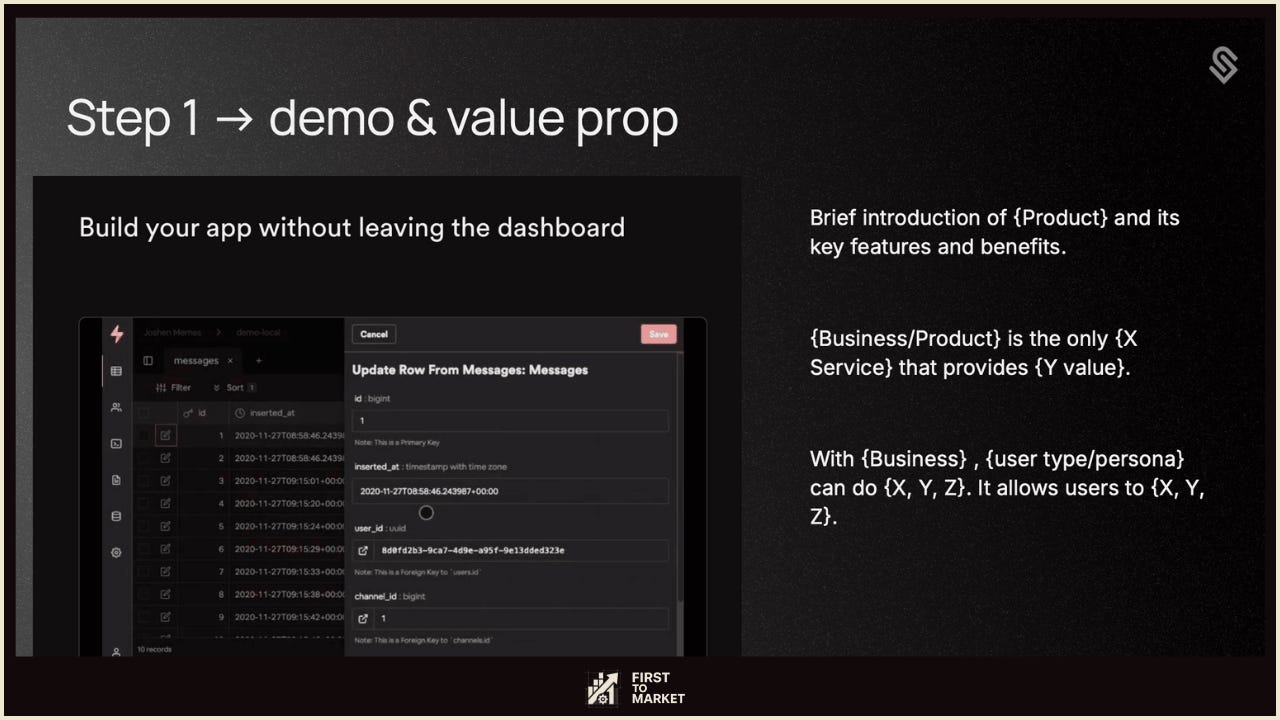
Lesson: The quality of each answer (and the pricing test overall) depends on how well the interviewee understands what you offer, fix or improve.
Common misstep: The demo is not a sales pitch. We aren’t trying to get them hyped on the product or service.
Step 2: What It’s Worth vs What It Costs
After the introduction, Fynn asks three questions:
What specific challenges or pain points do you think this product could address for you?
Are there any features or aspects of the product that stand out to you as particularly valuable?
How likely would you be to buy this product if it were fairly priced, on a scale of 1-5?
The last one assesses purchase intent with the price deliberately removed, which means a low score is more of a product or positioning problem.
Lesson: The buyer (or champion) must recognize value in order to test the price that they would be willing to pay.
Common misstep: Don’t fill their silence. Silence (or at least hesitation) is also an answer.
Step 3: Anchor Against What They Know
Ask them to help you build a 3-5 row table of adjacent things they already buy. The columns are simply: the category, the tool, what they pay for it annually, and our product’s relative value as a percentage: “We spend $100,000/year on Salesforce and you’re 50% as valuable as Salesforce” = $50,000/year.
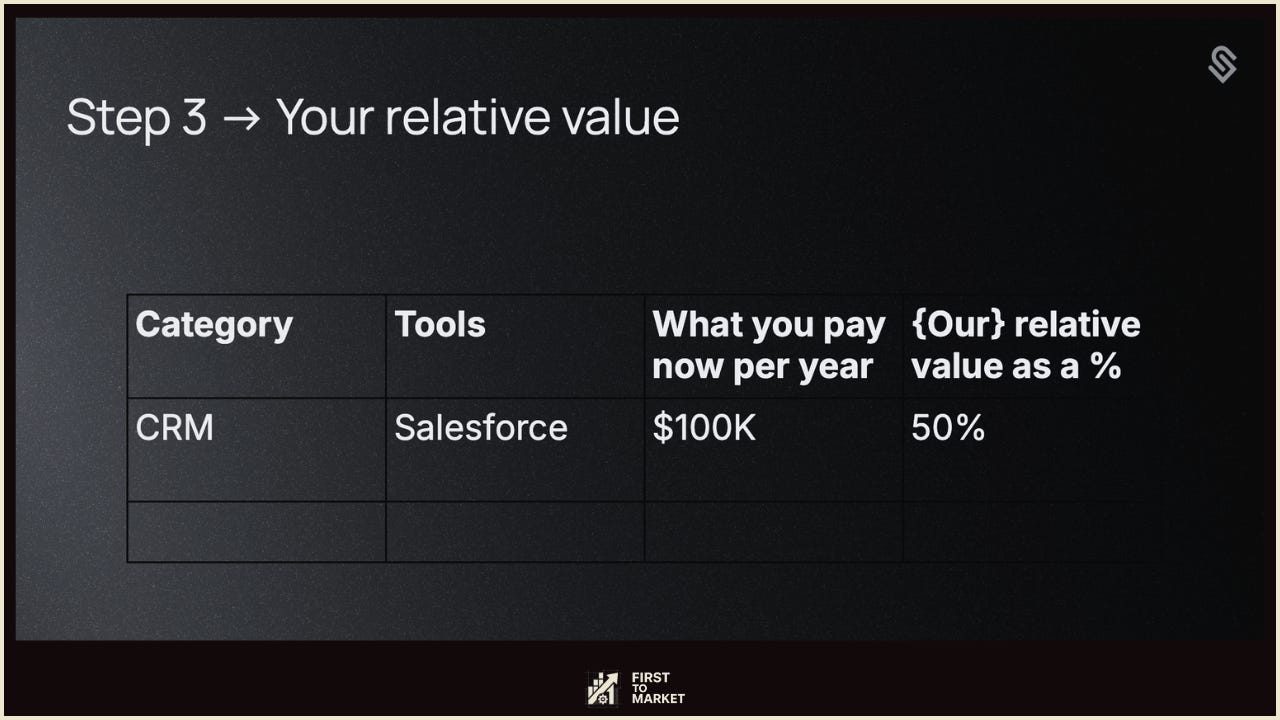
For new categories, I think that software products may not be limited to grading themselves against only software products, either.
1mind prices its AI agents against employee headcount.
Harvey ties its per-lawyer price to expected billable hours.
Aurora quantifies in terms of autonomous trucking miles.
Lesson: Anchoring gets the interviewee thinking in dollars they already spend and understand.
Common misstep: Anchors aren’t limited to direct competitors. A range of tools and price points can be more revealing.
Step 4: Find the Price Metric
“Price metric is probably the most important part of the whole thing,” Fynn said. “It’s the fundamental element of your pricing strategy, and it helps establish how you will charge.”
The price metric is the unit you charge for: a seat, a ticket, a resolution, a mile. When it goes up, the customer invoice goes up.
His question: “Which price metric would be most intuitive for us to use or most aligned with the value you receive?”
He shows a list to guide them:
Seats
API calls
Integrations
SKUs
Customer count
Monthly active users
Number of products
Number of entitlements
Number of features
Other
If needed, sometimes Fynn redirects: “Imagine it’s Year 2, we doubled the price, and you are fine with it. What changed in your business?”
Asking what justifies 2x the price forces them to name the thing that actually drives value.
Gorgias charges on ticket volume.
Sierra charges on resolutions.
Day AI charges for each AI assistant.
“I’m trying to listen for an answer across a composite of conversations,” Fynn said. “People don’t know how to talk about this stuff, so I’m trying to infer what’s actually sellable, not just take the first thing they reach for.”
Lesson: The best price metrics are what the answers keep returning to across conversations.
Common misstep: Don’t choose a price metric simply because it is easiest to track or bill.
Step 5: Test the Packaging
Show your latest packaging and give them 60 seconds to read it without talking over it. Fynn asks two questions after that.
What do you like and dislike?
Rank the tiers/options in order of preference, where most preferred means the tier that lines up best with the value you need.
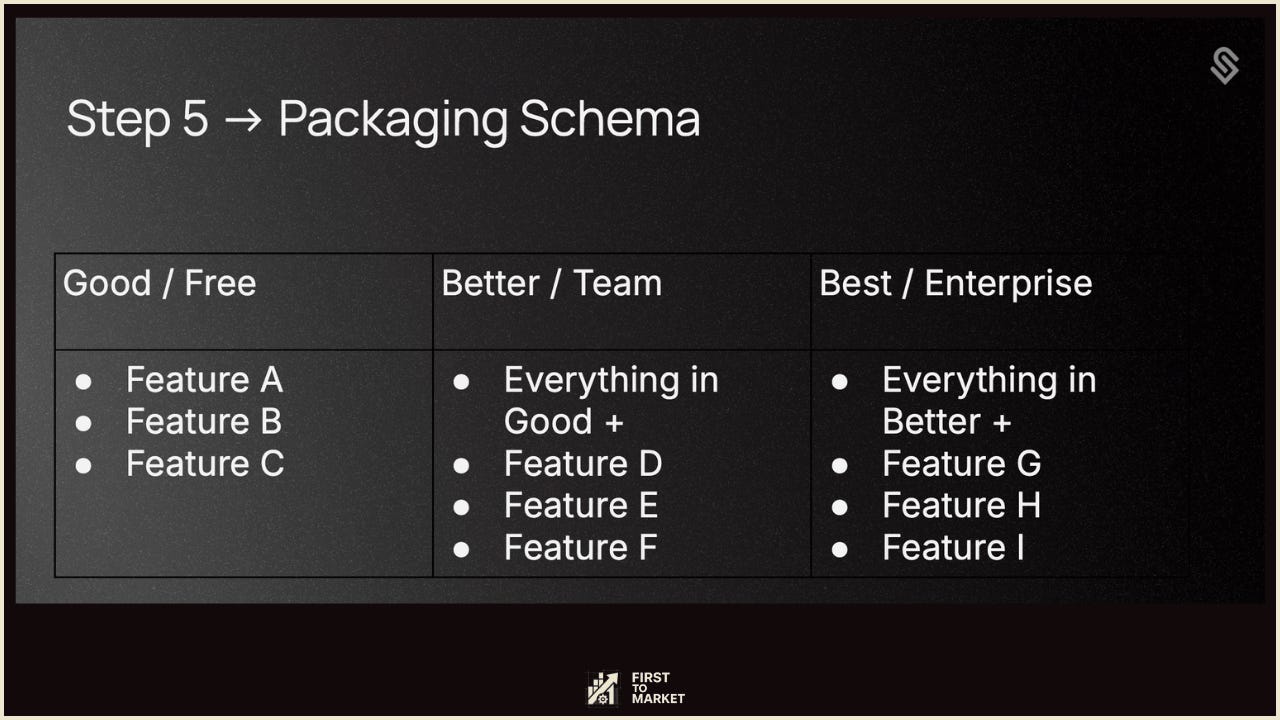
Lesson: We’re not asking them to design our pricing page. We are listening for whether the tier we assumed they’d pick is the tier they pick.
Common misstep: Don’t jump in to explain the pricing to them. Just listen, document and answer questions as they come up.
Step 6: React to the Price
Give them a specific price and ask which of four statements fits best.
I would purchase this immediately, and I have the authority to do so.
I would advocate for it at this price, but I would need approval from others, which I believe is achievable.
I would consider it, but significant internal approval would be required and I am uncertain about the outcome.
At this price, the product is beyond our current budget or cost expectations.
The second option is where you’re aiming. It means the number is defensible without leaving too much money on the table.
If this all feels like an intimidating thing to commit to paper, just remember it’s not permanent:
Tesla reprices the same car by thousands of dollars throughout the year.
Lightfield made seats unlimited and moved to credits.
Clay added a 2nd type of credits for its pricing tiers.
Lesson: You’re looking for the place where the price stops being defensible.
Common misstep: Don’t think of the price as some irreversible commitment. As long as we get a signal on the price metric, we have flexibility with the dollar amounts we assign to it.
Step 7: Find the Other Factors
At this point we have a direction on price metric, packaging and price tag. Fill in the gaps by asking for the other factors that influence what they’re willing to pay.
Giving them examples can help:
Where does the budget come from?
Who else needs to approve it?
How often would you actually use this?
What would you compare it against?
Are there specific payment terms you require?
Are there any current products or services you’d have to drop?
Do you know other people/brands already using something like this?
Lesson: What people will pay isn’t 100% rational. Every org has budget pressure, internal politics, egos, personal aspirations and things that are difficult to address on pricing pages.
Common misstep: Don’t confuse a purchase hesitation with a price objection. Fynn didn’t say this but, from my experience, the overall price tag can be a much smaller factor than most of us think.
Step 8: Close It Out
Fynn ends interviews by asking whether there’s any other feedback on the product, pricing, packaging or the exercise itself.
In journalism school, we learned that the best question of any interview is “Is there anything I missed?”
Sitting through one of these is a lot for someone. Acknowledge that.
Fynn said that he gave discounts to early customers at Schematic. For similar types of customer interviews, I sent a gift card for more than expected because (1) I wanted it to be obvious that it is a gesture rather than a direct payment for time and (2) it still always paled in comparison to what I’m getting in aggregate, even if one or two of the calls were less valuable.
Lesson: You are very, very thankful. Make that clear.
Common misstep: Don’t miss the opportunity for a relationship- and retention-building moment with a customer.
Compile and Decide
“I think the business should bias towards speed,” Fynn said. “After 10, we’ve probably got what we need. I don’t think I need to do this 150 times to be statistically relevant.”
At his previous 3,000-customer company, about 30 interviews in a quarter was enough. Even 5 interviews can be enough to make confident decisions, according to Fynn.
Lesson: You’re looking for the trends across conversations. People won’t say the same thing, but they will use a lot of the same words and rationales.
Common misstep: Don’t wait for a definitive, statistically significant answer that is not likely at your scale. Make the decision and move forward as soon as you feel like you have just enough info to do it.
None of this requires a pricing consultant or product expert. After you convince a handful of customers to meet with you, it simply requires committing to the process: putting in the prep time up front, being disciplined in the interviews, (sometimes) chasing interviewees as they no-show and reschedule and life gets in the way.
You’ve got this. Hit reply or get Fynn’s free book if you need a pep talk.
From the Workbench This Week
I mentioned at the top that I’m doing price testing, too, which is why I tracked down Fynn.
We’re launching a new product in a very new category so it requires lots of up-front education for them to understand what we are doing and why it matters. It is always exhausting, sometimes discouraging, and occasionally super exciting, all in one day.
What Fynn’s process is giving me is permission to be wrong in the short term, hopefully in an effort to arrive at a place that is more “right” in the long term. I’ve long believed that customer interviews are the most valuable thing that a marketing leader can do, and this is only reinforcing it.
Next week I’m putting together an AEO strategy guide. If you’ve got questions you want answered or tactics to include, hit reply and tell me.
Have a beautiful weekend.
I spent nearly two decades in San Francisco marketing, including as a CMO, so your point about pricing as a strategic decision really resonated with me. I’ve always seen pricing as part of positioning because it affects who buys, what they expect, who you compete with, and how the entire brand has to show up.
It took me back to my agency’s nine years working with Apple. At a time when much of the computer market was competing on price, Apple kept choosing premium. That was risky, but the product and marketing gave people reasons to value it differently: design, experience, simplicity, identity.
We saw something similar later working with Beats. Headphones had traditionally been a pretty price-sensitive category, but Beats helped turn them into something closer to fashion and status. Suddenly the comparison wasn’t simply, “Which headphones cost less?”
Going premium can be a hard decision because you deliberately narrow the market. But when the product, positioning and brand all support the price, premium can become part of the desirability. The lines wrapped around Apple Stores in major cities before product launches were pretty hard to argue with. 🙂
Some of the advice here is gold, Andrew. Very relevant for B2B finance.