


The first price that a team picks is almost always wrong. Whether backed by willingness-to-pay surveys (which can get it wrong) or a total shot in the dark, the decision absorbs a lot of energy and creates a lot of anxiety for something that is basically guaranteed to be wrong.
I’ve been there and I get it: it’s a visible decision, it feels irreversible, and it’s the market’s first impression.
You’re not alone. To back it with data, I coded the pricing models of 160 companies in the category database then combed through 20 CRM startups for illustrative examples.
Four patterns emerged across both exercises.
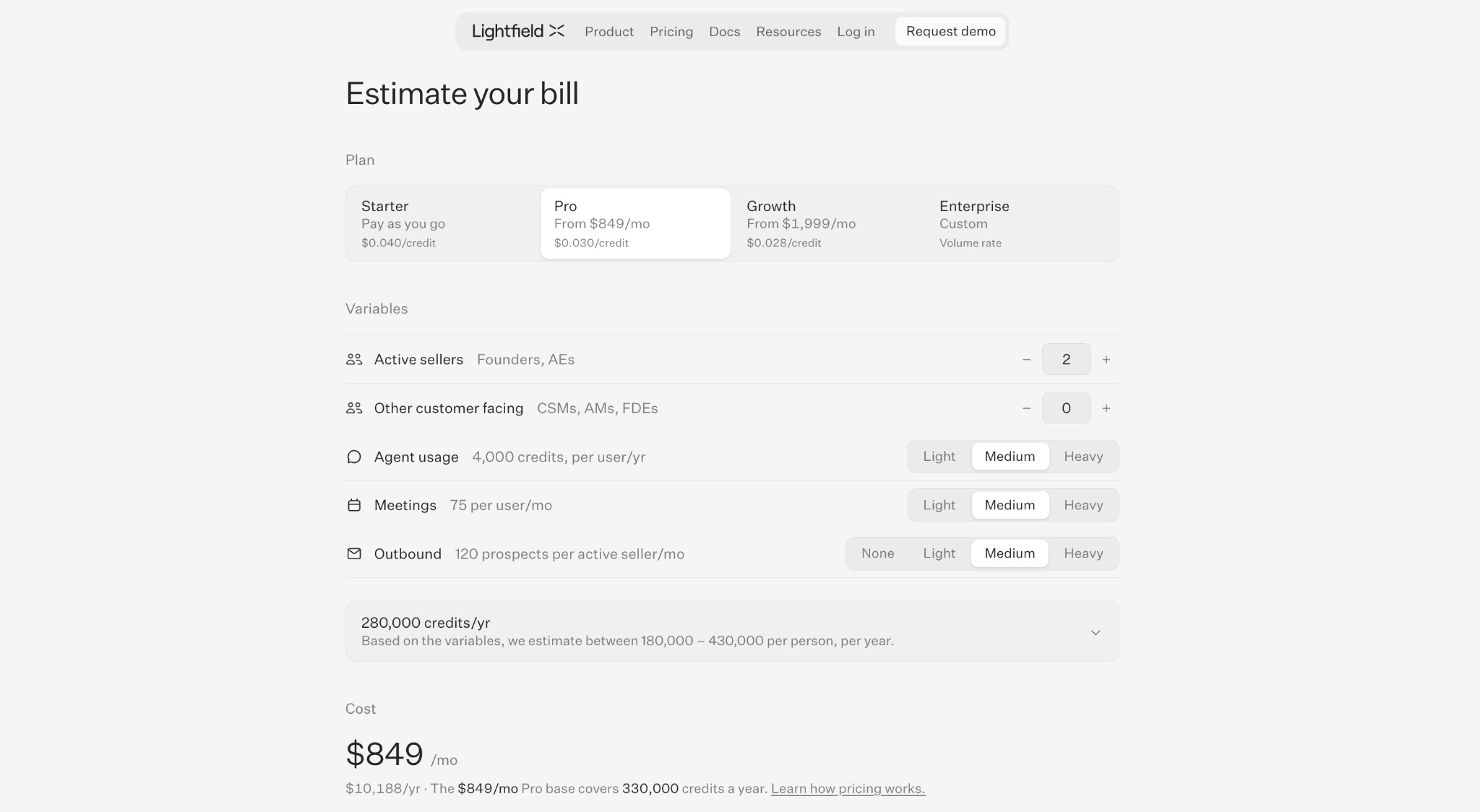
Product “seats” are no longer the default. In CRM, Lightfield gives unlimited seats on every plan and prices credits.
But metering is usually AND rather than OR. In CRM, Attio kept its $35 seat and added two separate credit pools on top of it.
Companies add tiers to grow accounts. In CRM, Twenty lists $9 and $19 per seat on its pricing page, then an Enterprise tier starting at $50,000 a year.
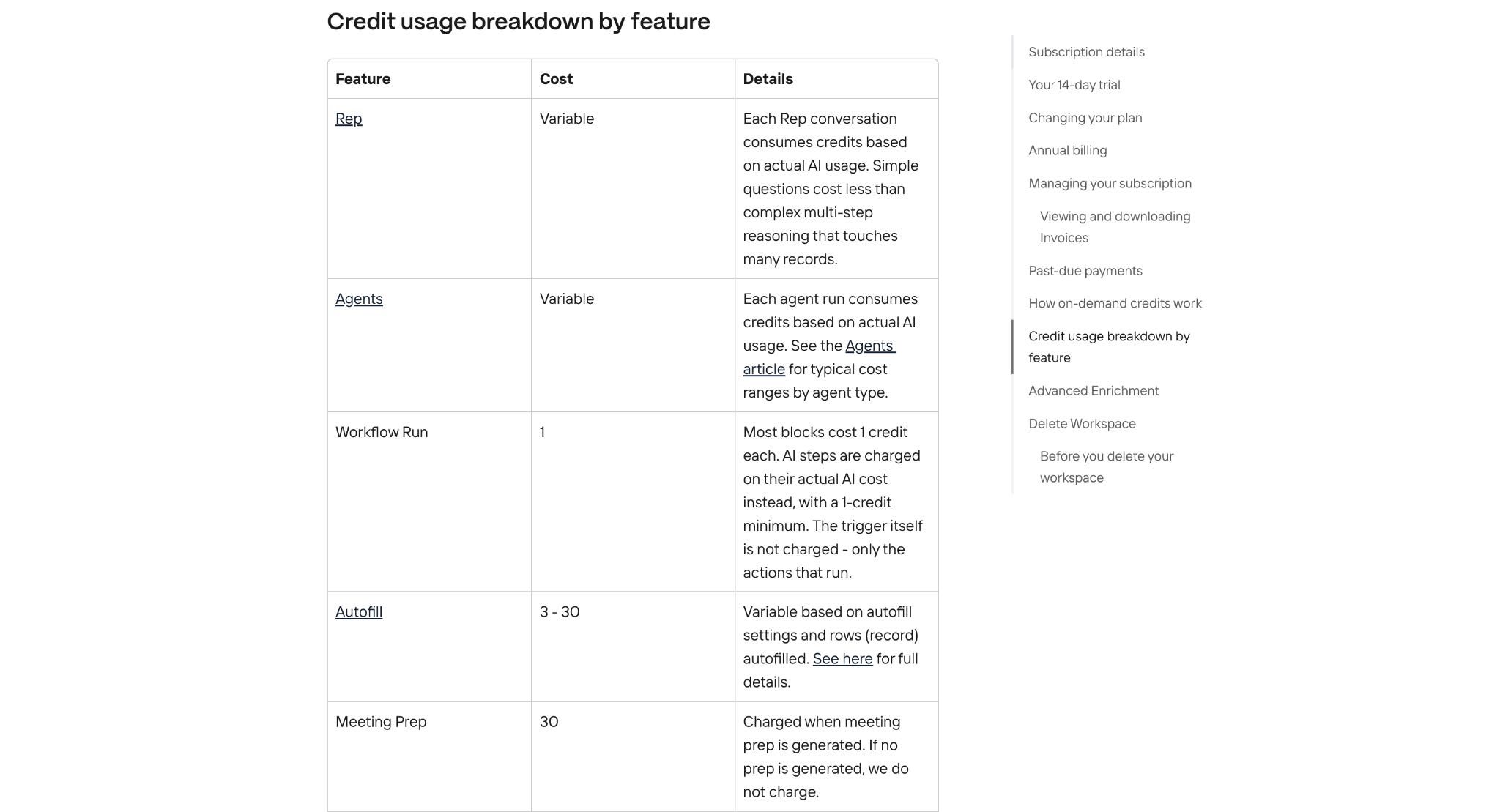
Metered pricing is still confusing. In CRM, Clarify uses a table in its help docs to show the credit ranges of specific actions. (More on that later.)
CRM was an easy example because ‘seats’ had been the standard unit of measurement for 20 years. But the same trend is visible across the whole category library, partly outlined in last week’s Great AI Migration. Of all the audited companies founded since 2020 that publish a price, 56% price based on usage or outcomes instead of only ‘seats.’
That’s kind of a big deal for founders in emerging categories, where there isn’t usually an incumbent’s pricing model to copy.
I think that means we shouldn’t be worrying as much about the sticker price as what is being counted and how we are counting it. This should help you with that.
Questions to test pricing in new categories
1. What does your customer already count?
The best unit is usually a number your buyer tracks whether or not you exist.
Fin (help desk) charges per resolution rather than users (like its predecessor Intercom).
Gorgias (help desk) uses the monthly ticket volume that teams need to triage.
Ashby (ATS) prices on company headcount instead of number of recruiters.
Fynn Glover, CEO at Schematic, a usage-based billing platform for companies with enterprise customers, told me that this step is a translation: You need to understand the intuitive value your customers already perceive then find the unit that captures it.
Common misstep: It’s easy to favor a unit that’s easiest to measure. For example, seats are easy because products have users.
2. Does the number go up when your customer wins?
The best unit of measurement makes your revenue a byproduct of your customer’s results: You get paid more because they got more.
Ashby (ATS) grows with its best customers as they add new employees.
Lightfield (CRM) meters credits against selling activity. The bill goes up when sellers are active (e.g. meetings are being booked, prospects are being contacted, etc.) instead of the company adding headcount.
Common misstep: Don’t assume more usage equals more value. It only counts if the value outpaces what the usage costs. Pylon (help desk) watched its annual AI bill go from ~$400,000 to $1.4 million without any change in value.
3. Can you say the price without explaining it?
Fynn said that most founders are better at pitching their product than pitching their pricing. If the pricing matrix or unit of measurement requires a long-winded justification, it’ll be even harder for the customer champion and procurement team and finance budgeters to justify you.
Nutshell (CRM) prices by hours saved per month. ✅
Fin (helpdesk) charges $0.99 per resolution. ✅
Twenty (CRM) includes 50 workflow credits per year in the Pro tier for $9 per month. ❌
Clarify (CRM) publishes what each action costs in credits, which is more transparent, but I think that’s a symptom of the problem: If a buyer needs a detailed documentation to even remotely estimate their monthly bill, the model is too complicated.
Common misstep: Resistance doesn’t necessarily mean it’s too expensive. Understanding the unit of measurement or being able to translate it into ROI could be much bigger blockers.
4. Will you be able to tell whether it’s working?
Manish Choudhary, CEO at Flexprice, an open-source usage-based billing infrastructure for AI and SaaS companies, told me that he recommends two metrics to assess if pricing is working for or against you.
Check gross margin on the top 10% of accounts. The blended average hides the tail until it’s too late. (Kyle Poyar similarly highlights the dangerous token consumption of the top 10% of AI users too.) Just raising prices doesn’t work if the top accounts are systematically unprofitable.
Split expansion revenue into (1) making more because customers used more and (2) making more because you decided to charge them more. The first one is sustainable growth.
Common misstep: Don’t wait until you need this data to start collecting them. Like my dad (still) tells me about planting a tree, yesterday was the best time to start and today is the next best.
Get the Price Wrong
This should all read like a long permission to be ‘wrong’ with your initial pricing as long as you’re right about the unit of measurement.
You can raise, lower, discount, grandfather or do whatever you need to do with prices without customers blowing up Reddit.
Getting the unit right is a more difficult thing to adjust: terms resets, account margins shift, customers refactor the value of the relationship.
Intentionally select a unit that your buyer already counts and make sure it grows when they win. You’ll still probably want to recast your rates by the end of the year, but at least the underlying framework will be stable and sustainable.
We’ll figure out the rest as we go.
Thanks for reading this week. I’ll be back next Friday with a big analysis on time to value and exceeding customer expectations. If you have experience or tips, hit reply and let me know.
Have an unforgettable week.
Pricing by the unit of value is a useful test because the same $500 can feel cheap or absurd depending on what moves. For an AI receptionist offer, I would track booked jobs recovered and gross margin after review time, not minutes or calls handled. Which billing unit best survives when usage rises but customer value does not?
I agree with the statement of a gap between Comprehensibility that is hidden behind Price sensitivity. I also fully agree with the point to slice by top-account gross margin, as in most cases dependency on top accounts creates marketing effects more than real profitability. As a reader thinking about B2B specifically, I recognise one gap between vendor and buyer: the price is negotiated on one set of parameters, usually technical, but then offered in a different way to end customers based on the value it creates for them. It is interesting then to see that the value is more beaten, as it is more debatable. The fact remains that in this context the purchase is a product that is then translated into the business value that end customers buy. This by default creates price inconsistencies and I would expect more alignment to happen.