


AI sales agents promised to replace the SDR role: paste in your website, add a credit card, and watch the qualified leads roll in.
Luna.ai was one of them, launching in 2023 on that premise. Today the domain is for sale, and I had to use Wayback Machine to find the old homepage.
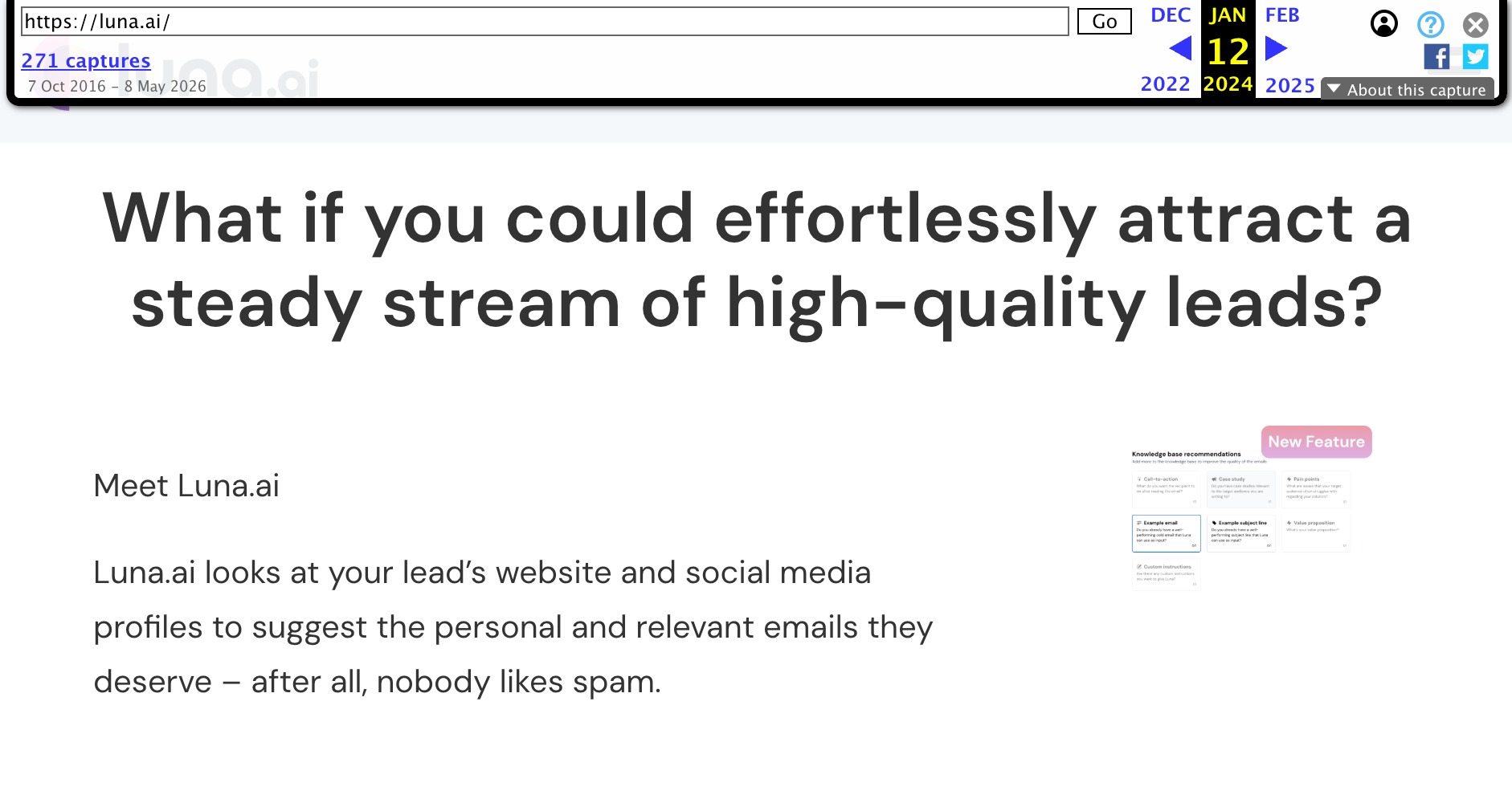
They couldn’t deliver on the promise to replace people with agents, and they aren’t alone.
Regie went from replacing the rep to being a “force multiplier” for one.
Artisan went from “stop hiring humans” to working alongside your team.
Day went from the “Waymo of CRM” to working in collaboration with reps.
Those are three of many AI-native companies that spent this year walking back their claims toward something more tangible and realistic: saving time, delivering value, not necessarily automating anyone out of a job.
At the same time, SaaS-era companies are racing to meet the same AI-era expectations from the opposite end of the spectrum, adding automation and pre-emptive action that frees customers from the (now-clunky) experience of navigating a user interface to find the right dashboard.
One widely publicized example is Clay, which now allows customers to skip its (once-indispensable) spreadsheet UI by connecting it to other tools through an API. Brendan Short covered it well in The Signal, if you haven’t read it.
Together, it’s two groups of companies moving in opposite directions, arriving at the same place. That’s a Great AI Migration, and it’s easier to see plotted on a single axis here.
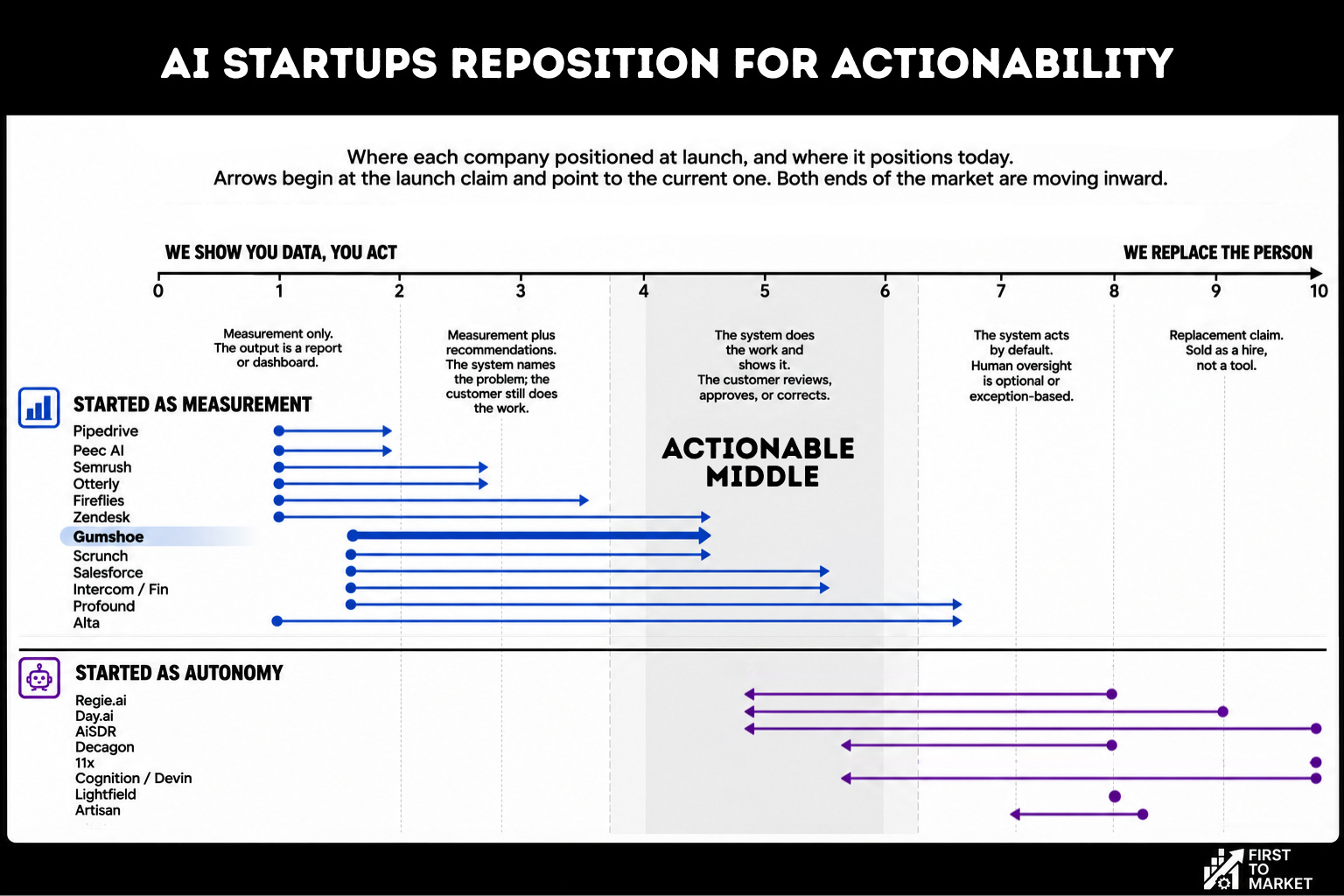
To test if these are anecdotes or an actual pattern, I coded 57 companies across seven categories in the category database: help desk, CRM, legal tech, AI SDR, coding assistants, meeting assistants, and AEO.
It’s definitely a pattern.
It also produced a diagnostic that is helpful whether or not you’re building an AI-native product, as we’re all building in the AI era at this point.
To illustrate the insights from the audit, I interviewed Jim Watson, an executive at AEO pioneer Gumshoe. They’re an AI-native company in an analytics category still shaped by dashboards, and they’re further along in understanding this shift than most companies, so Jim’s wisdom is shared throughout the article.
Five questions to test your AI-era positioning:
1. Do you name the labor you remove?
It’s tempting to focus on the technology or the layer your company automates. But buyers want to know what you’re actually doing for them.
Granola calls itself the AI notepad for people in back-to-back meetings. The labor they are removing is organizing notes while customers are already onto the next call.
Regie talks about removing the thousands of micro-decisions that slow down sales reps.
Codex says “drive the work you own and delegate the rest.”
For Gumshoe, Jim puts it as the difference between “what” and “why.” A tracking dashboard tells you your AI visibility is 32%. The labor they remove for their customers is figuring out why it’s 32% and what to do to improve it.
Common misstep: Peec AI sells “AI search analytics for marketing teams,” and it’s an example of a feature set that’s stuck in a dashboard era. There’s nothing that reveals what the customer gets to stop doing.
2. Can your customer do something different tomorrow morning?
This is what the Actionable Middle (from the chart) promises and neither end can deliver. A dashboard gave you a number that you had to research. Full autonomy did something, but the customer wasn’t in the loop.
Zendesk moved from routing tickets to resolving them.
Alta turned its dashboard into an “AI System of Actions.”
For Gumshoe, one customer was positioning itself around expertise. Gumshoe showed AI models were describing them through their loyalty program instead. They were winning an attribute they didn’t want and losing the one they’d invested in, a finding that easily translates to action.
Common misstep: When unsure of what’s actionable, it’s tempting to throw quantity of information at customers rather than quality. Being truly actionable can mean giving customers less. Gumshoe surfaces the single highest-leverage action in an audit, then checks back on whether it worked.
3. What gets your buyer promoted?
Someone inside the company has to champion your product, defend the expense, and explain the results next year. In B2B, the best products help both the client company and the client buyer.
Day heard that a self driving CRM was “too scary” for customers so they pivoted to be a control and configurability layer.
Harvey calls itself a co-pilot since the lawyer still has their name on the filing or brief.
For Gumshoe, marketers use it to turn AI search from a blind spot into a grade that moves “up and to the right.”
Common misstep: We’re selling to humans, and non-sociopath humans are unlikely to champion a product that promises to make their team redundant.
4. Does your revenue survive your own success?
Pricing models are a bet on behavior. If your pitch is that customers don’t need to log in to use a “seat” like a traditional SaaS product, then winning can break the model that pays for you.
Clay is leaning into usage-based billing as customers stop logging in for that “seat” experience.
Fin charges per ticket resolution. Zendesk is pivoting toward the same model, stuck in a hybrid limbo.
For Gumshoe, the unit is a project rather than a person (seat). What separates the tiers is how often the tools run and which ones you get.
Common misstep: Getting stuck in the middle ground between seats and usage is awkward for customers. Just ask a Salesforce user.
5. What can you afford to give away?
Freemium worked in the SaaS-era because additive product usage was super cheap or free. That’s no longer the case for AI-native companies, which have to pay token costs, but buyers still expect a cheap entry point that over-delivers on value.
Zendesk uses ticketing as a table stakes entry point that moves people to per-resolution agentic features.
Canva and Notion added tiers for their AI features.
For Gumshoe, it’s a product that needs tokens to run each day for each account. A “Free Tier” is never going to be sustainable, so they use a one-time audit as a “Free Trial” to cap the up-front investment, which speaks to me as a growth marketer.
Common misstep: Buyers expect to try something before they pay, and in an AI-native product that trial has a direct cost. Cap it so it’s predictable, then factor it into CAC as part of the growth marketing budget.
It’s a new era all over again
Business intelligence products have promised Answers > Dashboards for a decade, but they keep delivering fresh takes on old dashboards. This AI migration is different.
The startup audits I’ve done this week show lots of prominent brands actually converging on the same place, even if they are coming at it from different directions.
The measurement companies are moving because parts of their product are becoming a commodity.
The autonomy companies are moving because buyers stopped buying their promises.
The times are changing and now is when you need to be adapting, especially if you’re an early stage company with an opportunity to get there first like Gumshoe.
Let’s learn from AI startups like Luna.ai, even if that means we have to use Wayback Machine to do it.
Andrew, really appreciated this framework, particularly the five questions at the end. I’ve been applying them to Djembe, which is quite different from many of the AI-native companies you describe—we’re focused on building trust and human connection, with AI playing a supporting role.
A few of the questions immediately challenged my thinking. “What labor do you remove?” made me realize we need to better articulate how we take the guesswork out of creating meaningful connection. “Can your customer do something different tomorrow morning?” helped me see a real strength: we don’t just diagnose disconnection; people actually practice connecting differently. And “What can you afford to give away?” has me thinking differently about letting people experience one meaningful Djembe interaction as the entry point rather than simply offering a traditional free tier.
Different kind of product, but your framework traveled remarkably well. Thanks for giving me a useful new lens for thinking about what we’re building.