


Welcome Paul, Juan, Janelle, Blake, Robin and the others who subscribed this week. This free newsletter is a lens on business for people building a startup in an emerging category. Please forward it to someone else who would find it helpful. They can subscribe here.
The first version of the First to Market category database was 19 Excel workbooks and whatever my memory could spare that week while also trying to potty train a toddler. The mess was fine because I was the only person using it.
Version 2 pulled data from that folder of XLSX files with Claude and automated the intake with an MVP site on Bolt.new + Supabase. It at least looked legit enough for someone to spend two minutes using it (so thanks to the few dozen who tested it). But everything after that was still done manually, backed by data that was always at least a little bit out of date.
Version 3 launched this week.
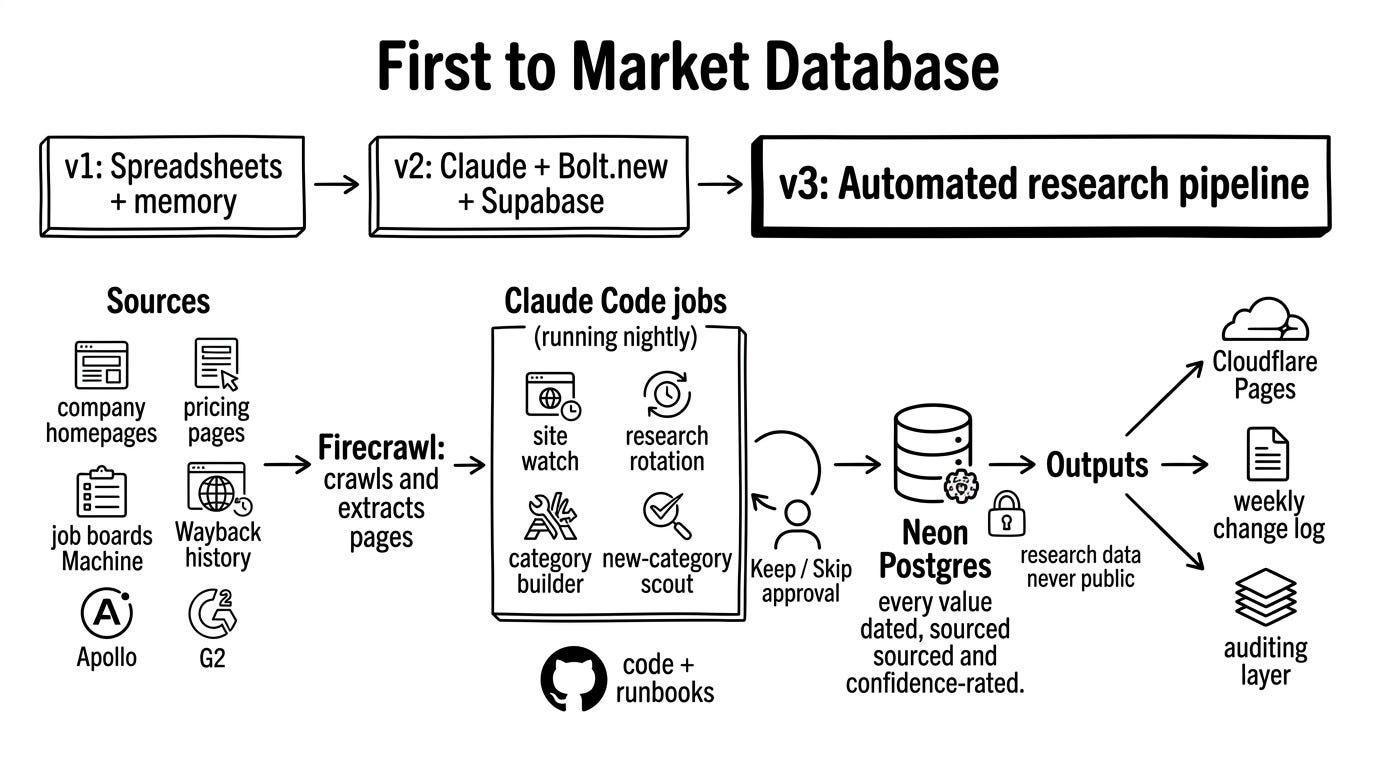
The data now updates itself every night instead of whenever I have time, and it’s public at categories.firsttomarket.co instead of locked in a spreadsheet or my sleep-deprived brain. (More detail in this week’s “From the Workbench” section at the end.)
How much polish a new product launch needs depends more on its audience than on our company stage. A rough version of the Category Database was 100% fine when I was gauging interest. But a scaled public product needed more to be valuable.
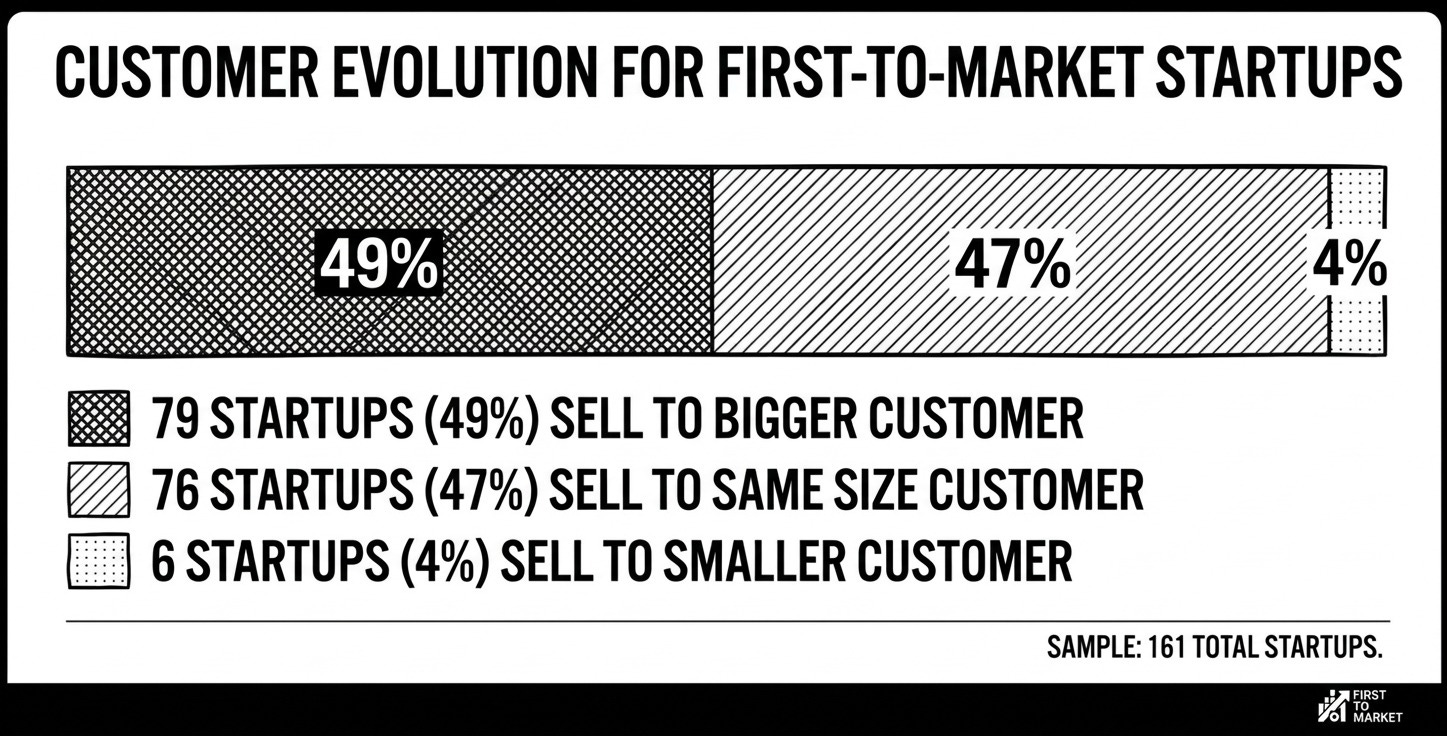
That probably sounds familiar because startups go through the same shift as they grow. From the database, 79 of 161 startups now sell to a bigger customer than the one they launched to, and only 6 moved to a smaller one.
Figma launched with an invite-only preview for individual designers. But now 95% of the Fortune 500 use it. That’s why when Figma rushed an AI feature for its 2024 conference, it had to quickly pull it.
Different audiences expect different things from a launch, and likely tolerate fewer mistakes. The four questions below will help you decide how much polish your next launch needs, whether it’s your first product or your 50th feature. (At the end, I’ve added an AI prompt that you can copy/paste to run the exercise, too.)
1. Who will see it first?
Early adopters sign up knowing the product is unfinished so a bug is less likely to surprise them. (Talk to any Tesla owner about this.) But a mainstream buyer is more likely grading the experience against another option with less tolerance for blemishes.
Elizabeth McCluskey, managing director at TruStage Ventures, told me: “Early-stage teams get a handful of first impressions, so I don’t like to see them launch too early. When you put something in front of people before it works, you can easily lose their trust for good.”
Elizabeth’s advice is to start with a small group to “treat these first users as collaborators.” One of her examples is AVA, an AI assistant for parents. The founder shared the early product with a small beta group of parents first, then iterated with them, before ever opening it to the public. Elizabeth said those early testers became its advocates. (Again, think about Tesla.)
Linear added about 10,000 emails to a waitlist then let in a few per week. Its founder told First Round: “We didn’t want to launch publicly and have a ton of people checking it out for a day, and then leaving, thinking the tool sucks.”
Canva launched for social media managers. Then 11 years later it added an enterprise plan with large-org requirements: SSO, admin controls and security standards. New features now must meet those requirements, as well as move fast enough for its OG early adopters.
Common misstep: Don’t expect the future to always look like the past. Our first launch probably went to a small group that expected bugs. Our customer base now might include people with different expectations. (This is why I still drive a Rivian and my wife does not.)
2. What will they compare you to?
Buyers judge every launch against something, and what that is can depend on how mature your category is. The Four Waters Framework sorts categories into four stages of maturity.
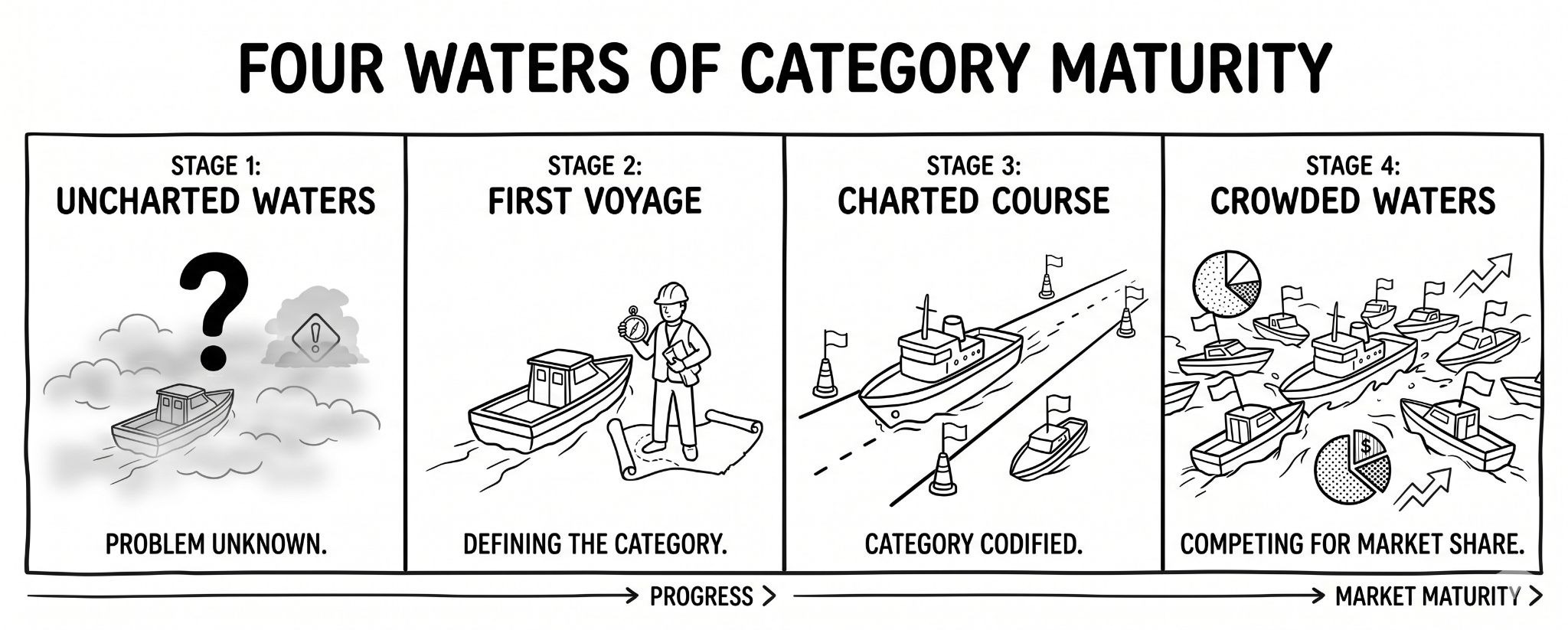
I checked this against the database (startups that launched in 2023 or later) and a launch often gets compared to something else:
An incumbent: About half the startups that launched into Crowded Waters named a specific incumbent at launch, like HubSpot or QuickBooks. Prospects in these categories compare options (feature vs feature) so it can pay to bring a more “fully cooked” product to the market. Attio entered CRM, one of the most crowded categories in the database, and spent about three years building before launching. Superhuman spent two years building an email client and still refused to launch. Its founder called the “launch and see what happens” approach “irresponsible and reckless.”
The old way: In First Voyage, most of the startups positioned against the status quo: hiring SDRs, paying a research agency or doing traditional SEO. So an AI SDR is measured against the human SDR it would replace.
Today’s price: Twenty is an open-source CRM and its CEO Félix Malfait told me that being open source means “you’re competing against the free version of yourself.” Every paid feature is measured against what customers can already get for free.
Test it: Look at your last ten lost deals and write down what each buyer chose instead. That’s what our next launch will be compared with so that’s the bar it has to clear.
Common misstep: Don’t confuse this with feature parity. Attio didn’t need every feature that Salesforce offered in CRM. It needed to win on the things about which its first customers cared most.
3. What could this launch break?
Once you have paying customers, every new launch is judged partly by what it does to the product they already use. The closer it sits to that product, the more polish it needs.
A separate product can move faster. FigJam is a whiteboard product from Figma that launched quickly because they said, “We were playing catch up. Speed seemed of the essence.” Having a rough first version of FigJam didn’t change the core design product.
An add-on is judged on completeness. The team at Gong started with call recording then added products for forecasting and engagement. Its co-founder explained that a second product is judged on completeness rather than product-market fit, “because at the end of the day, product-market fit is for a category.”
A change to the core product needs the most care. When Lindy pivoted from a workflow product to an AI assistant, growth marketing leader Haneen Azhar told me it kept supporting the enterprise customers on its original product instead of disrupting those relationships.
Test it: Ask whether a customer who never uses the new feature could still be hurt by it. If so, it needs the same polish as your core product.
Common misstep: Every new idea doesn’t need to be part of the core product. Launching it adjacent to the core product, the way Figma did with FigJam, can grant you needed grace.
4. Are you polishing the right thing?
The other way to get a launch wrong is to spend months (or years) perfecting something built on the wrong assumptions. In the category database, 30% startups founded in 2013-2016 took two or more years to launch. Of the 23 founded in 2023, only 13% took that long. It’s directional at best, but fewer startups are spending years building before launch.
Speed makes it easier to be wrong. Lindsay Liu, co-founder of Super and writer of The Headline, told me her team’s first beta took 10+ months, which “was considered fast back in that era.” But she warned that AI tools “bias towards too much execution. And if you don’t know the right brief, then you’ll get lots of polish on the wrong output.”
The wrong buyer is costly. The team at Stripe said that its billing product was “naively launched” on the assumption that the developers who integrated payments would also evaluate recurring billing. But that decision lives in finance so Stripe missed its quota.
Pre-selling tests your assumptions before you build. Kat Weaver, an exited founder and angel investor who has helped founders raise $100M+, told me that “there will never be a perfect or right time before going to market.” Her advice is to “start testing with potential customers before it feels fully viable,” and even pre-sell before an MVP exists: “The customer intention is what sets one up for success.” (She writes about raising capital in her newsletter.)
Weak feedback doesn’t always mean wrong assumptions. The team at Mercury showed the MVP to 100 founders, and only two were enthusiastic. But they kept building for more than a year on the premise that the founders understood the problem and “just couldn’t imagine what a better banking experience could be.”
Test it: Ask a few target customers to explain the problem you’re solving. If their description doesn’t match yours, fix that before you fix the product.
Common misstep: Don’t consider something an MVP until you’ve talked to customers about it. As Kat put it, “Doesn’t count as a true MVP to me if you haven’t done customer interviews around it – just making something doesn’t mean a customer wants it.”
Before your next launch
To work through these four tests for your own launch, paste this into Claude, ChatGPT or your AI chat of choice:
Help me decide how much polish my next launch needs, using the four questions from Andrew Garberson's First to Market article "Is Your Next Launch Too Early or Too Polished?"

Step 1: Context. If you already know my company, product and customers from memory or earlier chats, summarize what you know in two or three sentences and ask me to confirm or correct it. If you don't, ask what I'm launching (a first product, a new product or a feature), who it's for and what category it's in.

Step 2: Ask me these questions one at a time, and wait for my answer before moving on. If an answer is vague, ask one follow-up, then move on.
1. Who will see it first? Are they early adopters who expect rough edges, or customers who expect it to work the first time?
2. What will they compare it to? An incumbent, the old way of doing the job (a spreadsheet, an agency, a new hire), or a free version, including my own? If I have notes on lost deals, what did those buyers choose instead?
3. What could this launch break? Could a customer who never uses it still be affected?
4. Am I polishing the right thing? Could a few target customers describe the problem back to me in their own words?

Step 3: Give me a short readout, under 200 words:
- Where my answers point toward launching now, and where they point toward waiting.
- The assumption I seem least sure of.
- Any answers that pull against each other.
Don't tell me what to do, and don't invent statistics or examples. Use only what I've told you and these four questions.

Step 4: Close with:
- A pre-mortem: ask me to imagine it's 30 days after launch and it went badly, and what most likely went wrong.
- One small step I could take this week to test the assumption I'm least sure of.
- If my category is at https://categories.firsttomarket.co/, point me to its page so I can see how other companies in it launched and positioned themselves. If you can't browse the web, just give me the link.
From the Workbench
I previewed v3 of the category database at the top. Here’s a little more on how it works, in case you’re curious. If you want specifics about the tech choices, reply and I’m happy to share.
It checks every company every month. Each night, automated research jobs run for several hours. They work through a slice of the companies in the database and check each one’s positioning statements, pricing, comparison pages, blog and open roles. Over the month, every company gets checked, and the database records only what changed, saving all of the historical data where it makes sense.
It re-researches what a crawler can’t see. A separate job works through every company on a rolling cycle for things like funding, headcount, customers and go-to-market motion.
It looks for what’s new. Every week, it scans accelerator batches (like YC), analyst coverage and funding news for categories and companies that weren’t on the map before. Nothing gets added without my approval, and once I approve one, the jobs build its profile the following night.
It’s starting to have a memory. Each company’s public history is getting reconstructed back to its launch year. That’s how this week’s article could compare what startups said at launch (whenever that was) with what they say today.
It tries to show its work. The 14,500+ data points are dated, sourced and given a confidence level that I can double check. Every week, I review a log of what changed, and the public category pages update when the data does.
All is free for subscribers at categories.firsttomarket.co so please enjoy it.
And have a beautiful weekend.