


Imagine you’re producing an electric car before most people have ever seen one, let alone been in one.
You’re also doing this in an auto industry dominated by 100-year-old brands with marketing arsenals that you can’t match.
Billion-dollar promotional budgets with Super Bowl ads
Dealership networks so dense that 90% of Americans live within minutes
A century of cultural familiarity
Tesla had none of these. What it did have was a small group of early believers.
Early owners emphatically loved their cars and talked about them constantly — like, seriously, all the time.
Most brand builders would see this as a positive signal from the market (PMF) and divert resources to scale promotional budgets. (“We’ve got something here.”) The program at Tesla had a more ambitious vision, and there’s a timeless lesson in it for any business developing a new product in a new category.
A referral program with a new goal
It’s surprising that Tesla’s referral program doesn’t get more attention.
While we’re only talking about a growth channel that accounts for a single-digit percentage of sales, two factors give it an outsized influence in Tesla’s overall growth story:
It acted as a critical bridge between early adopters and mainstream car owners.
Several percent is still $2 billion in sales, based on my math.
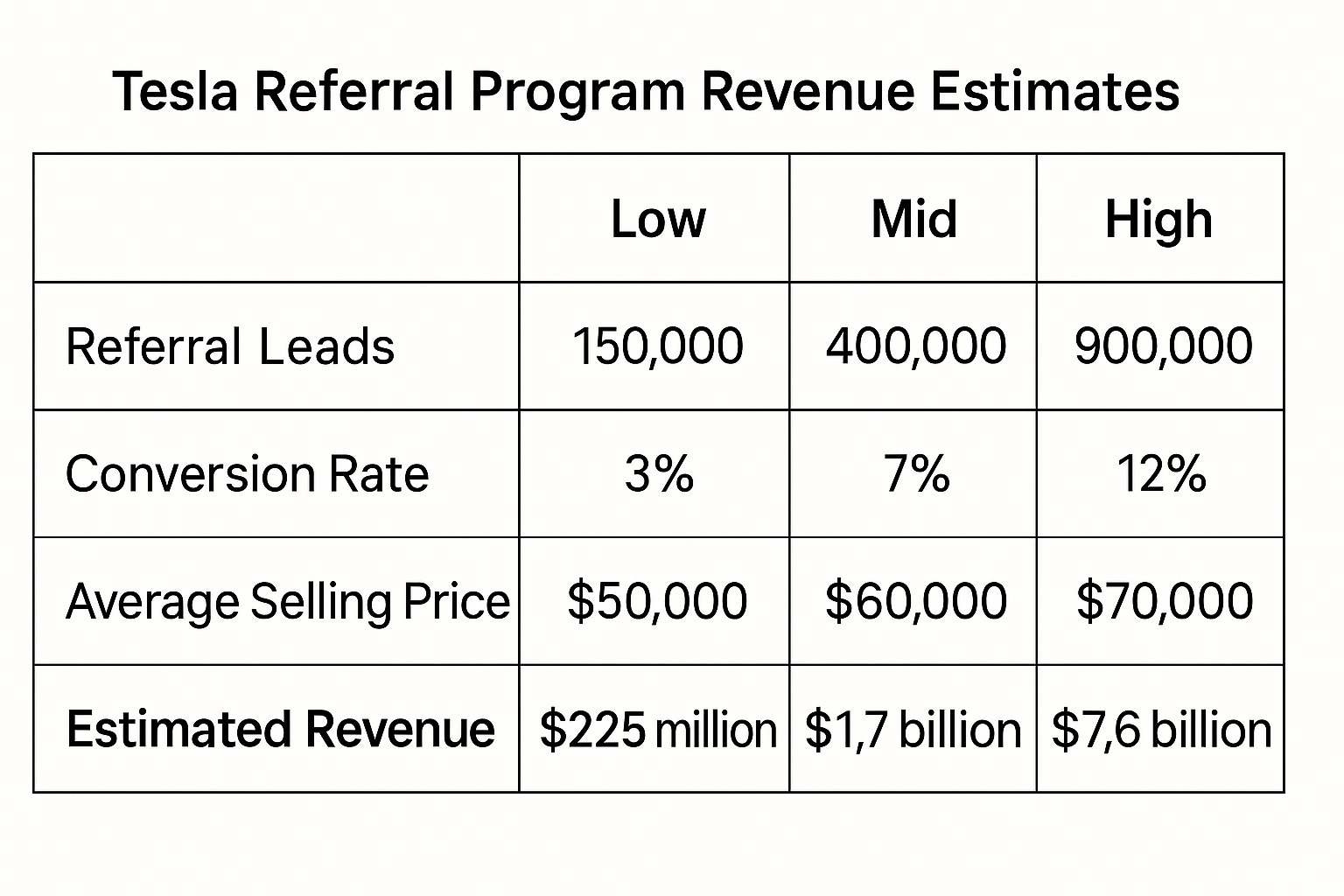
Rather than getting lost in the rewards and incentives, which are interesting but not novel, let’s dissect how Tesla turned its early customers into category educators, not just a sales channel.
If you’re building in a misunderstood or emerging category, like I am with Recurrent, here’s the part of Tesla’s playbook you need to steal.
Where traditional marketing fails
The hardest lesson I’ve had to learn at Recurrent is that you can’t battle beliefs with traditional marketing channels.
At least not with the limited timelines and budgets of most startups.
People still don’t understand electric vehicles. They remain worried about range, charging, battery degradation, fires, reliability, cold weather, etc. (I’d keep going but the scar tissue is real.)
A billboard wouldn’t resolve those kinds of objections.
It was not a new problem, but the solution was innovative for their sector. Tesla learned early that people trusted owners, not ads, and designed a referral program to align incentives.
Tesla’s Referral Program Playbook
Tesla’s referral mechanics were simple:
Give owners unique links
Reward both the referrer and the buyer
Add status tiers and leaderboards
Offer immediately tangible or high-prestige perks
Yeah, ok, those are mostly table stakes for a B2C referral program. Here’s what actually mattered for them when creating a new product category.
1. It lowered the barrier to peer education.
Most Tesla conversations happened organically. People stopped owners in parking lots. Neighbors asked questions. Co-workers wanted to know about charging.
The referral code gave owners a natural bridge: “Use my link if you end up buying one.” That shifted conversations from casual to something more intentional.
2. It created natural product demonstrations.
Everyone remembers their first ride in a Tesla. The big screen and instant acceleration create multi-sense wow-moments that break through whatever you believed before you sat in the car.
Activating their owners alleviated part of their dealership deficiency, and created something that dealers couldn’t replicate: the demo came from a passionate owner, not a salesperson.
3. It turned social proof into a distribution channel.
Today this is a basic tenet of influencer marketing, but it wasn’t when Tesla started the program. They created a marketing asset from customers pitching in their own voice.
EV creators (YouTube, etc.) remain Recurrent’s largest marketing investment for a lot of the same reasons.
EV beliefs and habits are entrenched.
Owners want to learn from other owners.
Decisions about a $50,000 asset are easier with enthusiasm.
4. It built identity and community.
The referral program helped to create influencers from the ranks of owners. Top referrers had status inside the Tesla community and that created an opportunity to be part of something bigger.
The Education Engine
If you’re building a new category, the lesson to take is that a referral program is not a growth tactic, it’s an education system.
Here’s how I would think about the framework.
1. Find your champions.
Not every early customer is an evangelist. Based on lessons from Tesla, I would be asking:
Who can I benefit as an individual with my brand? Giving them more influence, more income, more recognition.
Why are some people already talking about our brand for free?
Who will the audience that we need to educate want to learn from?
2. Remove any friction.
Consider all of the tools that would make teaching easier and build them. Most of us don’t have an attractive physical product like Tesla so this isn’t as easy as it sounds, especially in some B2B environments where there’s personal or professional risk in a referral.
It’s unlikely that this step is as simple as adding a “Refer a Friend” button in your product.
3. Reward education, not deals.
Both Tesla and Rivian have rewarded scheduling a demo drive. I’m sure both companies have modeled that back to revenue, but I think too many referral programs are structured like affiliates: they don’t reward the behavior, only the revenue.
Your revenue is your goal, it’s not their goal.
4. Capture the lessons.
Your customers may be better at explaining your product than you are. Find ways to document their explanations so they help to write your category narrative.
FAQ pages
Case studies
Onboarding content
5. Build belonging.
People advocate for products they feel connected to. I don’t have much sage wisdom here, other than it’s probably not a private Slack group.
Your Education Engine
If you’re in a well-understood category or your product is self-explanatory, maybe education isn’t part of your referral program. But I think that’s a smaller list than most people realize.
For the rest of us, this case study on Tesla reminds us to activate the people who already believe in our category to educate those who don’t, while removing every barrier that makes that harder than it should be.
That’s how a handful of early believers helped fuel $2 billion in Tesla sales. Maybe it’s the fuel you’ve been looking for, too.