


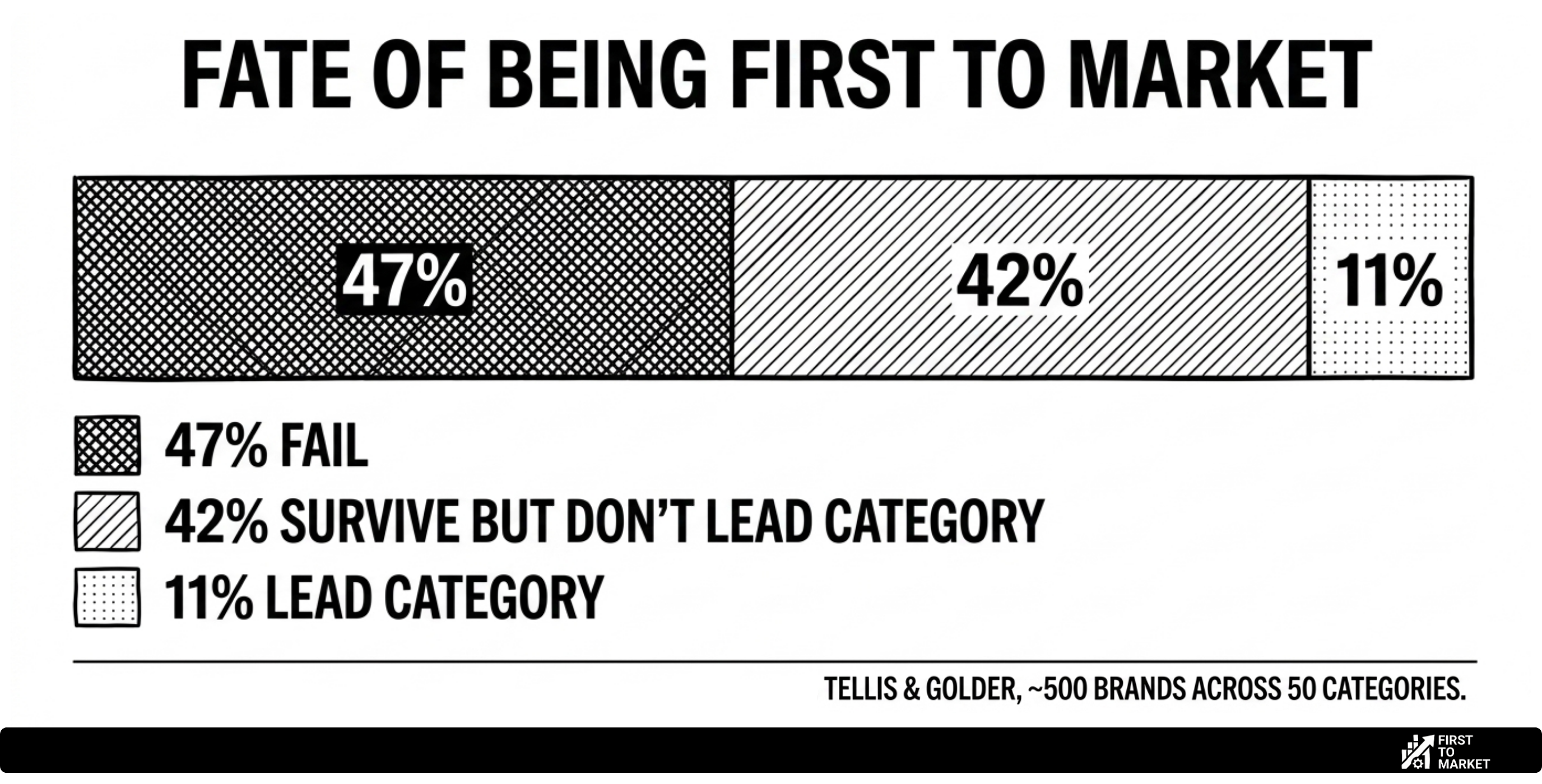
A study of 500 brands across 50 categories found that half of pioneers fail. Many of the companies that ended up leading those categories showed up about a decade later.
That’s the bad news.
The good news is that the other half didn’t fail. I find that 1993 study even more motivating today as AI shrinks the cost and timelines necessary to bring an idea to market.
The catch is timing. You can have the right idea and still be too early to make it. As a founder put it to me recently: “How do you tell the difference between being early and being wrong?”
In real time, it’s difficult. Early and Wrong give off the same signal: People say they like the concept then don’t follow through. (Keep in mind I’m living some of this right now in the EV sector.)
This post is the diagnosis of being early vs wrong. Next week is the prescription: How to cross the gap once you’ve determined that you’re not wrong.
The Blocked Demand Test
Demand that hasn’t arrived is either blocked or absent.
Blocked demand has something sitting between the buyer and the purchase.
Absent demand isn’t there and may never be.
We’ll start by going through the two common types of blocked demand, followed by what absent demand looks like from a seat inside the company.
1. The Belief Blocker
In this scenario, the demand is real but buyers don’t fully understand or trust the category yet. That’s often the blessing and curse of being early.
Slack is an easy example. When it launched, no one thought of team chat as something worthy of a budget line item. Instead of convincing a CFO that it deserved budget, Slack got the people who’d actually use it hooked first, one department at a time. By the time the invoice reached finance, the belief was already undercut by hundreds of employees who loved the product. Slack’s CEO said the growth was “almost entirely on word of mouth.” Their belief blocker just needed exposure.
Harvey broke through the belief blocker with client logos. It courted the most prestigious firms first, betting that these clients would also be the most persuasive references. Harvey now counts the majority of the Am Law 100 as customers and reached $11B in valuation.
Test it: Review recent deals or customer surveys for recurring doubts, which is how a belief blocker presents itself in the buying process. What happened when you put proof in front of that doubt? (Client reference call, case study, pilot program, testimonials) Did the blockers give way? Belief blockers tend to budge with reassuring evidence, whereas other blockers do not.
Lesson: A belief blocker is something that education and proof can unblock. (We’ll go through how to package it in part 2 next week.)
Common misstep: Resist the urge to treat every objection as a belief problem.
2. The Enablement Blocker
Here the demand is real, and buyers get it, but something outside your control is in the way.
A missing piece of infrastructure
A partner who won’t play their part
A behavior the rest of the chain hasn’t adopted yet
Grocery delivery is a good example. Webvan was the original Instacart. It raised nearly $1B to build its own warehouses and truck fleet, then caved under the costs. A decade later, after smartphones enabled gig driving, Instacart rebooted the idea and it worked. People wanted what Webvan originally offered but the infrastructure didn’t exist to support it in a cost effective way yet.
Michelin built run-flat tires that drivers wanted and carmakers backed, but the product stalled because service garages wouldn’t support it. The blocker was a critical ecosystem partner rather than a buyer issue.
Test it: Go back to those same sales notes to look for conditional language: “once we have,” “we can do X when Y is ready,” “we’re waiting on...” Enablement-blocked buyers are postponing vs rejecting.
Lesson: Every business depends on the health and collaboration of its ecosystem. If the blocker does not live with the product or buyer, other parties may be limiting the free flow of demand. (We’ll get into a whole targeted playbook for dislodging these in part 2.)
3. Absent Demand
If it’s not one of the other two blockers, that’s when I start to look for absent demand.
Quibi is the case study. They raised almost $2 billion, launched in April 2020, and threw in the towel by October. The founders blamed timing: “I attribute everything that has gone wrong to coronavirus. Everything.”
Except they weren’t just early and it wasn’t just COVID.
Short form video exploded on TikTok over that same period and streaming hit all-time highs as screens became our closest friends. People simply didn’t want Quibi’s version of it.
Amazon’s Fire Phone has similar lessons. The smartphone market was mature in 2014 — iPhone was already on #6 at that point? — and Amazon had the brand + distribution. But the market didn’t want it.
Test it: Take your most engaged prospect (the one closest to ‘yes’) and remove the blocker yourself: eat the cost, build the one-off integration, hand them the thing they said they’re waiting on. If they still don’t move, you may have found the reason.
Do the people who do buy keep coming back on their own or only when you nudge them? Read “What not having product-market fit feels like” by Melissa Kwan to double check your gut here.
Common misstep: Being “early” can be easier to stomach than “wrong” so be careful not to find a convenient false positive.
Unblocking the blockers
Each scenario leaves a different constraint on your pipeline.
Belief-blocked buyers are hesitating.
Enablement-blocked buyers are delaying.
Absent demand is curious but needs continuous prodding to maintain interest.
They can look similar at first glance: initial interest that won’t convert. The difference is how they respond when you intervene. Put targeted proof in front of a belief blocker and it moves. Whereas absent demand stays stuck even when you remove the blocker entirely.
I’ve experienced all of them and none are fun. Being early is actually the harder job because now you have to survive the gap while working to break through the blockers.
Next week is the prescription.
We’ll go through the four ways I’ve found to cross the gap when you’re early, including what to do when the blocker is yours to remove, and how to avoid handing the win to whoever shows up after you.
This resonates. I’ve learned the hard way that there’s a difference between being too early to the party and going to the wrong party.
That's a marketing / business ethos we should all remain vigilant of: "be careful not to find a convenient false positive." I'd argue it's helpful for your own growth to fall into the trap once to learn from it, just not at the Quibi scale.