


The tactics that keep you afloat in the early days of a new category can capsize you as the market matures.
Slack’s path from category pioneer in 2013 to today is one of the clearest illustrations of this. It shows how dramatically the right moves change at each stage, and what it costs when you don’t adapt in time.
This post walks through each stage using Slack as the lens. If you want the full framework first, start with The Four Waters Framework.
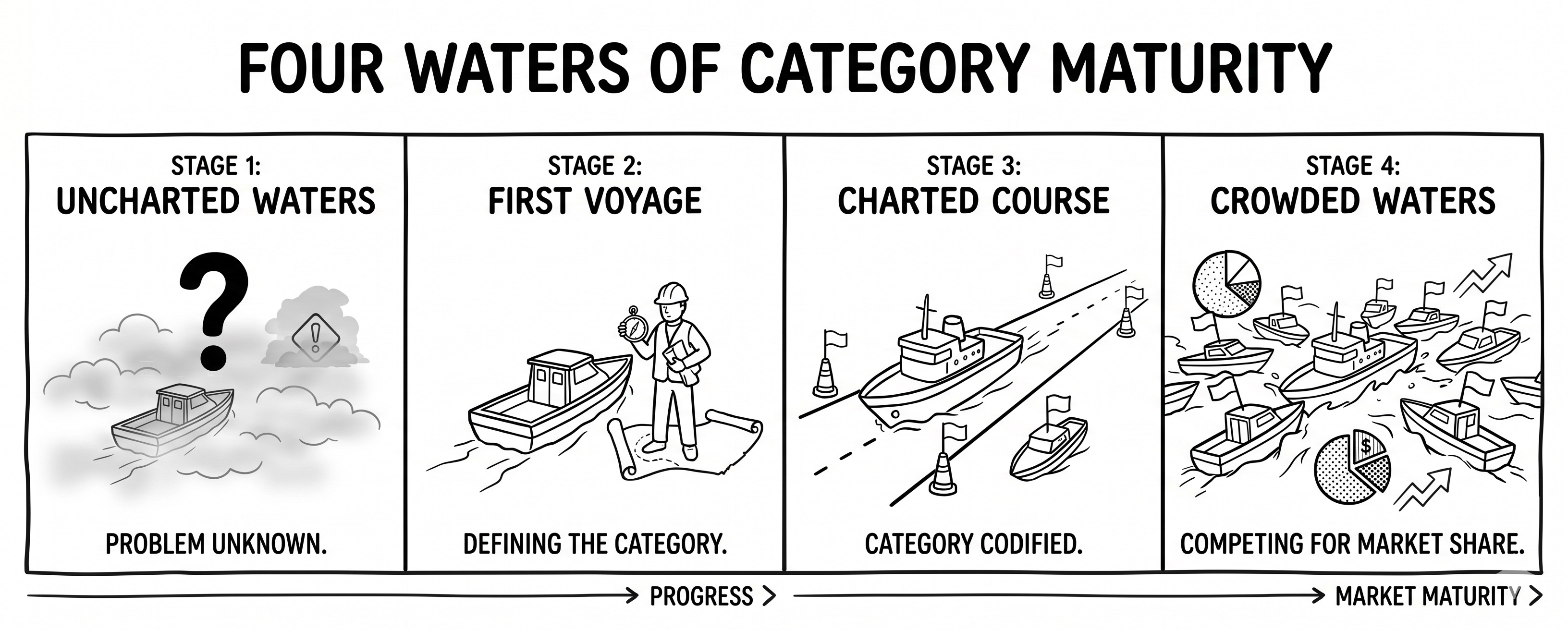
Evolving with Your Category
Category creation follows predictable stages. As the waters around you change, the playbooks and tactics you use must change, too.
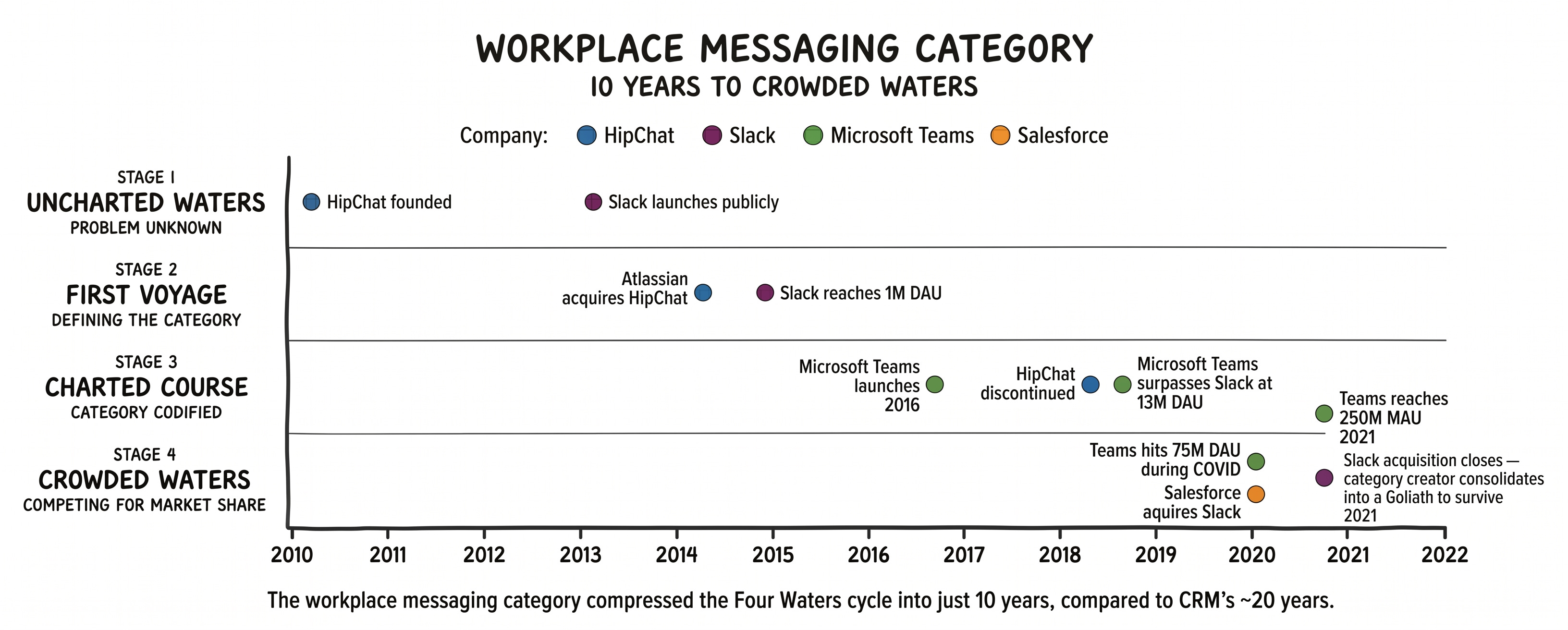
Stage 1: Uncharted Waters (2013)
The idea that companies would pay for workplace chat was unproven when Slack launched. Existing platforms had chat products (AIM, Google Hangouts) but they were seen as places for casual, unstructured messages.
Enterprise communication happened through email. That meant there was no existing budget or line item for team messaging, outside of some small dev-focused tools.
That constraint turned into an advantage. No established playbook gave Slack permission to build differently:
No MVP. The early product was polished enough that initial users helped peers see the potential and create the internal business case.
No IT. Focusing on end users let Slack bypass IT leaders who had no dedicated budget and could quickly smother adoption.
Ecosystem first. Slack invested in integrations early, positioning as a multiplier rather than another standalone tool.
The lesson: In Uncharted Waters, you’re building belief rather than capturing demand. Traditional growth channels and tactics may not help you yet.
Stage 2: First Voyage (2014–2016)
Slack reached 1 million daily active users within 2 years. At that point, tech company prospects got it immediately. That drew attention from serious competitors, who reacted with product pivots (Microsoft Yammer) and bolt-on acquisitions.
Slack used its head start well. Rapid releases (e.g. threading, emoji, integrations) kept competitors focused on parity while Slack kept moving the target. By the end of this stage, “slack” had become a verb and corporate FOMO created inbound demand.
The lesson: First Voyage is when you make clear to the market who is winning. Get it wrong and you educate the market for the competitors chasing you. (Think: 2nd mouse gets the cheese.)
Stage 3: Charted Course (2017–2019)
The category was undeniably real. Mainstream companies across industries adopted structured real-time communication and nobody was saying “we’ll just stick with email” any longer.
Then Microsoft launched Teams by bundling into Office 365 at no additional cost.
The Charted Course trap emerged: Slack had built a strong product and a loyal user base, but hadn’t built enough defensibility against a distribution-based attack. What had looked like network effectings and switching costs for Slack suddenly didn’t appear as strong.
Microsoft’s bundling move was predictable in hindsight. The category was valuable enough to attract a platform player, and platform players compete with distribution rather than features.
The lesson: Charted Course is when you solidify defensibility. Network effects, ecosystem lock-in and brand moats begin to matter. While Slack built some of these, they didn’t have an answer for Microsoft’s bundling.
Stage 4: Crowded Waters (2020–2021)
COVID accelerated adoption of all workplace tools — one of the happiest professionals I ever met was a Zoom sales manager in 2022.
As Microsoft Teams exploded growth through bundling, Slack needed to bulk up to survive in the saturated market.
Result: Slack sold to Salesforce in 2021 for $27 billion. Slack couldn’t win the Crowded Waters fight independently. The acquisition reoriented the competition between two platforms rather than two products.
The lesson: In Crowded Waters, operational excellence and corporate development (including M&A) matter more than innovation. Sometimes the right move is redefining who you’re fighting with rather than who you’re fighting against.
What Slack Got Right and Wrong
Slack executed the early stages masterfully. They built the right product for Uncharted Waters, ran the right playbook in First Voyage and became synonymous with a category they created.
The costly missteps appeared in Charted Course. They didn’t build defensibility fast enough when the window was open. Even if Microsoft’s bundling advantage was foreseeable, Slack didn’t have an answer for it.
The tactics that made Slack great in the early 2010s weren’t enough to protect them by 2020. Understanding which stage you’re in is essential to running the right playbook.
Now you’ve got the framework to avoid the same mistake.
ALSO the visuals for these frameworks and category timeline are a must-have! I'd vote, not demand, for more charts like these.
This 🌱 “The lesson: First Voyage is when you make clear to the market who is winning. Get it wrong and you educate the market for the competitors chasing you. (Think: 2nd mouse gets the cheese.)”