


It’s tough to break into mature categories because incumbents have years or decades of compounded advantages.
Salesforce makes $40 billion a year and counts 90% of the Fortune 500 as customers. Their annual conference draws 45,000 people, many with “Salesforce” in their job title. That’s called defensibility.
Except AI shattered Salesforce’s architectural advantages and birthed dozens of ankle-biter startups. The CRM category has been cracked open, and the company with “CRM” as its stock ticker is on its heels.
But incumbents aren’t all teetering.
The well-prepared ones are striking back by shipping AI products backed by their data advantages, refactoring pricing models and self-disrupting before challengers can get a toehold.
Almost every software category is experiencing some version of this.
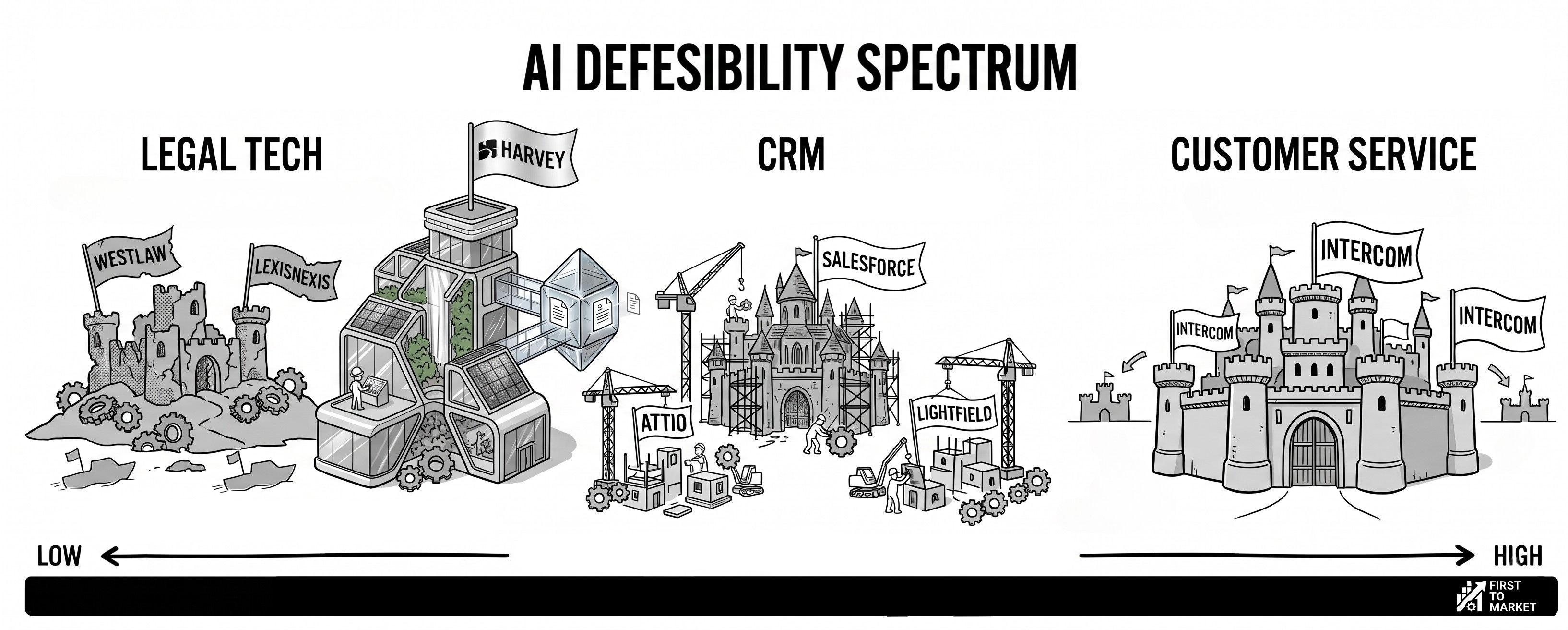
On the one end is legal tech. Startup darling Harvey.ai is doing $200M ARR in its first 4 years with +60% of the top US law firms already paying. Incumbents Westlaw and LexisNexis are blocked by their own architecture and pricing.
On the other end is customer support. Incumbent leader Intercom shipped Fin within weeks of ChatGPT’s launch and rebuilt pricing around AI-assisted outcomes before challengers could find traction.
Somewhere in the middle is CRM. Salesforce acquired and launched its own AI bolt-ons. Attio reoriented around AI. Day.ai, Lightfield.ai, Clarify.ai, and Reevo.ai have each raised $20M+ to chase CRM wedges.
The AI Wedge Framework
The most successful AI startups are breaking into mature categories by attacking the constraints that no longer apply. When incumbents can’t defend without breaking their own business model, the startups have found a durable wedge that:
Exploits an ex-constraint. These are deeply embedded product, pricing or org structures that used to be economically or technologically necessary and are no longer essential with AI-native products.
Requires the incumbent to cannibalize. Reorienting a business model is both painful and distracting: fragmented customer base, dual product lines, margin compression.
This framework helps you find a wedge that meets both characteristics of a durable AI wedge.
1. Map the Category
We need to understand how the incumbents in your category make money. For each major incumbent:
What’s the primary revenue model? Example: Salesforce subscriptions are tied to “Seats” across core products.
What constraints does that model depend on? Example: Salesforce’s seat-based pricing worked because humans had to operate the CRM.
Which of those constraints can AI eliminate? Example: AI can populate the CRM without a human in the seat.
How are incumbents responding to challenger attacks? Example: Salesforce is responding with M&A and its Agentforce product.
We’re trying to uncover where the category is primed for a wedge and whether incumbents have structural defenses.
Test it: Pick your category’s largest incumbent. Respond to each of the four questions as specifically as possible.
Lesson: A wedge starts with understanding the incumbent’s economics. Most AI startups skip this step and end up with interesting products that don’t threaten anybody.
2. Find the Ex-Constraint
A constraint is a structural condition that shapes the incumbent’s product, pricing or organizational design, and is (presumably) no longer necessary with AI.
For CRM, humans had to enter information and maintain the system. AI automates those steps and questions seat-based pricing.
For legal tech, experts searched databases and interpreted results. AI cuts out everything between query and deliverable, while some incumbent platforms are still pricing by search volume.
For customer support, people responded to tickets in a queue. AI can resolve many customer questions independently.
Each of these constraints were foundational and permanent. Now they aren’t.
Test it: Complete these sentences with specifics in every blank.
“[Incumbent] was built when [constraint] was unavoidable.”
“AI eliminated [constraint] by [specific mechanism].”
“Without [constraint], [incumbent’s pricing / architecture / org] no longer makes sense.”
Lesson: The wedge is an ex-constraint, but not every ex-constraint is a wedge.
Common misstep: Don’t mistake product disruption (cleaner UI, lower price, faster onboarding) for structural disruption.
3. Identify What Breaks
A good wedge forces the incumbent to choose between defending and protecting their business model.
Intercom broke their seat-based model with $0.99-per-resolution pricing with Fin. They are privately held and most public companies can’t afford to make that dramatic shift.
For bigger and less dynamic organizations, it’s more often a slow bleed:
A fragmented customer base that juggles new and old pricing models
Dual product lines that split attention
Slowing overall growth as business shifts from one bucket to the other
That creates opportunities for startups. While incumbents navigate internal complexity, your challenger brand can ship features.
Harvey uses per-lawyer pricing to make search-volume-based pricing look antiquated in legal tech. Westlaw can add tiers with AI features but it won’t fire its sales force and abandon 50 years of sales-led growth.
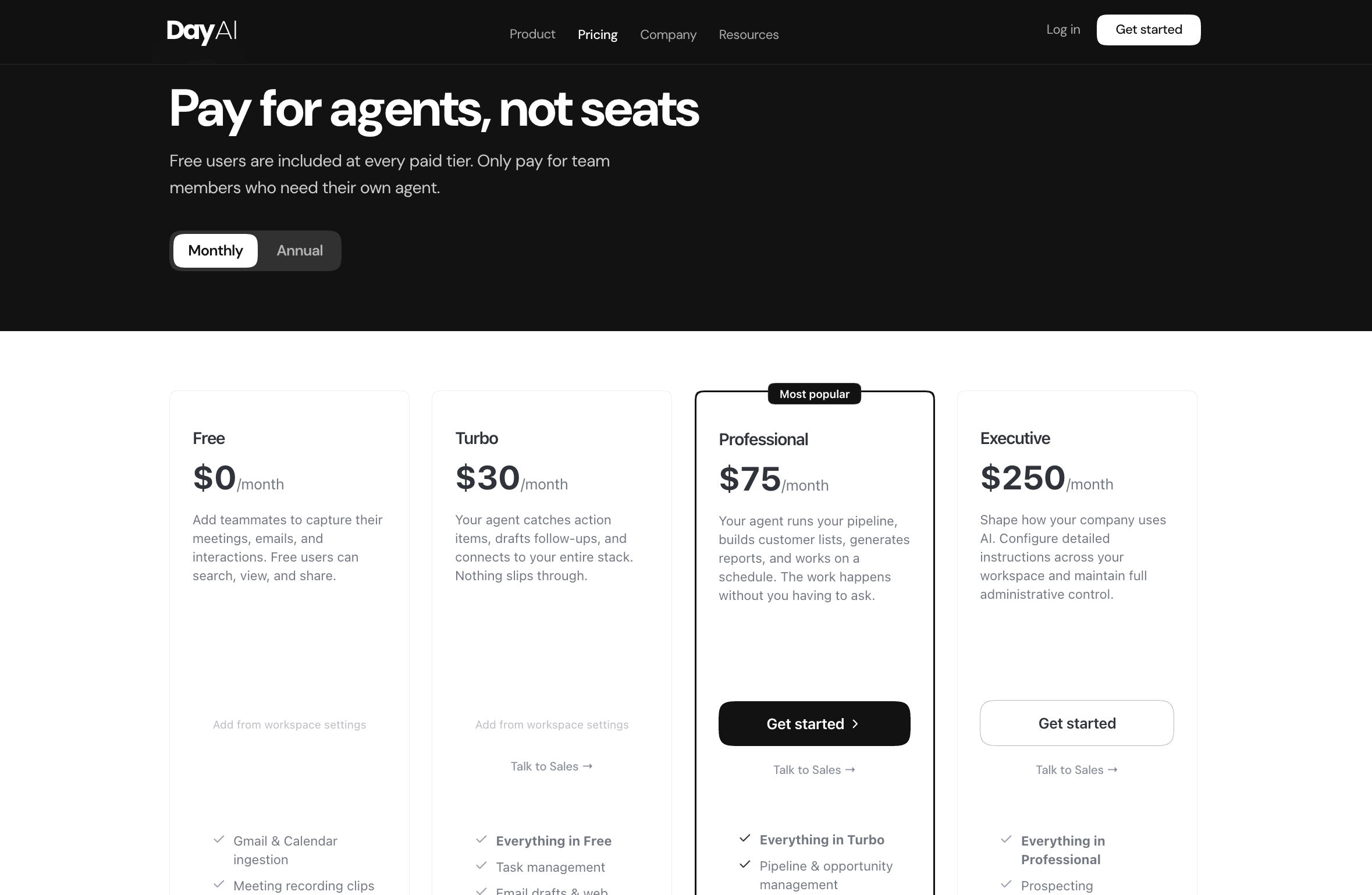
Day AI uses per-assistant pricing to make seat-based economics look antiquated in CRM. Salesforce can’t disrupt its enterprise contracts to respond to that.
Test it: Complete this sentence with two deep business-model pains.
“When [your startup] wins, [incumbent] has to either ___ or ___.”
Lesson: The wedge isn’t a differentiated product. It’s a structural threat the incumbent can’t defend without leaving behind a trail of blood.
Common misstep: Don’t mistake a product feature for a wedge. A wedge should force the incumbent to dramatically reprice, rebuild or repair.
Cracking Open Your Category
The final “Crowded Waters” stage in the Four Waters Framework is not a finish line. AI reminds us that mature categories aren’t closed when the underlying technology is disrupted.
But the wedge isn’t AI itself.
Your wedge should be the specific ex-constraint AI eliminates and the specific cannibalization the incumbent has to overcome to defend.
The category label is sitting there (CRM, legal tech, customer support) and the former constraints have disappeared. Your job is finding the durable wedge that forces incumbents into defense mode so you can exploit it before they can stop you.
This is an excellent article. A new way of thinking not just dropping people into a funnel and praying to be different. I found you from IG…best eye opening article this week. Thanks.
What excellent clarified thinking. I would love to share with you. My four step disruption process to disrupt any industry. I don't have anything to sell. I just like talking about it.