


Welcome Cindy, Mike, Brady, Cristina, Ryan and the others who subscribed this week. First to Market is a weekly newsletter with a lens on business for people building in emerging categories. It stays free thanks to our sponsor Clarify, the full-stack AI CRM, so please check out their platform. (It’s excellent and I use it each day.)
Getting dropped into an empty software dashboard feels so 2015. That was my experience last week when trialing a highly reviewed marketing tool. “You expect me to do all this work in order to see any value?” For better or worse, I just don’t have the time or patience for that.
I closed the account.
Around the same time, I set up a new CRM. It’s the best onboarding I’ve had with a software product:
The agent did the labor of connecting accounts and populating information.
I was asked to confirm details rather than enter them into a UI.
Every step contributed to visible value.
Migrating from my legacy CRM took 35 minutes, and 15 of them were making a coffee. For me, it was the perfect contrast to the “old way” of onboarding, whether that be a software product or a services engagement or a doctors office or whatever.
I reached out to the team behind Clarify (CRM) to learn about their onboarding experience. Chris Eberhardt told me: “Some people love it, some people hate it.”
Customers use Clarify by chatting with it so the onboarding follows the same approach. For people who would rather click around a UI, Chris said, “perhaps Clarify isn’t for you.”
That makes a ton of sense to me for two reasons:
It’s a freemium product so why not disqualify the wrong people sooner, before they waste their time and the company wastes its tokens.
Onboarding in emerging categories is especially important since lots of people arrive without clear expectations around value or ROI.
Onboarding that’s done well pulls the right customers closer and (oh so gently) lets the wrong ones save some time or hassle. This post explores a few tested onboarding adjustments that work for other startups, along with examples from the category database and what I’m doing at Recurrent.
1. Deliver on the promise
Customers sign up because of something we told them, or at least something we told someone else to tell them. Onboarding is where they find out whether that thing was true.
That likely matters more in a new category. Someone switching payroll providers already knows what payroll software should do, so they’ll give us some grace if the first week is slow. But someone trying the first product of its kind doesn’t have that context or an easy comparison. A lot is riding on first impressions.
Here are a handful of companies from the category database with a promise about the setup on their homepage:
Mercury (startup finance) says you can apply in 10 minutes.
Fondo (startup finance) says you can set up in minutes.
Replit (AI coding) says you can turn ideas into apps in minutes.
WordPress.com (CMS) says no technical setup is required.
Each of those is a promise the onboarding has to keep. In the AI migration post, we looked at Luna.ai, which promised that its AI agents could replace an SDR. The product couldn’t deliver on that promise and the company folded.
Test it: Write down the 1-2 promises that you make to prospects: ad headline, home page hero, sales deck, etc. Compare that to what a new customer should expect from onboarding: what they’ll do along the way, and what they’ll have when it’s done. How closely are you delivering on the promise?
Common misstep: The onboarding needs to be more than an intake form. When I was in consulting, our projects started with a discovery call that often ended with: “Thanks, we’ll call you in a month once we do the work.” That was a jarring failure to deliver immediate value for someone who just spent an hour sharing their business hopes and dreams.
2. Do the setup work for customers
Clarify made me connect my email to start. The team said it has tested different combos of email and calendar access during onboarding. “If you don’t connect your email and calendar, you likely will not find value in Clarify,” Chris told me. Without that context, I wouldn’t have gotten the instant setup or the automations (call transcripts, daily briefing, etc.).

Fondo (startup finance) has new customers connect their bank tools so it can begin categorizing transactions.
Peec AI (AEO) populates suggested prompts to track based on your website.
Test it: Sign up for Clarify’s free plan and watch how it asks you to verify information rather than enter it. What aspects of that could you replicate for your own product or service, and which would you NOT want to copy?
Common misstep: Don’t ask for what you should already know. When a sales call opens with “Tell me about your business,” I know it’s going to waste my time. A software onboarding that asks for company details after I’ve already entered my work email tells me the same thing.
3. Use friction as a filter
Not every customer is the right fit, and it’s on us to help the wrong ones realize that sooner.
The team at Clarify collects feedback from people who close their account, and some of those people are “very animated” about the onboarding experience.

“If someone isn’t motivated enough to work through the onboarding process as we’ve designed, they’re probably not a great fit customer,” Chris told me.
NetSuite (ERP) ads say it’s for companies with at least seven figures in revenue.
Equals (AI spreadsheets) increased conversion rate by removing a required onboarding step but retention dropped by 30%. They added it back.
Hinge (online dating) requires completed profiles before matches begin, even though 20% don’t complete them.
Linear (product management) used a launch waitlist as a filter.
Test it: Think of the customer that you wish never converted. What could have told them earlier that you/they weren’t the right fit? That’s a filter that could be worth systematizing.
Common misstep: Don’t confuse bad UX with bad fit. Not every customer abandons or churns because they are a “bad fit.” If you’ve ever had to use Netsuite, you get it.
4. Our pricing sets the timeline
At Recurrent, we think a lot about time-to-value because most of the insights in our consumer product come from trends that take weeks or months to surface. When it was 100% free, people were ok with that wait. Now that it’s freemium (30 days free), lots of people start the trial and cancel the same day if they don’t see value.
That’s not necessarily uncommon: one study found that 55% of cancellations on trials happen on the day people sign up. But it should force us to consider time-to-value expectations. (We talked about these types of expectations in a recent pricing post, too.)
Test it: What does a new customer have at the end of their first session that they didn’t have before? Does it outweigh what they invested to get there?
Common misstep: Price is more than dollars and cents. What a new customer pays includes their time, access to their (Gmail) accounts, a request to the engineering team. The total price raises the expectations from that first session.
Pushing and pulling away
The marketing tool I closed last week pushed me away. That probably wasn’t part of their plan. Its onboarding asked for 1-2 hours of setup (not totally clear) before delivering anything, and I wasn’t willing to invest that.
Clarify’s onboarding pushes people away, too. Mostly on purpose. It’s not for the people who would rather click around a CRM than bark instructions into the Claude app from a stationary bike during the 25 minutes I get to myself between toddler bedtime and parent bedtime.
Onboarding is the last step of acquisition. Decide who yours is built to pull closer and who it should push away.
From the Workbench This Week
I’ve been wrestling with review strategy this week.
Recurrent is an online business without a retail location, and AI answers are beginning to source from places like Trustpilot more and more.
My hesitation in these situations is always about giving away control: Once the profiles are live, anyone can post to them, and whatever they post becomes permanent source material for LLMs (and humans).
We already have a strong brand and plenty of Reddit threads where customers vouch for us. Adding Trustpilot feels like adding a wild card to an already-winning hand.
But I found out we’ve already lost some of that control. A review site called Trustburn has a Recurrent page with reviews from people describing the car they bought from us. Except we don’t sell cars, and the reviews are all super samey and fake sounding. (That’s also not our logo.)
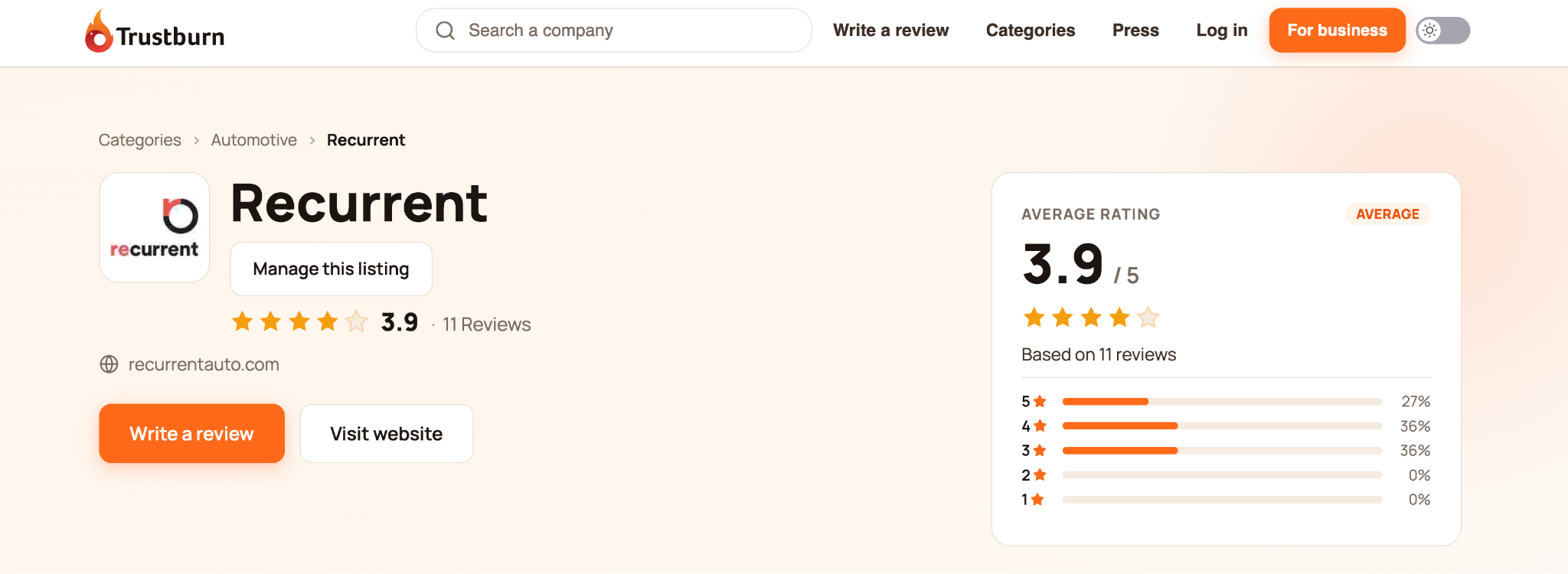
So this is what I’m living this week. If you have tips, I’ll gladly take them. Otherwise I’m closing the computer on review sites later today for some Halloween fun.
Have a beautiful weekend.