


Welcome Kathy, Audrey, Kyle, Mike, Rebecca and the others who subscribed this week. First to Market is a free newsletter with lens on business for people building in emerging categories. Please share it with someone else who would find it helpful. They can subscribe here.
Back in August the cofounder of Twenty told me that he’d lose sleep competing as an AI layer, rather than being the system of record.
Twenty is an open-source CRM attracting enterprise customers from Salesforce and other legacy platforms. “Salesforce will survive because it’s a great infrastructure,” Félix Malfait told me. But most companies are not: “AI is pushing SaaS companies to become excellent at either the infrastructure or the harness, and you don’t want to be average at both.”
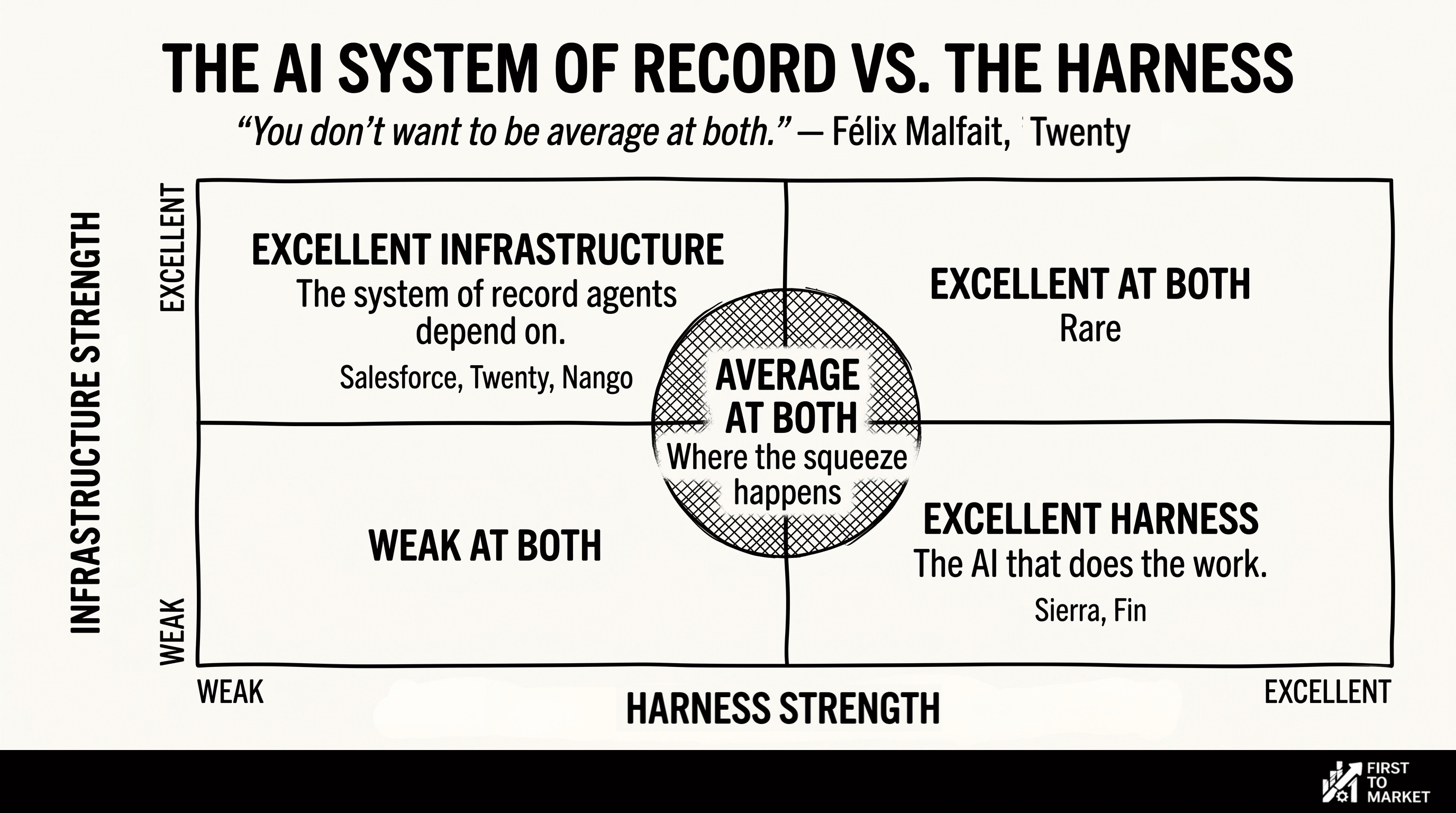
Think of the harness as the AI layer (mostly on top of a frontier LLM) doing the work. The infrastructure is the system (of record) that informs it.
It’s something I’ve been thinking about since talking to Félix. As an angel investor, I’m often analyzing how durable a very-early-stage startup can be as the barrier to creating a copycat product nears zero.
Susan Montgomery, an angel investor who writes Angels & Unicorns, describes most “AI-powered” startups as “a rented model in a pretty dress.” If the pitches I’m hearing haven’t needed a moat to add their first 100 customers, how defensible are they as they attract their next 1,000? Or 10,000?
I asked 15 companies that sit uncomfortably close to that infrastructure-vs-harness line: “What in your product gets more valuable as the models improve?” 14 either declined to comment or didn’t respond.
Gulp.
To make the question less intimidating, I went back to the category database to pull together a 4-part rubric from how category leaders position, price and sell in this environment, adding advice from other smart founders and investors. (You don’t have to sell AI-native products for this to be helpful — Westlaw launched in 1975, and it’s one of the examples.)
1. What gets more valuable as the models improve?
Every model release makes it easier for a customer to skip the UI or product completely. (I’ve been transparent about this at my day job.) What we sell has to get better as the models get better, rather than getting replaced.
Nango runs integrations across 1,000+ APIs. As models get faster at writing the integration code, the company sees itself getting even more valuable as the place that code runs.
Westlaw (in legal tech) has used AI to streamline legal research, but every citation needs to stand up in court (example 😄) so the stamp of approval from a 50-year-old company gets more valuable.
Test it: If you’re in a B2B business, pull the notes from your last 10 deals to isolate why each customer chose you. How many hold up if the models got 2x as good or cost 1/2 as much?
2. What can’t a competitor copy as models improve?
The other threat is a competitor aided by the same model advances. Susan said she asks (1) whether the company has proprietary data and (2) whether the business can afford to use that data as it grows. “Inference costs climb with usage, so if every new customer makes the unit economics worse, the growth chart is really a chart of accelerating losses,” she told me.
We want an old-fashioned flywheel: each new customer makes the product better in a way a copycat competitor starting today can’t match.
Waymo (AV) delivers a better product with every autonomous ride. Even a competitor with the exact same AI and hardware would still be starting at Mile 0.
ContentMonk (AEO) learns from every brand it supports, tracking which actions improve AI visibility to proactively help other customers.
Test it: Paste this into Claude or ChatGPT or whatever and answer its questions.
I want to find out how easily a competitor could copy my company using today's AI models.

Step 1: Ask me up to five questions, one at a time, about my product, my customers, and what they pay me for. Wait for each answer before asking the next.

Step 2: Act as a well-funded founder with access to the same AI models I use. Outline how you would build a competing product in 30 days. Be specific about the tools, data sources, and shortcuts you'd use.

Step 3: List what your copy would still be missing that my customers would notice. For each item, say whether a competitor could buy, scrape, or build it, and roughly how long that would take. Consider proprietary data, customer history, results over time, integrations, trust and track record, and distribution.

Step 4: Give me the two or three hardest-to-copy items. Then suggest how I could lead my positioning with each one.

Be blunt. If almost nothing is hard to copy, tell me.
Lesson: Our head start and defensibility should grow with each new customer, regardless of how the models improve.
3. Will people or agents interact with you as models improve?
The buyer doesn’t change in the near term. A marketing leader still picks the ABM tool, an HR leader still picks the ATS tool. But what they’re grading on is ALREADY changing. I won’t approve a new platform for our team that doesn’t have an MCP because Claude is where the team starts most work.
Félix thinks software is still the bottleneck: “In sales, the models are already good enough to run most workflows, and yet the penetration rate is extremely low because the tools haven’t caught up.” Once they do, Susan expects the value to follow the workflow: “As agents take over the seats, the value stays with whoever owns the workflow those agents run through, and the software humans used to log into keeps nothing.”
Some companies are already building in that direction:
Parallel designed its product on the premise that “our customer is an AI.”
Contentful (CMS) says: “Built for humans. Ready for agents.”
Tealium (CDP) lets AI tools make changes then waits for a person to approve them.
For now, a person still approves these purchases. Meta’s Muse is a preview of how that could change: its 6+ million users can already have it book reservations, order groceries and make purchases. The jump from B2C to B2B is only a matter of time + comfort.
Test it: Imagine your website, app, social profiles and booking page disappeared tomorrow. Could a customer’s AI still find you and engage with your product or service? That’s how a growing share of people will interact with us as the models improve.
Lesson: Customers probably don’t want a better interface from us. They may not ever want to interact with the interface again. (🙋 That’s me.)
4. What will customers pay for as the models improve?
I was solo parenting a toddler for a week recently so I enlisted Claude during naptime to:
Plan 6 dinners with as many hidden veggies as possible.
Put every ingredient into the (digital) cart.
Check the cart against what I’d ordered in recent months to avoid duplicates (e.g. a 2nd tin of cumin).
Scheduled the delivery.
I wasn’t looking for “meal ideas” or “online ordering.” All I wanted was to go from an empty fridge to ingredients in a pan. Meal planning apps and Walmart’s website are built for steps (select quantity, add to cart, schedule delivery) that I didn’t want to take. The only thing I wanted to pay for was dinner without giving up daddy-daughter time.
“Companies of the future are the ones that do not ‘help people do the work’ but instead ‘deliver results to customers’,” Ugi Djuric, founder of ContentMonk, told me. It’s reminiscent of something Julien Bek popularized at Sequoia: “A copilot sells the tool. An autopilot sells the work.”
ContentMonk (AEO) commits to results on every plan: new traffic, AI visibility or new customers. Ugi told me he credits that for a churn rate below 5%.
Sierra (help desk) only charges when its agent solves a customer’s issue.
Test it: Write out your customer’s steps in the same way I went from an empty fridge to dinner. Which step do they pay you for, and will they still need you for it in 2–3 years?
Lesson: As agents take care of the steps, the result is the only thing left worth paying for.
Run the test before competitors
I don’t blame the 14 companies for passing. It’s not an easy question, and most of us haven’t had to answer it yet.
But that will change.
I’d wager that most of us will hear some version of the question in the next 18 months: “What gets better here as the models get better?” The one from a prospect might come from curiosity, but the investor version (the kind Susan asks) will be a little sharper.
Get ready by answering the questions in this post. If you get stuck, hit reply or leave a comment and I’ll help you navigate them (as I navigate them myself).
Have a beautiful weekend.