


A new founder told me he isn’t worried about landing customers 1,000 through 10,000. It’s getting customers 0 to 100 that keep him up at night.
That’s a common confession in emerging categories.
The first paying customers are the most intimidating because there’s no playbook, no brand recognition, no demand.
Conventional wisdom suggests building a funnel:
Ads for reach
Content for consideration
Drip campaigns for conversion
That approach assumes educated buyers who are already searching for what you sell. But our first 100 customers aren’t searching.
AI-native CRM, Lightfield, found itself in the same situation. I spoke with head of growth Matt Serna, after hearing CEO Keith Peiris on Mostly Growth, to understand how they thought about it.
From what I dissected, they found their first 100 customers in stages:
First ~10 from their network
Next ~40 from communities
Next ~50 from creative growth loops
That pattern isn’t unique to Lightfield. Stripe, Airbnb, Tinder, Product Hunt and dozens of other now-famous companies followed a similar progression.
Here’s the lesson for founding teams to steal.
Laddering to Your First 100 Customers
Think of your first 100 customers as climbing rungs on a ladder. Each rung requires a different approach. While it is tempting to skip a rung, they aren’t optional because one (almost) always leads to the next.
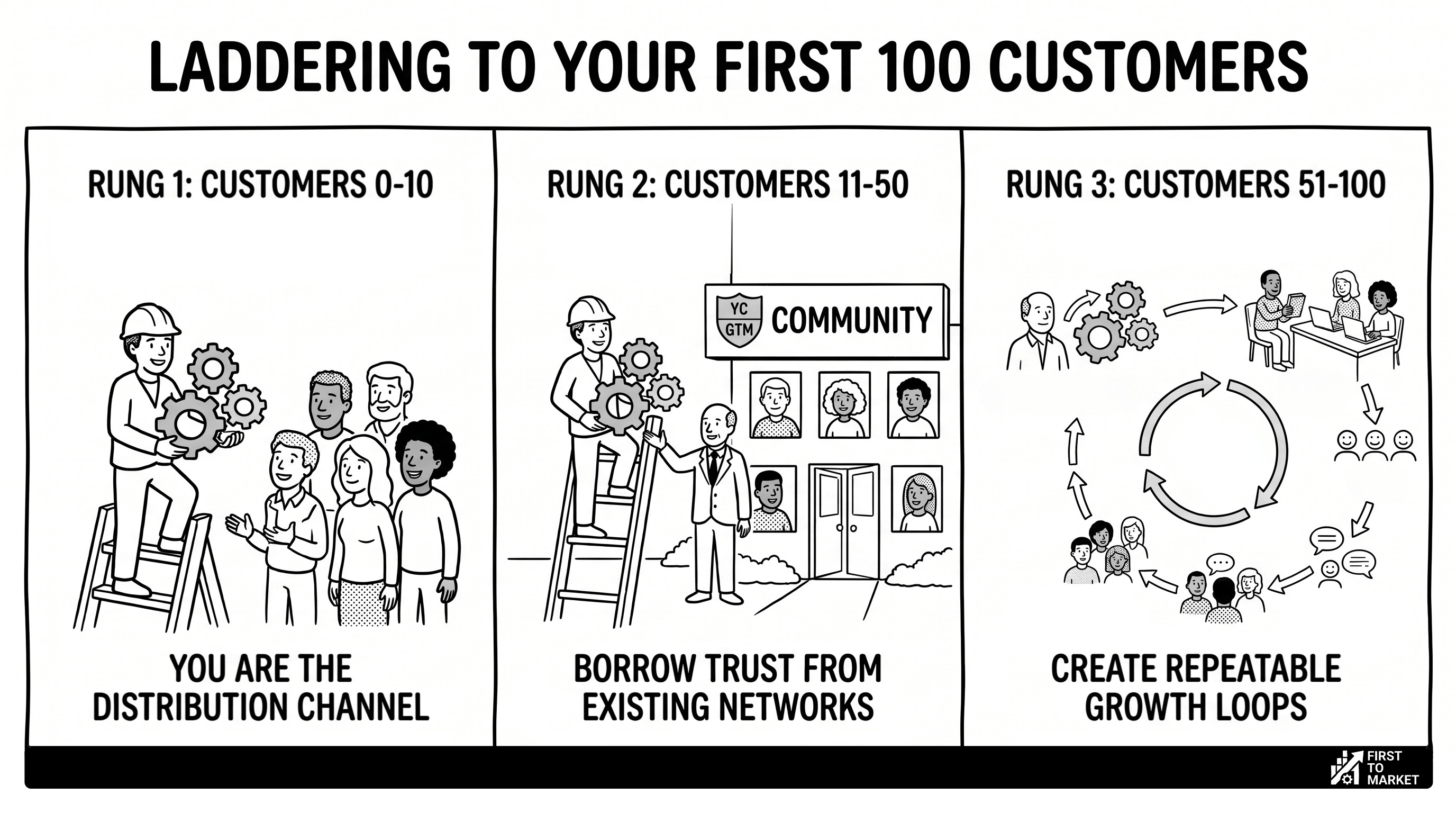
Rung 1: Customers 0-10
Your first customers don’t buy your product. They buy you.
These are people in your existing network who trust you or your reputation enough to try something unproven. They aren’t evaluating features against competitors. They’re doing a favor for a person they know.
Lightfield’s first 10 customers came from the founders’ personal networks.
Stripe recruited their first customers from other Y-Combinator counterparts.
On Rung 1, you are the distribution channel. That’s not scalable and not PMF, but that’s okay. The goal is getting people using your product so you can learn what to fix before the next rung.
Test it: List 20 people in your extended network who (1) fit your ideal customer profile and (2) would take a call this week. If you can’t get to 20, lean on your closest relationships to borrow their credibility and expand the list.
Lesson: You’ll find your first 10 customers because they trust you. Keep that trust by listening to their suggestions and helping them feel invested in the company so they stay customers long enough to learn from them.
Common misstep: Don’t spend money to acquire your first 10 customers. If the people who already know you won’t use the product, strangers probably won’t either.
Rung 2: Customers 11-50
You still don’t have brand awareness, case studies or inbound demand at this point. You’ll likely need to borrow credibility from an institution, community or network that your prospects already belong to.
Lightfield’s next batch of customers came from 1:1 outreach to other YC companies. Stripe’s initial adoption followed the same path. When a fellow YC founder asks you to try something, there’s built-in pressure to say yes.
Product Hunt launched as a daily email. The founders spent the first hour each day contacting the product owners who appeared in it, recruiting them into discussions about their own products. Those product owners shared the discussions with their audiences, which brought new people and products to the site.
Clay’s cofounder joined GTM groups. When people said something intelligent on a related topic, he would start a conversation with them. Whenever anyone mentioned challenges in Clay’s sweet spot, he’d give thoughtful and complete answers to their question. This also created an opportunity to learn how prospects talked about the problem, which shaped how Clay positioned itself.
Existing communities were our primary growth driver in the early days at Recurrent. Passionate EV owners don’t announce themselves, but they congregate in specific and predictable places. Being part of their groups gave us the temporary credibility we needed for them to try us.
The specific community varies. Startup groups, industry Slack channels, conference circuits. Find where your ideal customers already trust each other and show up there.
Test it: Name 5 communities where your ideal customers already congregate. Join the top 2 where people are actively asking questions about problems you can solve. Spend 30 minutes a day for two weeks answering those questions without pitching.
Lesson: You’re trying to embed yourself (rather than your company) in existing networks where trust already exists at this stage.
Common misstep: Don’t invest in your own community yet. You don’t have the center of gravity for it.
Rung 3: Customers 51-100
Your network and community growth motions reach diminishing returns at some point.
For mature categories with educated buyers, this is where paid acquisition takes over. For emerging categories, that’s rarely an option. We couldn’t generate scalable returns from advertising for the first 3 years at Recurrent.
The alternative is a repeatable growth loop that creates value for prospects before they ever evaluate your product.
Lightfield’s version is one of my favorites. They hosted readings at their office from prominent authors on GTM. The authors agreed because each attendee got a copy of the book, courtesy of Lightfield. Everybody won:
The events attracted founders who cared about the topic.
Lightfield got a room full of ideal prospects in a relaxed setting.
The authors sold a bunch of books.
Lightfield has run at least 3 of these events and plans to hire a dedicated person to increase the frequency. They treat it as a pure GTM investment because roughly 25% of event attendees sign up for a Lightfield trial within the first month.
That’s a lot different than spraying banner ads and cold emails. Those customers came from delivering genuine value through proximity. When you’ve assembled a room full of your ICP, some of them will want to know what you do. That’s a repeatable loop that doesn’t rely on founder sales.
Tinder built a different loop on the same principle. They worked with sororities at multiple universities to throw exclusive parties where admission required downloading the app. If women joined, men would follow. The value was the party and the product was the ticket.
Airbnb built theirs on the supply side. They sent professional photographers to the apartments of early host signups to improve listing quality. It helped the host get their first bookings, and it also created a this-is-legit moment that locked in supply while attracting more demand.
The common thread is that each company found a way to make their product the natural next step after an experience the prospect already valued.
Test it: Start by documenting what your first 50 customers value most about working with you. How could you deliver a version of that value to prospects who don’t know you yet? Those answers are the start of a potential growth loop.
Lesson: Repeatable growth loops are the bridge between scrappy founder-led sales and scaled growth. They work because they lead with value rather than a pitch.
Common misstep: Don’t default to traditional paid acquisition channels because the creative alternatives feel too small.
Climbing Your Ladder
“Build a funnel” is the right advice for Customer #800. It’s the wrong advice for Customer #8.
Think about early customer acquisition in stages rather than getting your first X customers.
“How do I get my first 100 customers?” ❌
“Which rung am I focused on right now?” ✅
Lightfield’s team understood this. They didn’t try to run a Series B growth playbook with their product launch. They climbed the ladder one rung at a time and matched their tactics to their stage.
Your ladder is waiting. Figure out which rung you’re on and commit to the work that rung demands. The next rung reveals itself when you’re ready.