


Welcome Jamal, Jennifer, Marc, Eric, Tom and the others who subscribed this week. This is a free newsletter for people building companies in new categories. Please support me by forwarding it to someone else who would find it helpful. They can subscribe here.
I got a number of questions after the AEO piece a couple weeks ago. Most were some version of: “Nobody understands or cares about what I’m building yet so how do I get coverage and media mentions?”
Early-stage teams often overlook their own milestone moments as opportunities. Since most of us aren’t announcing $1B valuations, why would a reporter at TechCrunch care to cover us?
TechCrunch probably doesn’t want to cover it, so you’re not wrong, but it misses the point: national bylines and Sunday editions don’t need to be the goal. Our product launch has to compete with people’s kids, their quarterly targets and whatever other international catastrophe happened that day. It’s going to lose, and that’s okay.
The goal for startups in new categories is establishing a simple narrative: what prospects, customers and investors believe about your category and your place in it.
The press is simply one part of that narrative distribution, and we’re fortunate it still covers these moments at all. Even when the startup where I’m head of marketing (Recurrent) was too small to mean anything to anyone, our early funding rounds were covered by Axios, TechCrunch, Business Insider and Forbes. (A TechCrunch reporter even shared why it writes so many funding stories: “If you want to chat with a CEO on the record for half an hour, the next time their startup raises is probably your best chance.”)
This is all top-of-mind for me right now. At Recurrent, we’re launching our first paid consumer product. It needs different messaging than anything we’ve done before, and the launch is a chance to reset how the market sees us and how all of our products work together.
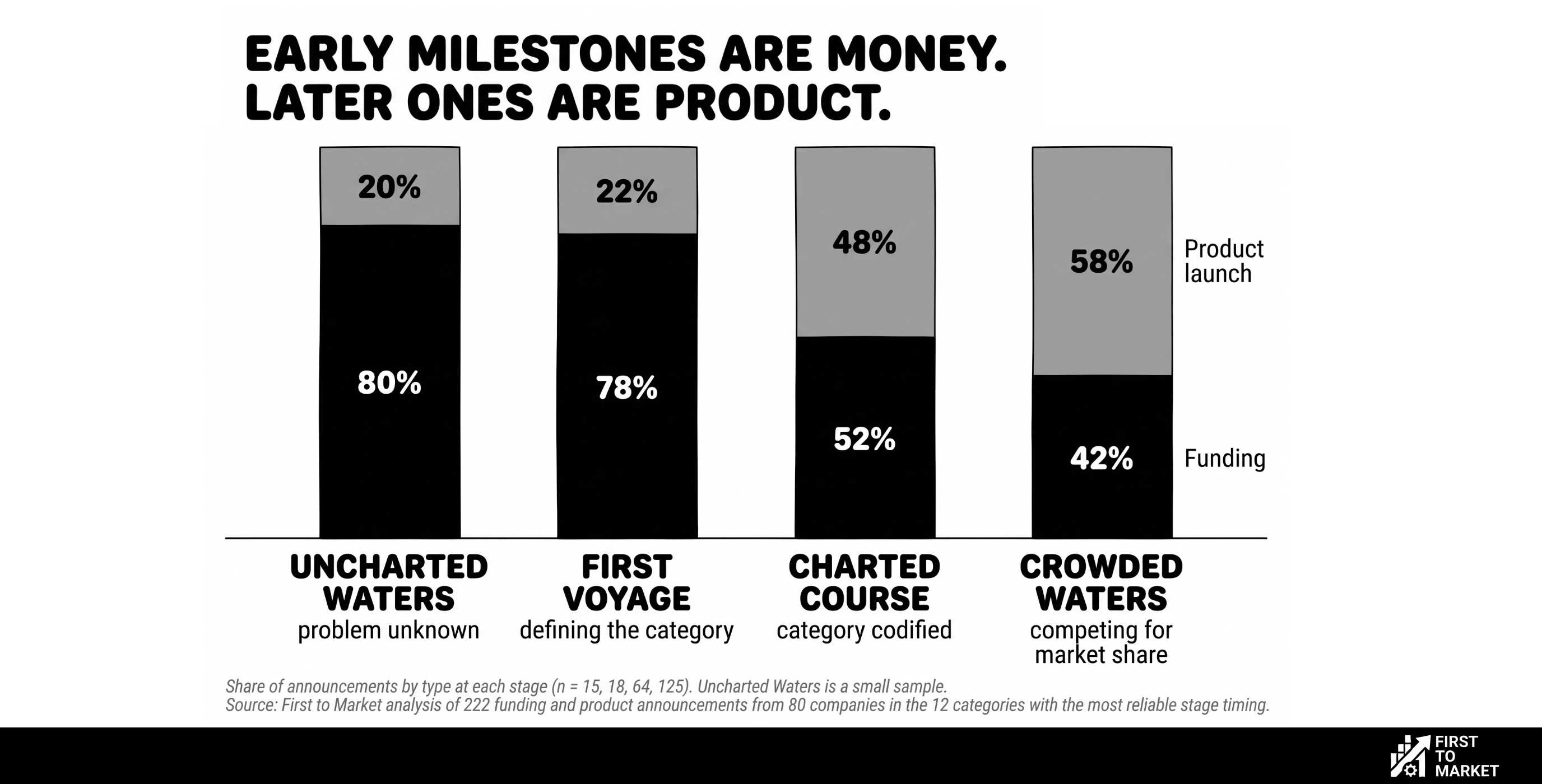
This week I looked at how other category leaders use these moments by auditing 700+ press releases (thanks, Claude), coding 388 funding and launch announcements from 133 companies in the category database against 13 signals, then mapping each one to its category’s Four Waters stage at the time it went out.
Yes, it was a lot. But the lessons and insights are 100% worth the effort. Here’s what I learned and you should borrow.
1. Start with the narrative.
Roughly two thirds of the announcements (63%) named a category or intentionally talked about the bad/busted status quo.
The marketing team at Profound told me they treat every funding announcement as the best opportunity to evolve the company narrative. Dozens of AI startups announce funding every week so it is noisy and crowded. Profound chooses the story it wants stakeholders to remember and builds the messaging around what they plan to do with the money.
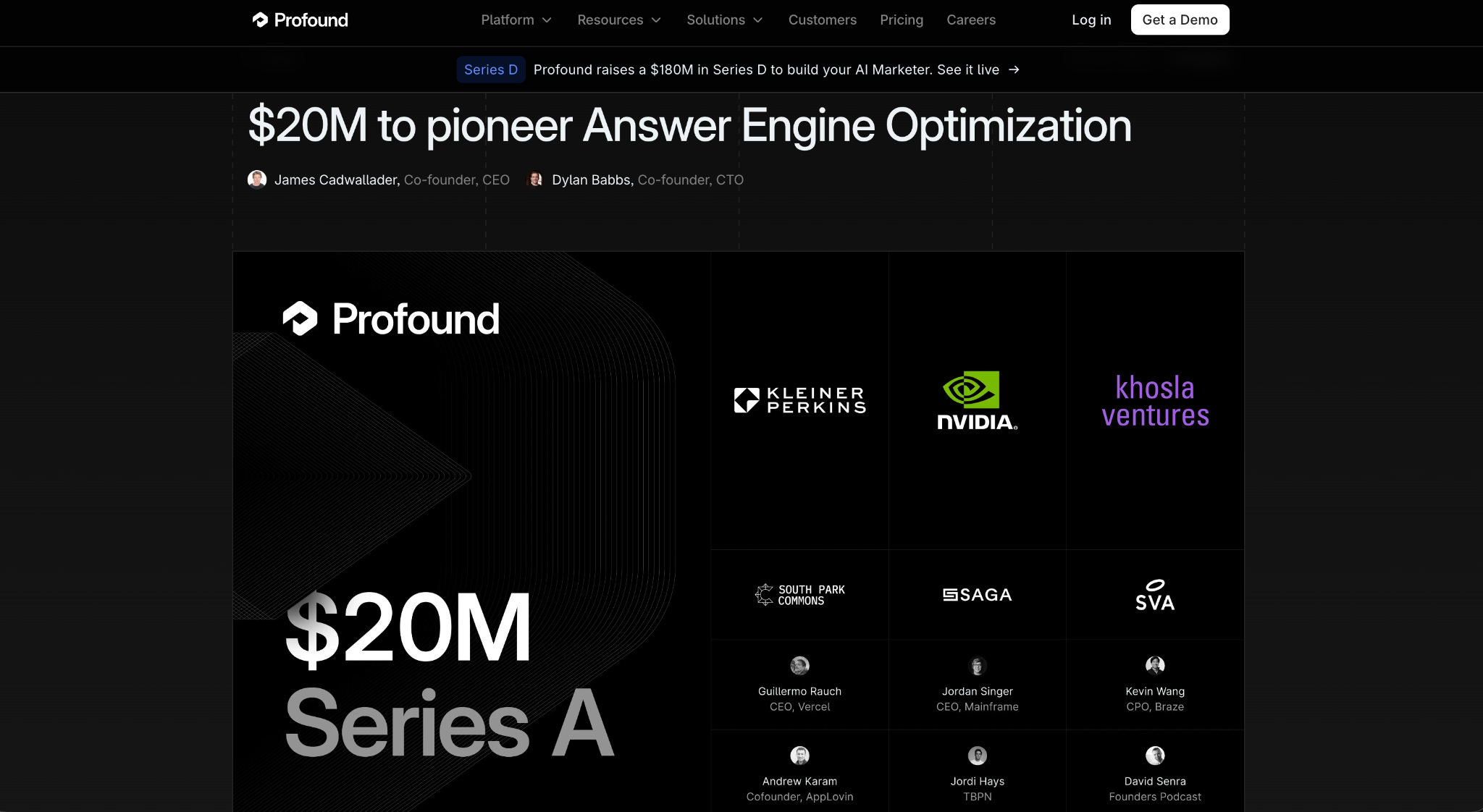
You can see it in three of the Profound funding rounds:
Series A set the category by raising “$20M to pioneer Answer Engine Optimization.”
Series C adapted the category “to build the marketing platform for the AI era.”
Series D (announced last week) raised $180M “to build the AI platform for marketing teams.”
Brendan Hufford, who writes Growing Up, a newsletter with deep dives into how top companies get customers, told me that he read the latest announcement as a category repositioning: “Series D repositioned them from an AEO tool to a larger AI marketing tool, largely placing them against how we’re all using Claude right now.” (That’s good company to keep.)
Test it: If you’re planning to announce a funding round, cover up the dollar amount in your release draft to make sure the positioning and category statements can stand on their own without a big number propping them up.
Common misstep: Don’t focus on the past. The big number and investor names will be forgotten in a week. But your stakeholders will remember your description of what the future looks like.
2. Tie the category to the broader market.
More than a third (38%) of announcements addressed the essential “Why now?” question by connecting their news to the broader market trends and stories.
Gorgias focused on ecommerce customers during its pandemic-era Series B.
Tealium aligned its Series F with GDPR.
Reevo tied a raise to the trending complaints about tool sprawl, even designating a “Why Now” section.
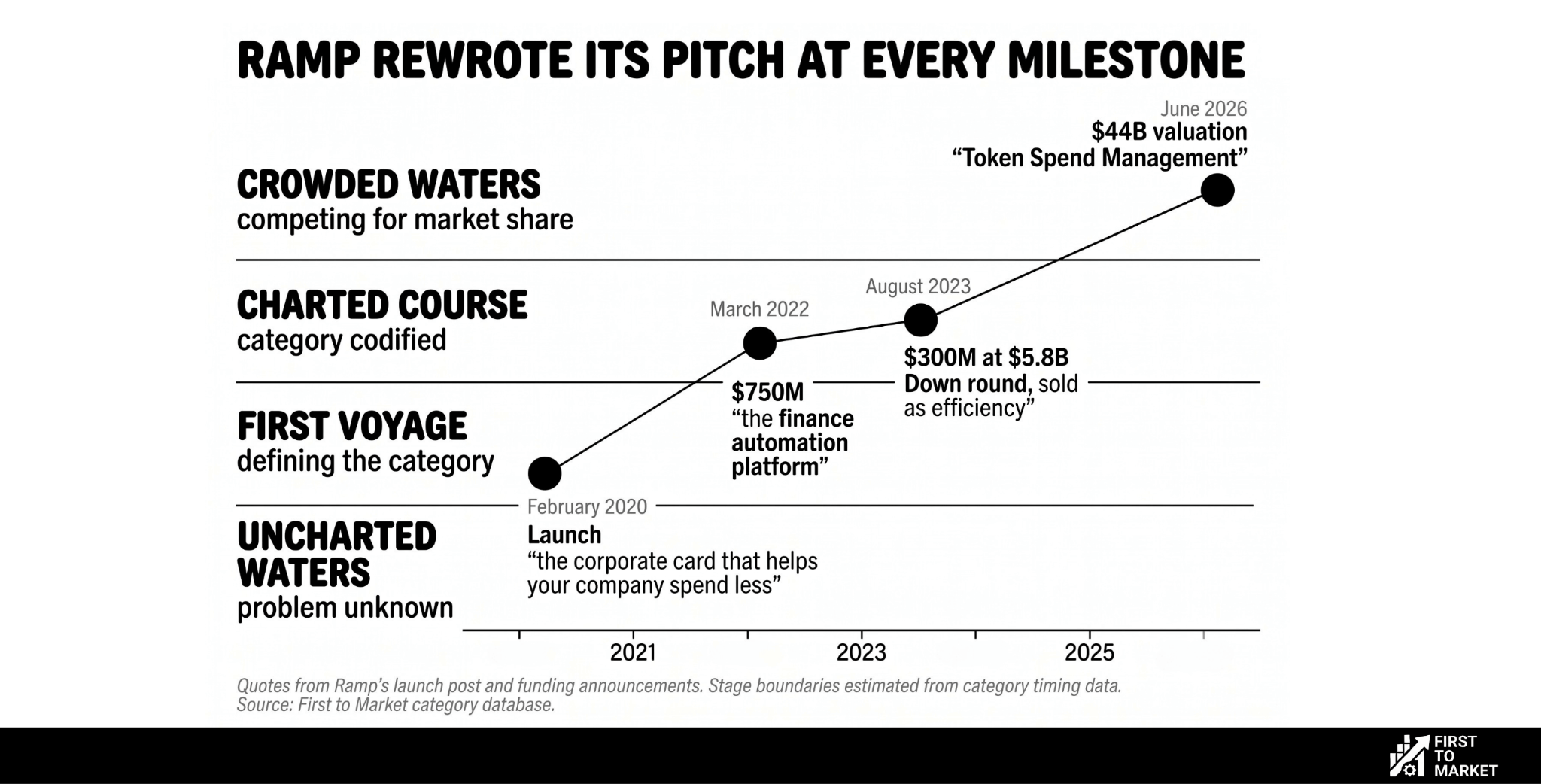
Ramp turned its down round into a recession-era efficiency story and its recent raise into the creation of a “Token Spend Management” subcategory. Brendan also happened to do an exhaustive recap on Ramp this week (and it’s worth your time).
Test it: What are your stakeholders thinking about this month? Imagine the tabs open in their browser that still don’t have an answer. Those can help with your “Why now?” connection.
Common misstep: Don’t chase the trend (called “newsjacking”) just because it’s in the news. Tealium included GDPR because it was in the news AND also a top-of-mind threat to its customers and prospects.
3. Let someone else make the claim.
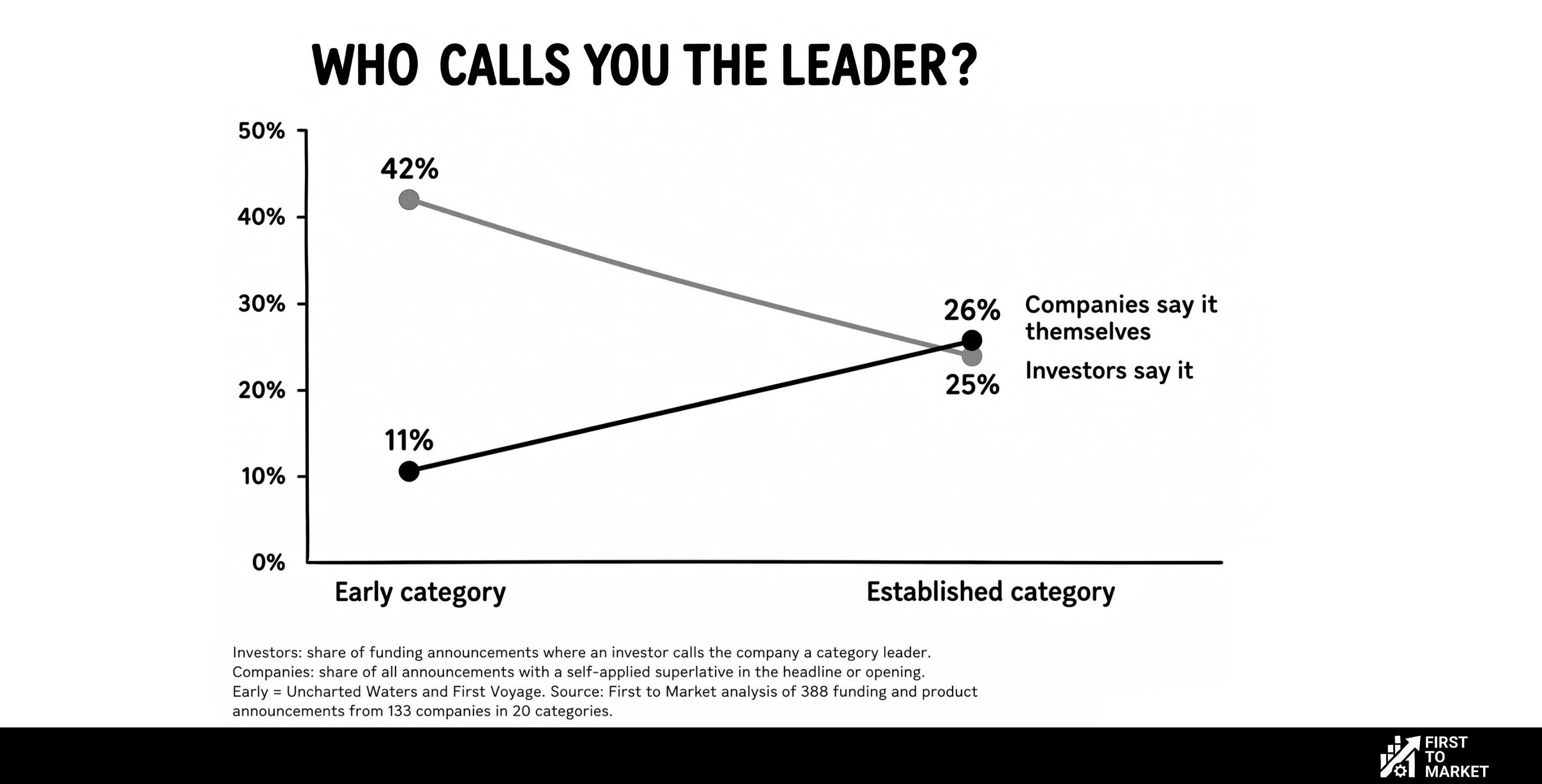
Early in a category taking shape, you can’t crown yourself the “Category Leader.” Investors made the claim for startups in 42% of funding announcements from early-stage categories (Uncharted Waters + First Voyage). In later stages, it dropped to 25%.
HubSpot used a Sequoia investor to call it “the emerging category leader in the SaaS marketing sector.”
PolyAI used Khosla Ventures to call it “a category creator for AI-powered, voice-based customer support.”
Lightfield used a16z to say “Salesforce defined it for the cloud era, and Lightfield is defining it for the agent era.”
As the category matures, companies have the data to make the claim themselves. Superlative claims in the headline or opening paragraph roughly double from 11% of early-category announcements to more than 20% in later stages.
But those claims are harder to believe coming from the company. As Luca Fancello told me for the AEO piece: “an AI discounts you calling yourself the best.” People do, too.
Test it: Who outside your company could loan their credibility to make your leadership claim for you at your next milestone? (I’ve even used customers and new executive hires.)
Common misstep: Don’t think of the announcement as a one-to-many broadcast. The Profound marketing team told me that it gives employees, customers and the rest of its community a heads-up and a reminder the morning it goes out. We aren’t making the announcement alone.
4. Count other people’s decisions.
Every milestone can be proof that a stakeholder with options chose you: investors, employees, customers, partners. All of them can be proof points. 78% of funding announcements stacked two or more proof points, compared with 44% of product launches.
Unify announced its Series B after "growing revenue 8x" and adding Cursor, Perplexity and others as customers.
Agility Robotics launched a product with “more than $300 million in multi-year customer orders.”
Pipedrive launched a product with early traction from “over 70,000 customers.”
Firecrawl used “more than 350,000 developers already signed up.”
Qualified cited “$200M in generated pipeline, 9,000+ meetings booked, and $6.8M in cost savings.”
Test it: What quantified examples of other people choosing you can you say publicly?
Common misstep: Don’t say “fastest growing” (or similar) without proof. More than half of the product launches audited did not stack multiple proof points. If you don’t have them, maybe “fastest growing” shouldn’t be your angle.
5. Stack the moment.
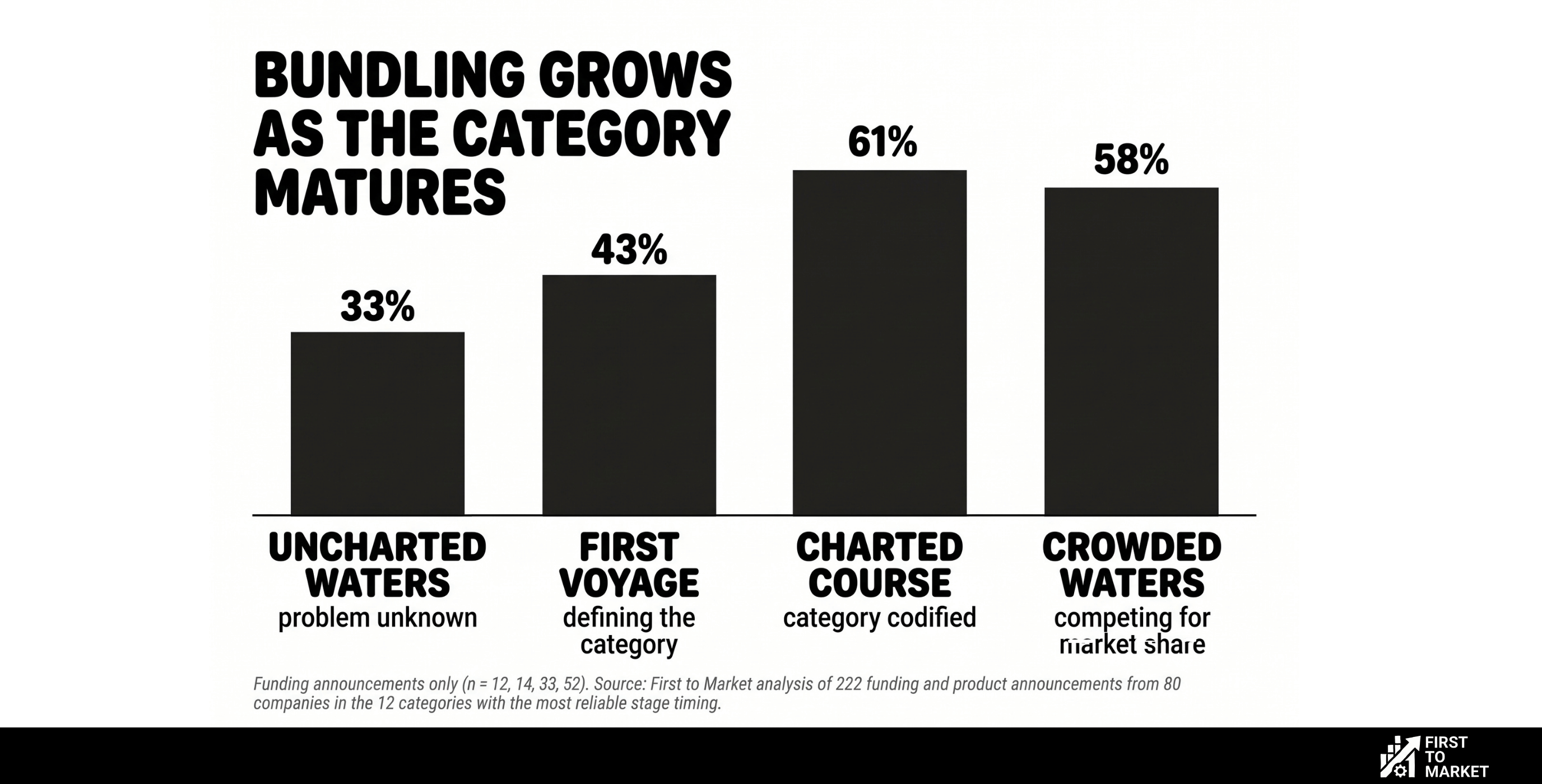
Once a category reached Charted Course, about half of funding announcements packaged the round with a launch, customer, partner or hire. In younger categories, it was about a third.
Ramp paired a raise with product launches around bill pay and travel.
Clarify paired its first acquisition with an exclusive waitlist for a new product.
Outreach paired a raise with three new products.
Profound paired a raise with a new agentic product.
Test it: Look at your roadmap for the next quarter. What other milestones could be paired with your next announcement?
Common misstep: Trying to be everything to everyone everywhere. The Profound marketing team told me it picks one social platform to win and designs all creative for that. Then it points everything back to the one post with a single call to action.
More Than a Day of Coverage
It’s easy to think of these announcements like a ticket on a kanban board: new → in progress → closed. But the finish line isn’t a published press release. We are trying to establish our narrative in the minds of stakeholders (prospects, customers, employees, investors, an LLM). It’s one part of our approach to saying something enough times, in enough different ways, that people we care about start to say it back.
Only 18% of the releases audited (1) named the category, (2) let someone else vouch for the company, and (3) backed it up with proof points. Those are the companies using a milestone moment to make a claim on the category, and we can learn from them.
Lastly, a huge thanks to the team at Profound. I gave them an impossible deadline and they gave me some great insights to share with you all.
From the Workbench this Week
I mentioned earlier that Recurrent launched a new product recently. It gave us a reason to update how we describe the company, its products and where we add value to customers. It’s still a complex offering for such a small startup, meaning different things to different people, but I love this part of the learning phase.
Ad tests are running.
Value props are collecting feedback.
Creators are activated.
Valuable product data is streaming in.
Since this product is on the consumer side of the business, there are also more public signals available, like one of the many Reddit threads that have popped up this week.

The startup life is hard, and sometimes very unpleasant. But it definitely has its rewards. I hope you’re seeing the upside and affirmation once in a while, too.
Have a beautiful week.