


People get awkward talking about their biggest competitor. It’s especially true with startups competing against an incumbent.
We don’t acknowledge their size because it’d make us look small.
We don’t accept their feature breadth because it’d make us look behind.
We don’t admit to their market dominance because it’d make us look weak.
Instead, we often try to position away from the Goliath to compete on a feature, an unbundled price, or some other angle they won’t match. The logic seems sound: If we don’t talk about them, people won’t think about them.
But buyers are already thinking about the incumbent.
The category leader is the default choice. Pretending they don’t exist doesn’t eliminate the comparison, it just makes us (and our products) harder to understand.
Supabase could have positioned themselves as “a modern backend platform for developers” or something buzzwordy to avoid a comparison to the industry standard, Firebase by Google.
Supabase did the opposite.
The top of their homepage positioned the company as an “open source Firebase alternative” from 2021 through 2025 (after reaching a $5 billion valuation).
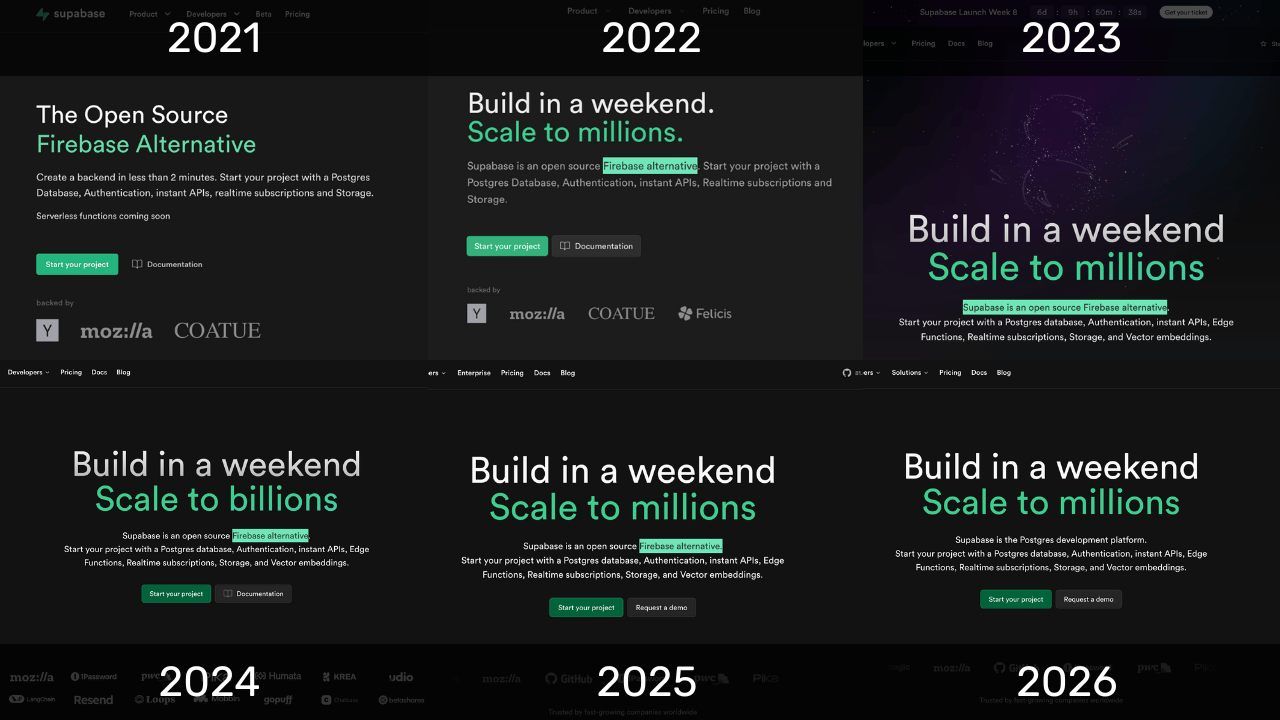
Note: Supabase started to adapt its positioning away from Firebase in the last 6 months — visible in the 2026 home page. In this interview, the CEO talks about how they are now serving more customers outside of their traditional ICP, including vibe coders (down-market) and enterprise businesses (up-market).
If you’re competing against an entrenched incumbent and burning through budget trying to differentiate away from them, here’s a lesson in alternative positioning by Supabase that you should consider.
The Alternative Positioning Framework
Here’s the framework that I’ve derived from Supabase and a handful of other modern brands that have pulled this off.
Step 1: Name the Giant
When Supabase says “Open Source Firebase Alternative,” they immediately answer key questions for their developer audience:
What is your product? It’s a backend-as-a-service like Firebase.
Who are you compared to? Firebase, the industry standard.
Why are you different? It’s open source and dev friendly.
The thing I noticed most is that they fully committed.
Homepage headline
Product comparison pages
Documentation on migrating from Firebase
Hundreds of pages across all parts of their site help prospects draw Supabase-friendly comparisons against Firebase.
Why it works: Naming the giant shows confidence. It says “yes, we know they exist, and we still think you should choose us for these specific reasons.”
Takeaway: Explicitly naming the incumbent eliminates confusion and some key buyer questions.
Step 2: Claim the Wedge
Supabase focused on something that mattered A LOT to a disgruntled (and outspoken) portion of Firebase’s customers: ownership + control.
They weren’t trying to lure Firebase’s entire customer base. They simply scratched at an existing itch and gave a specific segment permission to choose them.
If you’re a developer that values ownership and SQL, which isn’t offered by the incumbent, you at least consider Supabase.
Why it works: Supabase found something that was tangible, defensible and mattered a lot to a small (but material) segment of Firebase’s audience.
Lesson: The wedge can’t be a nice-to-have feature. A good wedge needs to fuel a fire that’s already burning.
Step 3: Prove the Difference
Supabase found a good wedge. But lots of startups break down on the offramp of Open Source Alternative. (In other words, it’s not novel or durable by itself.)
Supabase embodied open source in every aspect of its company, culture and marketing. Here’s a quote from an investor who actually embedded himself in the company for a period:
“From day one, Supabase was built on community trust,” said Aaron Cort. “It grew into one of the most starred open-source projects on GitHub, scaling from early Hacker News buzz to powering millions of databases.”
Why it works: I’ve cited a memorable insight that your primary channel is the one that your customer business can’t live without. Github is like the town square of collaborative and open source development.
Lesson: Make the wedge tangible. Prospects should be able to verify claims independent of marketing messages.
Step 4: Lower Switching Costs
The switching costs for development tools can be enormous, and scale with project and team size. For marketers, think of it like migrating a CRM or analytics platform. Not only is it the direct inputs to migrate, but there’s time to ramp up on the new platform and risk of having to move back if it doesn’t work out.
Supabase put its energy into eliminating the binary choice: stay or go.
Developers were encouraged to start new projects on Supabase with generous free tiers rather than migrate existing work.
Support documentation outlined how to make partial migrations or run Supabase and Firebase in parallel.
It also activated its community to develop creative solutions and reduce the fear of the unknown.
Why it works: I’ve built on Supabase and, although not in their original ICP, the onboarding process felt like a low-cost experiment with quick time-to-value rather than a mundane platform migration.
Lesson: Status Quo Bias reminds us that it’s always easier to do nothing. Any friction in the form of time, irritation or risk only compounds the cost to switch.
Can You Use the Alternative Positioning Playbook?
Here are several tests to see if this is right for you and your business.
Question 1: Who’s the dominant incumbent?
If it takes your brain more than a fraction of a second to answer this, we’ll need to dig a bit deeper.
Alternative positioning works best when there’s a single default choice that your buyers already know.
Fragmented markets with lots of feature overlap and complicated consideration criteria are not a fit here. An example of that is marketing automation.

There are too many leaders in this space, all serving their own niche and bumping into each other. If you can’t name one dominant incumbent, the market is either too fragmented or you’re developing a new category.
Question 2: What’s your wedge?
Complete this sentence: “We’re like [incumbent] but [meaningful difference].”
Then ask:
How is the difference tangible to prospects?
Does it solve a meaningful pain for a specific (targetable) segment?
How easy is it to defend from the incumbent?
The common answers are “faster” or “cheaper” or “easier.” Be objective here. Is that a really, REALLY meaningful difference to your customers?
Remember, you could be biased here. It’s always good to have someone check your work.
Question 3: Can you prove your wedge?
Ideally, you’ll become the wedge, like Supabase. Figure out now how you’ll embed this concept in your DNA so it is obvious with every stakeholder interaction.
It needs to be visible everywhere.
Comparisons
Technical documentation
Benchmarks and testing
Testimonials and case studies
Feature highlights
Pricing strategies
A skeptical prospect should be able to verify your wedge on their own.
Question 4: What’s blocking switches?
List every friction point that prevents a satisfied incumbent customer from trying you. Stakeholder approval, team training, migration downtime, etc.
How can you attack each one to reduce or eliminate it?
Supabase reduced migration lift with tooling and documentation. They reduced risk by encouraging their ICP to start small with free access.
Alternative positioning is less effective when switching costs are too daunting.
The Takeaway
By positioning as the alternative, you’re you are making a conscious tradeoff to be tied to the incumbent’s narrative (for better or worse).
You boom when they boom.
You stumble when they stumble.
If they pivot, you’ll have to adapt, too.
But in exchange, you inherit a lot of their shortcuts, including a reduced customer acquisition cost (CAC). You get to redirect existing demand that already understands the problem and has a budget allocated.
Supabase didn’t have to convince developers that backend-as-a-service was valuable. Firebase already did that work.
Supabase just had to convince a specific segment of developers that open source + SQL was worth the switch.
That’s how you compete against billion-dollar incumbents without a billion-dollar budget.
The question is: Does your market structure support this approach? And if it does, are you willing to tie your positioning to the incumbent’s narrative?
If the answer is yes to both, you may have found your clearest path to reducing CAC and accelerating growth.
I'm someone who first became aware of and started using supabase a couple years ago, I think that wedge, as you outline it, definitely worked on me. I think the very virtue of being an alternative to firebase piqued my curiosity. I had used firebase enough that it became a known known whereas supabase's positioning made it a known unknown that piqued my curiosity. The clincher was also that supabase made it super easy to switch and the thought of not having to mess with firebase/google IAM was super appealing. Great writeup!