


Welcome back! One quick thing before we get into this week’s topic:
This newsletter is where I hand off the finished frameworks. But most of my week is messier than that, running marketing and growth at a VC-backed Series A startup.
Build vs buy mar-tech decisions
Weighing PR risks and rewards
The outbound template we use each week with ZERO personalization
I’ve started posting that stuff on LinkedIn. If you want the operating decisions in real time, connect with me on LinkedIn (and mention ‘First to Market’ so I know to accept).
I also set up a First to Market page so I can tag contributors and keep the archive in one place. Follow it if you want, but my profile is where I actually post.
Ok, enough housekeeping. Let’s get into the good stuff.
Cold outbound gets a bad rap, and most of it is deserved. Anyone with a senior-ish job title on LinkedIn can tell you that. Now that every seller in the world can be supercharged by AI for only $20/month, I get at least 2 dozen terrible cold emails per day.
But I’d argue that being great at engaging people who don’t know they need you yet is an essential skill for startups in new and emerging categories.
This week’s newsletter is about that.
In my years and years of managing campaigns, they often look broken right up until they work because the wrong expectations lead to measuring the wrong metrics.
Click rate says one thing.
Reply rate says another.
Open rate still doesn’t tell you anything.
So I asked three people who spend their days thinking about startup outbound strategy.
Brendan Short writes The Signal, a newsletter on GTM automation, with operator experience at Apollo.io, Zoom and Wiser.
Alon Even is a fractional CMO and writes Alon’s GTM Take, where he shares go-to-market systems that accelerate B2B pipeline.
Jasper Vanuytrecht is a GTM leader and writes Founder’s GTM, which shares Claude Code skills that founding teams use to win more clients without hiring.
Their answers overlapped more than they clashed so I adapted those conversations into a portable framework I’m thinking of as The Outbound Recognition Ladder.
Use it to spark ideas and inspire your own approach.
The Outbound Recognition Ladder
The tactic-du-jour for outbound right now is leading with a valuable insight and asking nothing in return. Brendan told me that’s his most common advice: “Give something that is genuinely valuable to your prospect. Even something they’d be willing to pay to receive.”
He’s right. It’s the best version of outbound. But it also assumes two things your buyer might not have yet:
the context to make sense of the insight
the belief that the problem is real and/or urgent
When the problem is genuinely new to them, they likely have neither.
This framework is built on the premise that recognition comes before intent. That means the first touch gets a smaller job: earn a click by naming a problem the person already feels.
Jasper tries to lead with a problem they already feel but haven’t put words to yet. “‘You’re probably still doing X by hand every week’ beats a clever category insight,” he told me.
Alon agrees: don’t lead with new category language yet. “Borrow the buyer’s current language: the workaround, broken workflow, manual process, or hidden cost they already recognize.” The job of the first touch “isn’t to sell the category, but to create problem recognition.”
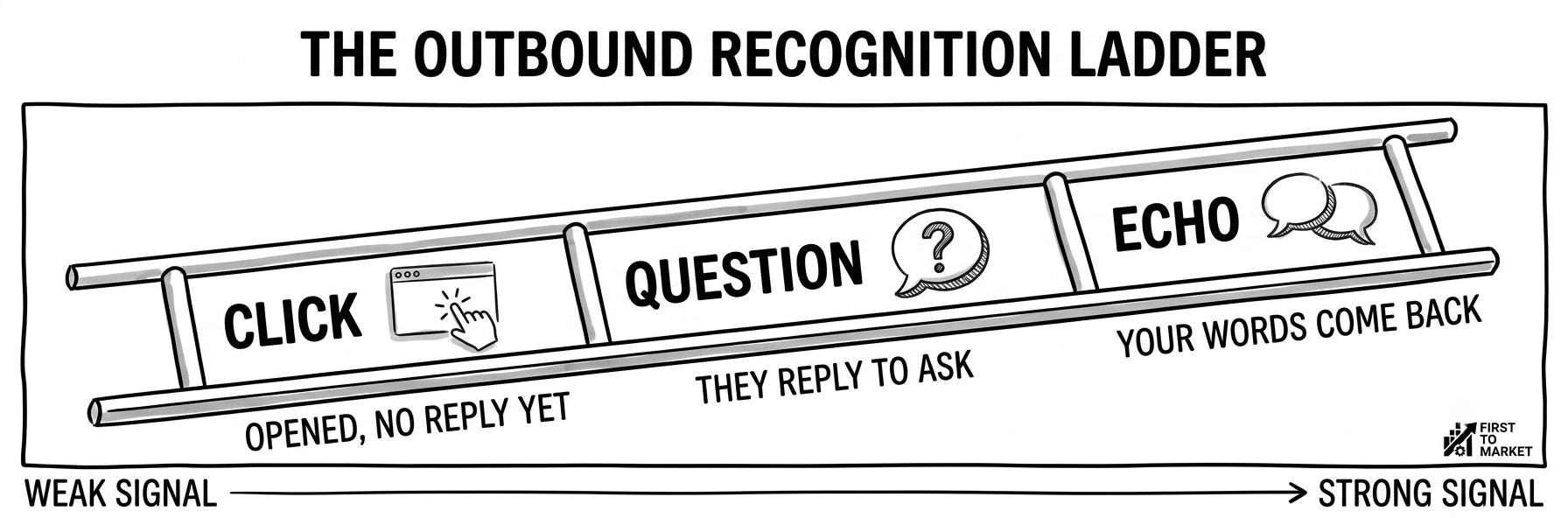
Rung 1: The Click
The first sign of recognition is not a “I’d like to learn more…” reply.
“Recognition shows up as a click before it shows up as words,” Jasper told me. Someone who opens the page you built is telling you the symptom landed, even if they don’t write back right away. Alon reminds us that we really just want to see “the right accounts engaging with the narrative.”
Test it: Direct people to a landing page that uses the same problem language from your outreach. Match the symptom you named (word for word) before introducing a product or category. The goal here is simply to teach and label a single problem that you are (eventually) positioned to help them solve.
Rung 2: The Question
The second rung is the start of a conversation. The click comes first. The question usually comes later, sometimes from a follow-up.
From Jasper: someone asking “wait, how would this even work?” can be worth more than a booked meeting because they’re processing a problem they hadn’t named an hour ago. Alon likes to see a short confirmation that says “yes, this is happening.” Same signal: the prospect is now inside the problem with you.
Test it: Count questions, not just meetings. Then answer each one by naming the problem in your language again, not by pitching. You’re feeding them the exact phrase you want to hear come back in Rung 3.
Rung 3: The Echo
The sign that the system is working is when your words are repeated.
“The early tell is not just reply rate. It’s whether your language starts coming back to you,” Alon told me. When prospects start “describing the problem in the language we introduced,” you have created demand that didn’t exist before the email thread.
This has been my lived experience as head of marketing at Recurrent. Electric cars were a small portion of the overall US auto market and the batteries were all new enough that it was easy for the industry to prioritize other pressing issues. It wasn’t until we helped them with the context and language that they were able to design business cases around how we could help them.
Test it: Pull recent replies and call transcripts. Highlight every place a prospect describes the problem in words you seeded. That count is your rung-three baseline, and you can measure it this week.
Revenue Is Still the Destination
None of this replaces sales this quarter. “Revenue is still the destination,” as Alon put it. The ladder is simply the leading indicator that tells you pipeline is coming before it arrives so you know you’re on the right path.
It also tells you when you’ve earned something bigger. As Jasper put it:
“The category is yours to teach later, once they’ve raised their hand.” By leading with the problem they feel, and letting your language come back to you, you’ll be the one in position to name the category. That’s part of the way to write the category into existence.
A big thanks to Brendan (The Signal), Alon (Alon’s GTM Take), and Jasper (Founder’s GTM). Subscribe to their newsletters. I promise that what they publish each week will make you better at this.
That’s all for this week. Hit reply with questions or ideas for future posts.
Thanks for including me here, Andrew. What stuck with me rereading this: recognition shows up as a click before it shows up as words. I see that constantly with founders who think a quiet inbox means the campaign failed, when the landing page data tells a different story entirely