


If you had a mobile phone in 2003, BYD probably made its battery.
Yes, that BYD.
BYD wasn’t a car company. They were the world’s second-largest rechargeable battery manufacturer. Their massive business was supplying batteries to Nokia, Motorola, Samsung, Dell, HP and many others.
That’s also the year they bought a failing car company, while still selling batteries to Toyota, Ford, and Volkswagen.
Today BYD sells more electric cars than anyone (including Tesla) all while supplying batteries to other companies (including Tesla).
This is more than an automotive story. It’s a playbook for how niche specialists beat established players when markets shift.
Here’s how they did it and why more companies should recognize when they’re sitting on this opportunity.
Recognizing the Category Moment
BYD’s customer list in the 1990s and 2000s was a who’s who of global electronics brands. But they were becoming commoditized.
Battery tech in consumer electronics was becoming standardized. As more manufacturers entered the market, margins compressed and the future would not be as promising as the past.
The niche specialization that had made BYD successful was becoming a commodity.
This is about the time that automobiles were becoming increasingly reliant on electronics. On top of that, major automakers were treating batteries exactly the way electronics companies had treated them in the 1990s: as a commodity component to be sourced and integrated.
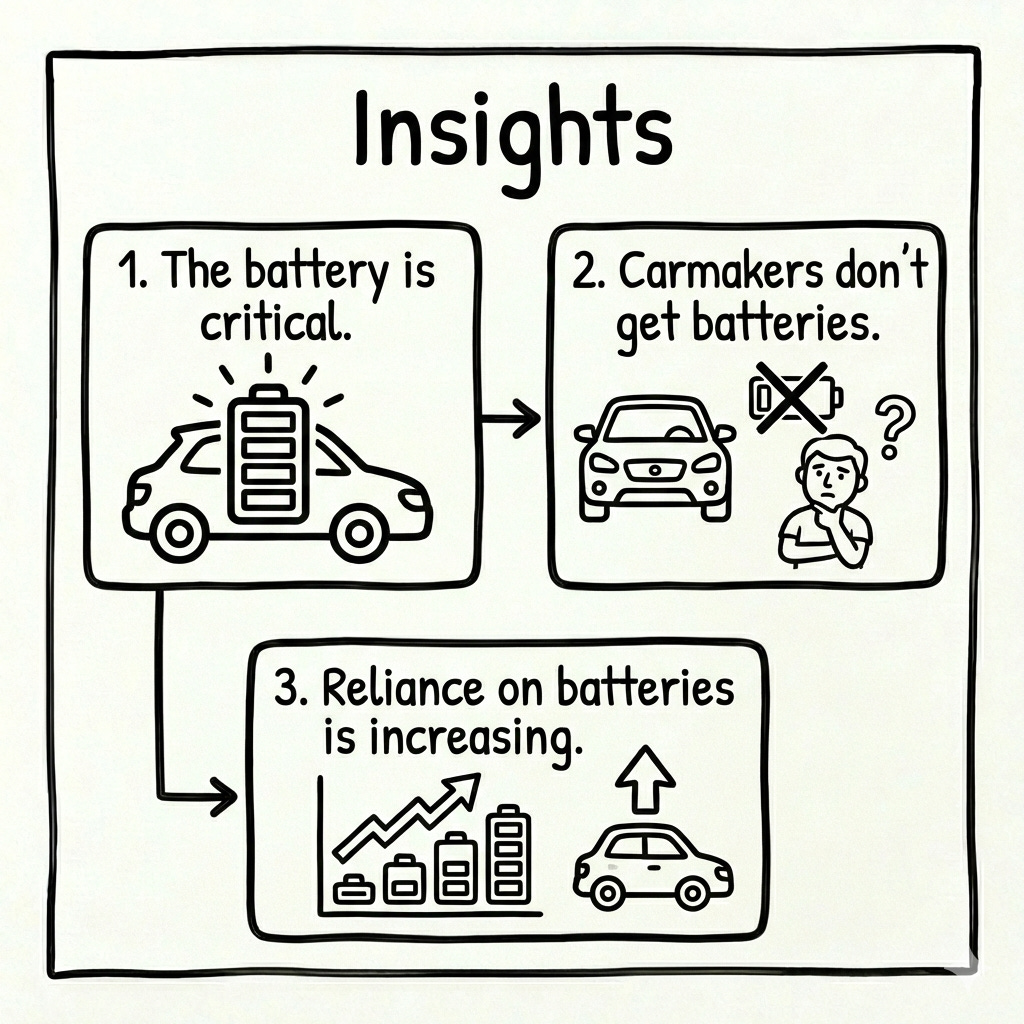
BYD saw three things their automotive customers didn’t:
The battery was a critical constraint.
Car companies understood engines, not batteries.
Reliance on batteries was increasing, and would only increase.
BYD saw a path for their ‘input’ to graduate to a strategic asset in a new category. As the ‘input’ experts, they could see downstream inefficiencies that others couldn’t see, and that gave them a competitive advantage.
How BYD Used Niche Expertise as a Wedge
Here are three trends from BYD followed by a framework that others can apply to their own businesses and industries.
1. Don’t Quit Your Day Job
In 2003, BYD expanded their manufacturing by acquiring a struggling automaker. They kept the BYD name and continued supplying batteries to other carmakers, operating two distinct business units:
Supplying batteries to electronics and automotive companies
Building vehicles using the same battery technology
That’s compelling because BYD had the opportunity to double-down or pivot, and they chose both.
B2B revenue funded B2C development.
Supplier relationships contributed to market intelligence.
Optionality remained open.
This isn’t a totally novel approach. We’ve seen a few other modern brands do this balancing act.
Amazon hosts Netflix and Spotify (B2B) that compete with Prime Video and Music services (B2C).
Twilio maintains their API business after acquiring a (competitive) customer data platform.
Stripe processes payments for competitors after launching point-of-sale hardware.
It’s possible to run parallel paths without a hard pivot. Sometimes (highly consistent) B2B revenue can even be used to develop (highly variable) B2C products without forcing customers to choose.
2. Place Unfair Bets
Traditional automotive companies were designing vehicles first, then sourcing batteries to meet the specs. Basically: “Go find a battery that fits this design.”
BYD flipped this process. They designed vehicles around battery constraints.
To avoid nerding out too much on battery chemistries and architectures here, I’ll simply say that BYD used their experience to bet on a cheaper, lower density battery that other OEMs viewed as inferior.
Most challenger brands benchmark against the industry incumbents. They look at what competitors are doing and try to match features or shave prices.
BYD used deep component knowledge to empower design choices that customers (a.k.a. other automakers) couldn’t envision.
3. Bring the Market with You
BYD’s batteries included innovation that made them objectively better in some ways. But they needed to get the rest of the industry to understand that.
In addition to investing in market education with dramatic demonstrations, they immediately sold the batteries to competitors to reorient the industry around their solution. Now dozens of carmakers (including Tesla, Toyota and Ford) use BYD batteries in their vehicles.
It only worked because BYD maintained both businesses. If BYD had cut off battery supply to focus exclusively on vehicles, they would have:
Lost steady revenue streams
Eliminated ongoing market intelligence
Given up the validation signal to the market
Forced an unnecessary either/or choice
Your Playbook: From Supplier to Category Leader
Here’s the 4-step framework that I’ve derived from BYD and other case studies to get you from Supplier to Category Leader.
Step 1: Evaluate Your Wedge Opportunity
An effective wedge is all about timing and market conditions. Let’s start by validating that you have the right conditions.
Tactics:
Develop a simple thesis of the future that outlines how the market will shift in your favor. Then share it internally and externally to validate or adjust it.
Map how customers currently integrate with you and where inefficiencies exist.
Document the essential expertise that you have and customers lack.
Key Decisions:
What is the timeline for your expected future (thesis from above) to become reality?
What external factors would accelerate or decelerate that timeline?
Will your current revenue fund new development without new capital?
Step 2: Dual-Track Your Operation
It’s time to add a business line while maintaining the existing component sales.
Tactics:
Launch as the experiment that it is. This is not a press release moment.
Take steps to protect and respect your customers with separate teams and limits to data sharing.
Test and update the market thesis that you created in Step 1.
Key Decisions:
What steps will you take to maintain current customer relationships?
What is your communication plan for each stakeholder group?
Step 3: Build Compounding Advantages
Design your product and economics around integration strengths that others can’t replicate.
Tactics:
Identify 3 dimensions that incumbents compete on, then 3 different dimensions where your expertise creates advantages.
Design products to win decisively on YOUR dimensions, while accepting being “worse” on theirs.
You’re likely increasing scale so look for quite volume-based advantages.
Key Decisions:
What dimensions will you own vs. deliberately concede?
Where do opportunities exist to vertically integrate?
Step 4: Establish Category Leadership
Evolve the category around your integrated strengths by bringing the market with you.
Tactics:
Reframe the category conversation around your strengths.
Position your approach as an industry evolution toward integrated solutions, not a competitive attack.
Use your dual business model as proof of expertise and leadership.
Key Decisions:
What metrics should define your leadership in the new category framing?
How can it be positioned as a natural evolution vs. competitive disruption?
How will you bring existing customers and partners along as the category shifts?
Don’t Miss Your Wedge Moment
This isn’t a new story. Lots of companies have found themselves in a component business that showed uncomfortable signs of commoditization. The question probably isn’t whether you’ll face this moment at some point, it’s whether you’ll recognize it when it arrives.
BYD saw that automotive was shifting from gas to electric. As the future unfolded, their battery expertise would increasingly become a strategic constraint in that world.
Look at what you know deeply that your customers will/do treat as a commodity. That’s your wedge.
The question is whether you’ll use it.