


Tesla collected more than a million Cybertruck reservations before it built a single truck. When it finally shipped, conversion rate was in the low single digits for a tiny fraction of expected sales.
The waitlist did exactly what a waitlist does. It measured curiosity.
For Tesla, the refundable $100 deposit was only 0.1% of the price tag, which ended up nearly 2x over the original estimate. Tesla and auto analysts both confused that waitlist for demand.
But waitlists aren’t the problem.
We’ve used them at Recurrent to launch the company and accelerate cold starts for several new products, and I still recommend them to many of the startups I advise.
Linear turned a 10,000-person waitlist into a filter.
Robinhood turned one into a competition.
Superhuman turned one into a badge of exclusivity.
Using one successfully comes down to what you make people do to get on it and what you do with them while they wait.
Since most teams do neither, here is a new way to think about it so you don’t make their mistakes.
The Waitlist Matrix
A waitlist has two key variables:
What it costs someone to get on. All of them cost something: an email address, refundable deposit, intro call, referral.
What you do for people once they’re waiting. You can let them sit while you work or you can work the list while they sit.
Plot the two and you get four kinds of waitlists.
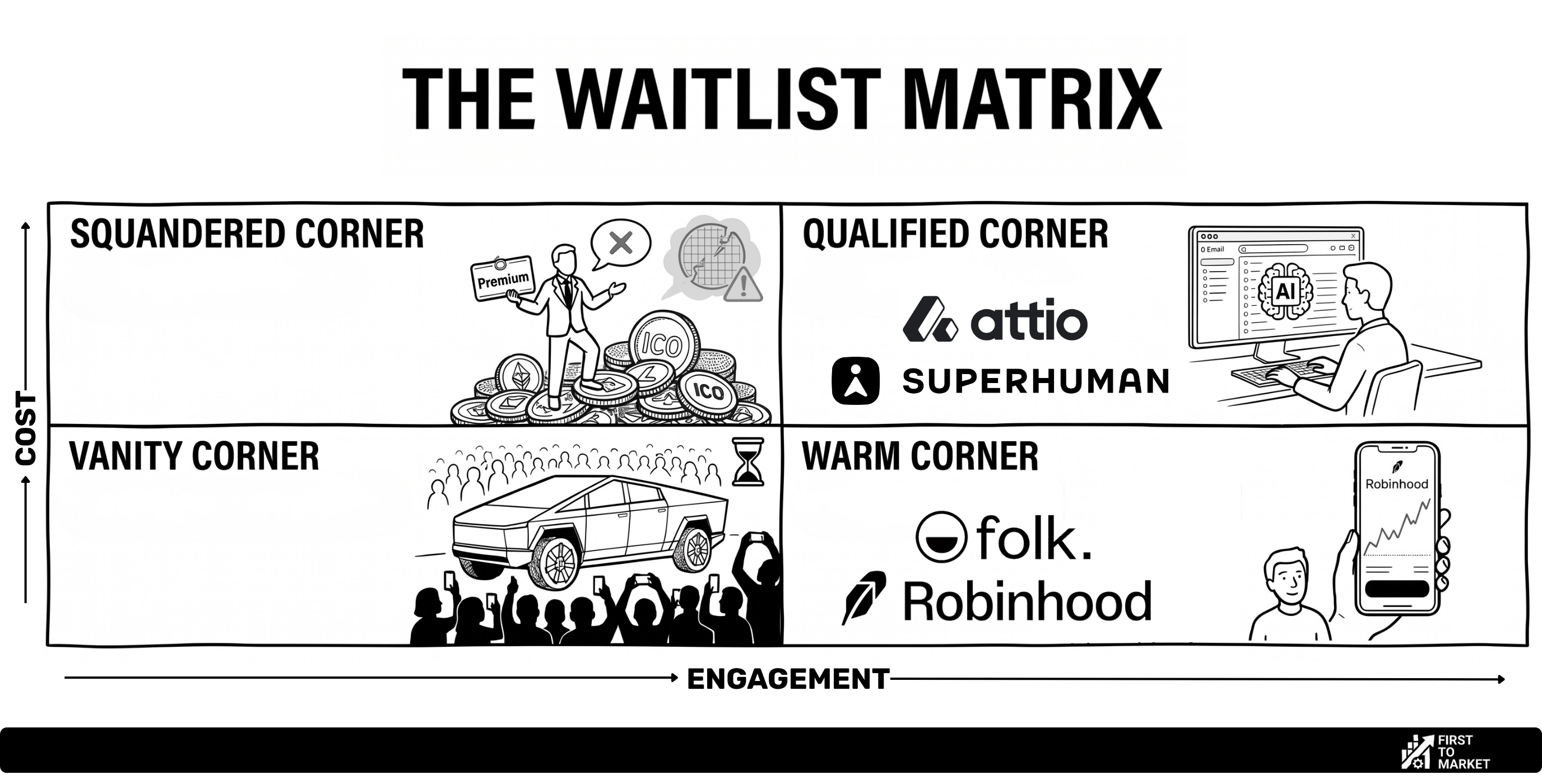
It’s rare that startup teams consider this before publishing their landing page. They end up chasing total signups and find the bottom left without intention. It’s optimized for size so it’s cheap to join and generally put on a shelf until launch.
That’s the Vanity Corner. It makes sense on paper because a big number is hard to argue with. “Hundreds of people want our product so it must be a great idea.”
Two moves help you avoid that misstep.
Move right so it costs something.
Move up to engage the audience while they wait.
You don’t need both to have a valuable waitlist. But I’d encourage you to pick one thoughtfully. Here’s how you can make that decision.
Move 1: Make the signal cost something
The signal you get is aligned with the cost you charge.
Quick and free = curiosity but not intent
Steep investment = intent but limited sample size
But keep in mind that the cost doesn’t have to be money. It can be effort, and sometimes that’s a better currency.
GitHub gated its Copilot preview to people already on a paid plan. The list would be shorter, but everyone on it had already had a credit card on file.
Superhuman charged in effort. Originally you had to book an onboarding call to even get an opportunity to get access. That sounds insane for a prosumer product. But it also got people to invest half an hour with the founders. We value what we work for.
Cognition’s waitlist was a form that asked what you’d want to build so the team could review before sending onboarding invites. The application was the filter, similar to what Linear did with its waitlist.
Waymo limited early access with a Trusted Tester program that included an NDA and request for detailed feedback. The cost of entry was a willingness to do research alongside them.
“Join the waitlist.” ❌
“Tell us what you’d use this for.” ✅
Test it: We should be deciding what we want from the waitlist before we build the form. Finish this sentence: “A signup tells me this person ______.” Pick what you actually need to learn and make joining cost that.
Lesson: Build the waitlist signup backward. Start from the signal you want, and the right cost becomes obvious.
Common misstep: Friction for its own sake isn’t a signal. The cost has to select for the customer you’re after rather than just having a hurdle to have one.
Move 2: Work the wait
Intent has a half-life. I can’t find the podcast to attribute it, but I heard Attio founder Nicolas Sharp say that the half life of a waitlist is much shorter than startups expect. He suggests that it is probably measured in days, even though people sit on the list for months.
We have two ways to counter that.
Shorten the wait
Keep them interested
The mechanics are well documented in academic studies.
People work harder the closer a reward feels so a waitlist that shows someone progressing is motivating.
Another study shows visible progress nearly doubled completion rate. In the trial, a loyalty card needing eight stamps from zero got redeemed 19% of the time, while a card needing ten stamps with two pre-filled delivered 34%.
That’s what fueled the Robinhood waitlist. You signed up, got your spot in line, and moved up by referring friends. A million people joined before launch. Even as regulatory approval delayed launch, the list stayed warm the whole way.
Folk CRM added a quick 10,000 signups but worked the waitlist by treating it as a conversation. The founders thanked them, asked what they expected the product to do, then granted access slowly. For them, a waitlist was user research that shaped what they built.
“We’ll email you when we launch.” ❌
“You’re #840. Here’s what we shipped this week for your use case.” ✅
Test it: Start by getting honest about how long the wait actually is because Attio guessed one year and it was three years. Then map the time between waitlist signup and launch as a journey. How much will they trust you in week #2, week #20 and the week before you launch? The goal is guiding them from a curious stranger to a ready buyer.
Lesson: The wait isn’t dead time. It’s a finite window where attention is high and expectations are low. It has a short half life.
Common misstep: Don’t waste people’s time with shallow updates on progress. A series of “We’re so close!” updates only trains people to ignore you.
Finding your spot on the waitlist matrix
The matrix has four corners so consider where you want to end up.
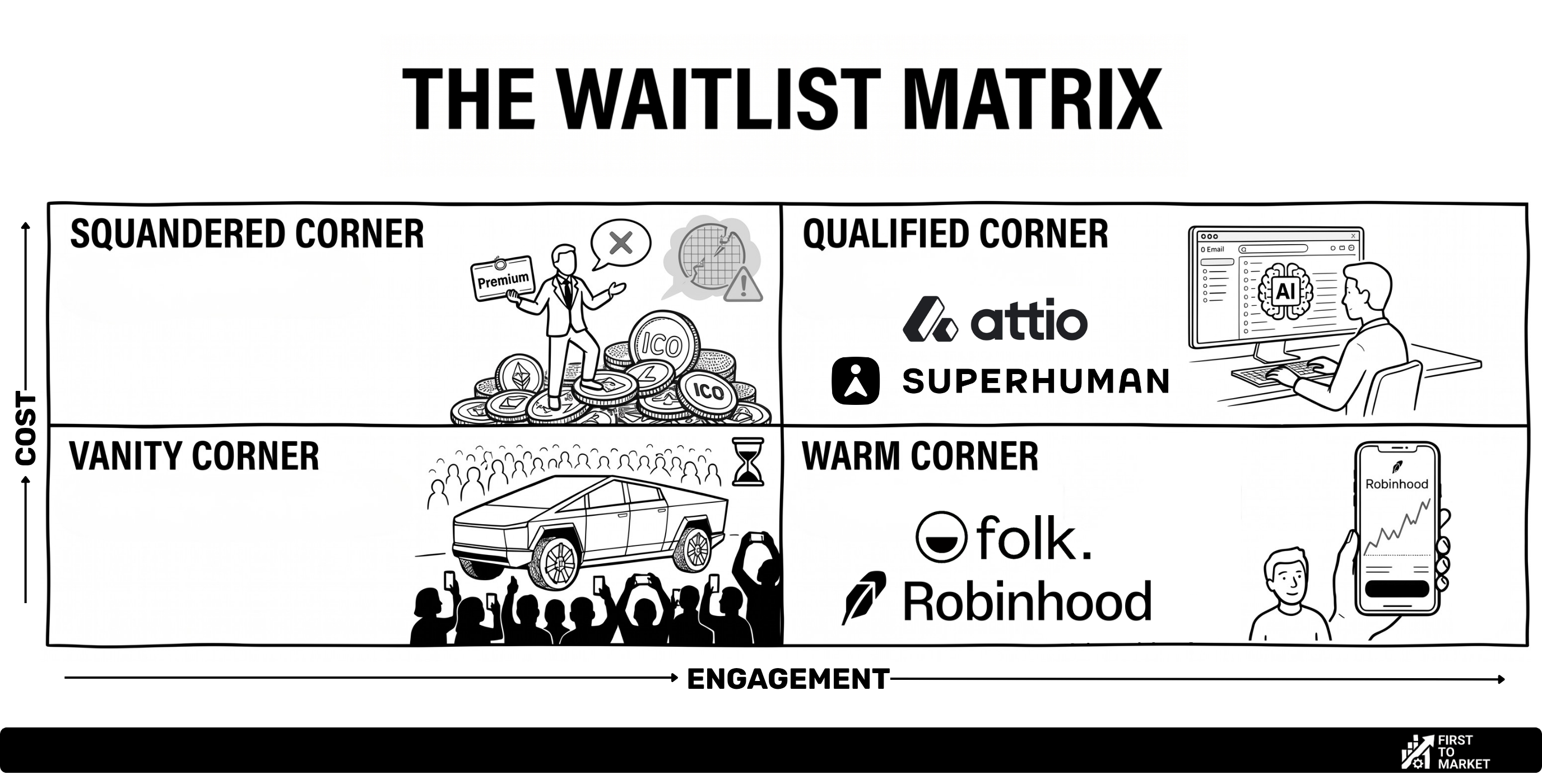
Vanity Corner (e.g. Cybertruck) is where lots of startups land by accident.
Warm Corner (e.g. Robinhood, Folk) keeps a low bar to entry but engineers the wait. It’s right when your bottleneck is awareness and the product explains itself.
Qualified Corner (e.g. Superhuman, Attio) asks people to invest up-front then keeps them close until you can serve them. This is right when your bottleneck is comprehension or capacity. It trades scale for intent. Clay kept its waitlist until it had millions in ARR for this reason.
Squandered Corner makes people earn their way in, then goes silent. But as a lot of hardware startups that picked this corner can tell you, a higher cost of entry only raises the price of getting it wrong.
“Grow the waitlist” sounds like a good use of energy but it isn’t a strategy. Choosing the Vanity Corner gives you a number that climbs while the signal underneath it gets weaker.
Before picking that path without intention, ask yourself what you really want from the waitlist.
Curiosity is cheap. It’s better to ask for something or earn the right to keep them. Ideally both. Do neither and you only get a nice number for a press release.
Curious about your thought regarding marketers using to create false scarcity and demand rather than do signups every month. “Signups now closed, join our waitlist” and then they open it periodically.