


Welcome Bradley, Kelly, Mary, Al, Adam and the others who subscribed this week. First to Market stays free thanks to our sponsor Clarify, which now syncs your LinkedIn DMs to the customer record in your CRM so everything is in one place. Here’s how it works.
I got home from a startup conference on Tuesday and started typing this. While the concept isn’t totally original, it’s been stuck in my head for months as I tried to tease out a lesson for those of us building in emerging categories.
A few things happened this week to bring it all together:
First, I joined a panel on AI threats and opportunities at the Iowa Angel Investor Summit. (Thanks to Tej Dhawan and Diana Wright for having me.)
Then a Roboflow co-founder shared their risk/reward decision process after a vendor raised the price of an enterprise (6-figure) tool. One of their engineers recreated it in less than a month.
Then I learned about Claimable, which uses AI to help patients appeal denied insurance claims. They didn’t say it exactly but their biggest competitor has to be patients just asking ChatGPT how to get denials reversed.
Then I read a piece by Dave Rubinstein on startups increasingly becoming the “free educator.” Prospects take a meeting and learn enough about the recipe to recreate it themselves.
And a couple of weeks ago, Joseph Lee, CEO of Supademo, told me customers can now vibe build an alternative that’s about 70% as good as his core product, and that’s good enough to cause churn.
Recently I wrote that in a new category, the competitor that beats us is usually the status-quo version of how customers handle the problem today: a junior employee, an agency contract, a legacy spreadsheet.
The ROI of those generally stays static: a spreadsheet mostly costs, operates and returns value about the same as it has for years. But I recently turned my own stack of audit spreadsheets into a category database that updates itself every night, has a public front end and feeds research into my articles each week, all for about $20/month. That would not have been realistic two years ago.
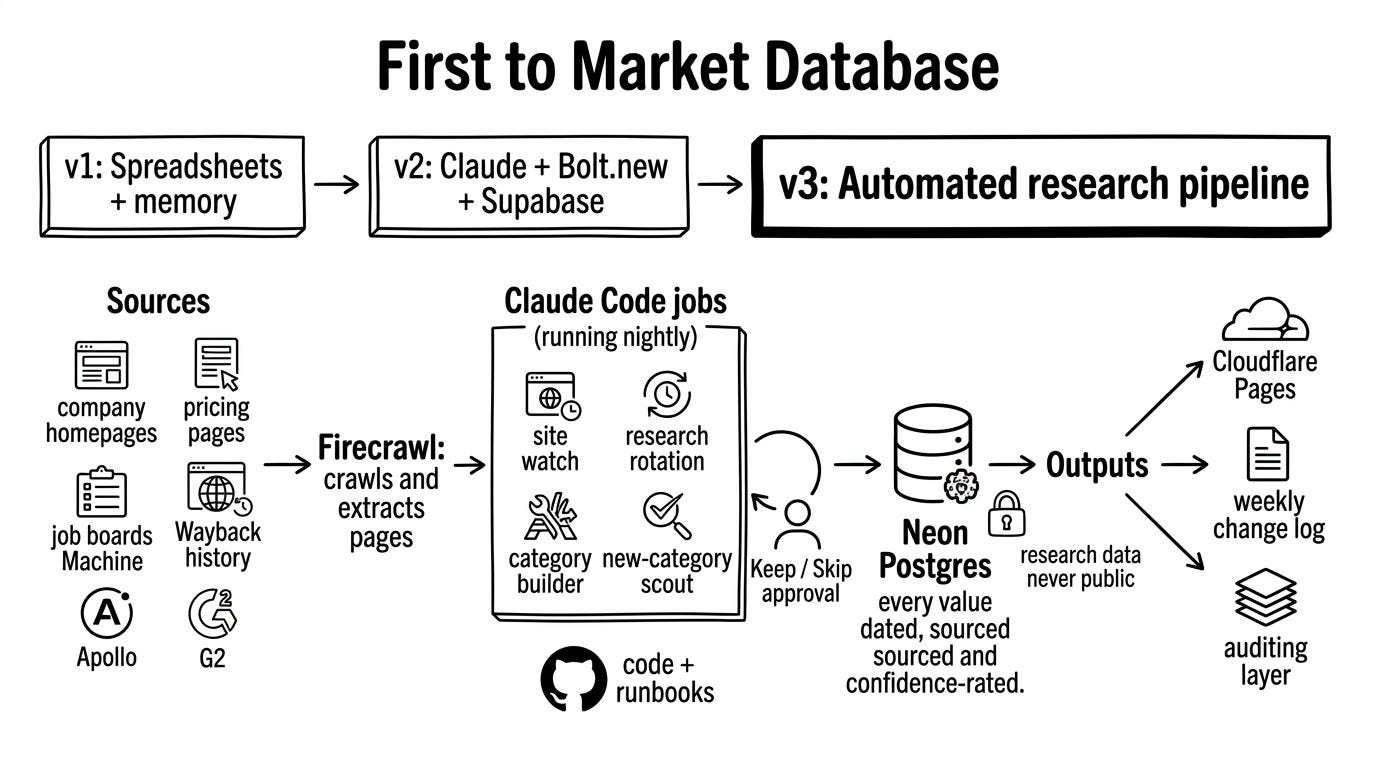
That creates a messy situation in an emerging category, where prospects don’t fully appreciate what we offer yet. We have to teach them before they’ll buy, but every lesson also creates instructions on building their own version. (True for both product and service businesses.)
Here’s how I think we can turn that threat into an opportunity.
1. Admit we are replaceable
Despite all of my YMCA participation ribbons from elementary school, I’m not special, and neither are you, and neither are our companies. (But keep reading and hear me out.)
The blatantly honest truth is that our products and services can be replicated to be 70% as good with enough motivation. The tools that help people do that are also getting cheaper and faster and better each quarter.
From the Roboflow example, I doubt that anyone at their company thought of the vendor as easy to replace until the price went up and somebody did the back-of-napkin math.
Reason to stay optimistic: A copy that’s 70% as good is missing 30%, and it’s usually the hard part: the edge cases, the maintenance, a helpline when it breaks. Roboflow had an engineer who could spend a month rebuilding a tool. Most of your customers don’t, and the ones who do usually have better things for that engineer to work on.
Test it: What would it take one of your customers to get 70% of what you offer? Think about the inputs: people, hours, data, tools. The fewer and cheaper those inputs are, the lower the cost of switching, and the more of a threat this should be.
Common misstep: Deep in your brain there’s probably a tiny voice saying: “Not me and not my company.” For this exercise, don’t listen to it. It’s not helpful and probably going to make you miss hidden truths.
2. Admit we have wisdom
During my decade as a consultant, plenty of companies took sales meetings to learn how to do the work themselves. We treated it as a cost of doing business. Now software companies tell me that they are seeing the same thing.
In a new category, we can’t totally skip the teaching part. But we can rethink what we teach. The advice from Dave Rubinstein’s article (mentioned earlier) is to focus on our wisdom as a guide who has been there before: where things commonly go wrong, what that costs and what we’d (de-)prioritize about their unique scenario. Prospects get a lot of value from the interaction AND a reason to trust us with the rest of whatever it is that we’re providing.
Dave wrote about a founder who pitched “AI for manufacturing.” Manufacturers were eager to take the meeting, learn about the solution, then never respond to another phone call. The revised pitch that worked better started with something that prospects had already felt: orders being lost because customers couldn’t get help picking the right part.
Lindsay Liu, CEO of Super, told me the value is in understanding “the problem you’re solving, the landscape, existing bottlenecks, and why those bottlenecks have persisted.”
Patrick Thompson, CEO of Clarify (CRM), challenges himself to understand the customer problem better than every other option out there.
Test it: Think about the last customer or prospect who got a lot of up-front value from you then didn’t convert. What was it (specifically) that they got from you? Instead of giving enough detail to do it themselves, the opportunity is giving them confidence that you’ve handled this hundreds of times before and will be there for them when they get lost in the future.
Common misstep: Don’t gate value for fear of giving too much away for free. My method was always to go really deep with one answer to one real problem, and make it clear that that was only the beginning.
3. Admit we have value
If a motivated customer can copy 70% of what we do, our unmatched value is in the 30% that they can’t.
Claimable goes way beyond an AI-generated appeal letter that any LLM could draft. It submits the appeal by mail and fax (because the fax machine is alive and well in this sector), follows up and adapts its playbook when an appeal is denied so it keeps getting better.
ContentMonk (AEO) told me they build a “Minimum Viable Service” around the end result they can deliver for each client. That proactive one-to-one help is what is credited for keeping churn under 5%.
Ocean.io (GTM tools) told me they work inside the tools that customers already use instead of adding another login. A lot of value comes from being easily accessible for as many people on the customer team as possible.
Test it: Look at the 30% from Question 1. Is it on your homepage and pitch decks and advertisements? If you’re focusing on the part that is easiest to copy, you’re kind of selling the 70% portion.
Common misstep: The 30% part is not a feature list. The best examples I’ve seen are a feeling that inspires optimism or minimizes concern.
The right side of practical
Andrew Kirpalani, who has a new fund called 2946 Ventures, said something at the conference that is totally applicable here: AI isn’t changing what’s possible, it’s changing what’s practical.
It was always possible for our customers to build their own CRM, appeal letter or internal tool. Now it’s practical.
But I still think it works for startups more than it works against us.
My category database was possible years ago. Although it wasn’t practical for one person with a day job + a toddler until recently. The same tools that let our customers build their own version also let us streamline our operations and chase opportunities that weren’t practical last year.
Just stay on the right side of “practical” for your customers.
Have a beautiful weekend.
The 70% copy point lands for service work too: once a prospect hears the recipe, they start pricing us against a junior plus ChatGPT. I now leave the edge cases and the maintenance in writing on the proposal so DIY looks cheaper only until something breaks. When you sell against that DIY option, do you price the maintenance as its own line, or fold it into the core fee?