


GM got a lot of attention this month with some bold announcements on (1) affordable EV models, (2) self-driving (3) and battery platform innovation. But that’s not what attracted the headlines or customer buzz.
It was the pending removal of Apple CarPlay and Android Auto that lit up the internet.
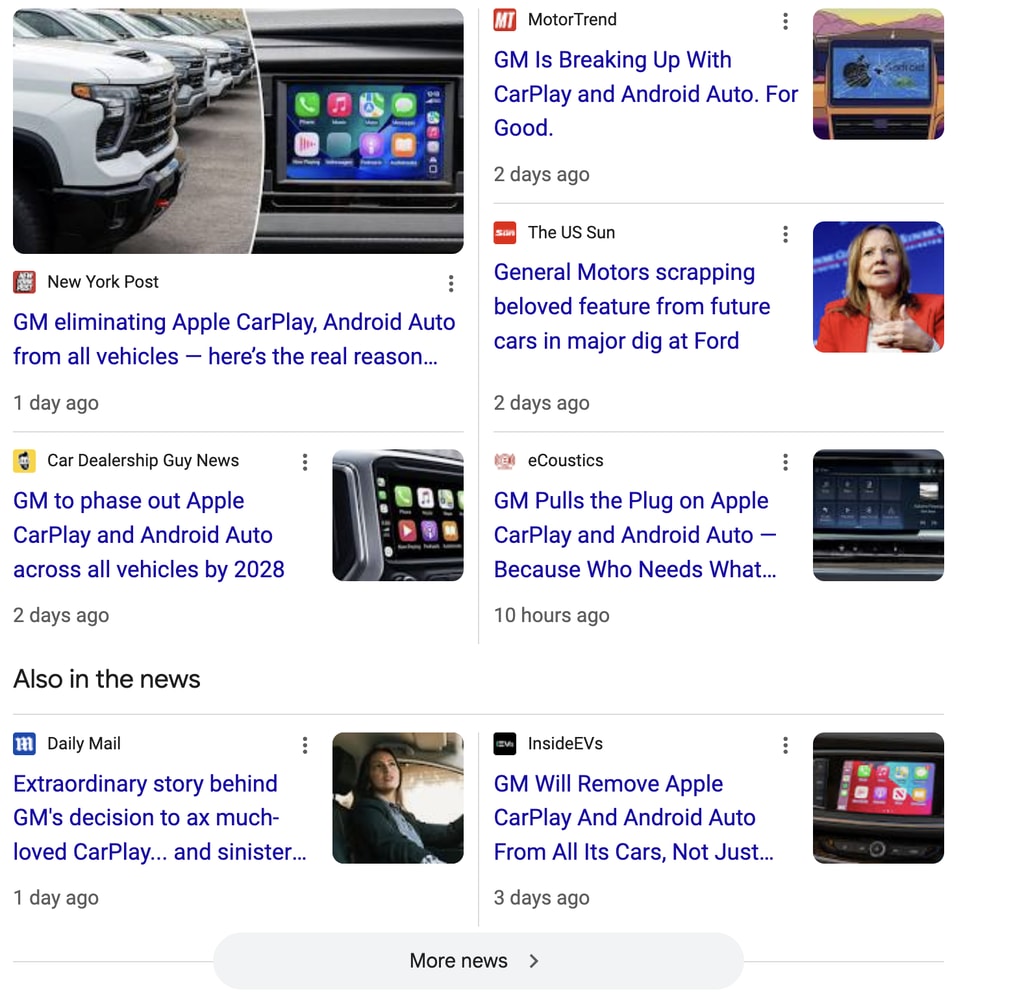
“Barra confirmed GM will eventually end support of Apple CarPlay and Android Auto on both gas-powered and electric cars. The timing is unclear, but Barra pointed to a major rollout of what the company is calling a new centralized computing platform, set to launch in 2028, that will involve eventually transitioning its entire lineup to a unified in-car experience.”

The backlash was immediate and visceral. Customers read it as: “GM is taking something I love.”
Legacy Brands vs Category Creators
For established companies like GM, removing a feature triggers loss aversion.
While GM’s additions represented an abstract, future value, its subtraction hit an immediate emotional nerve. Behavioral economists call it loss aversion, and it explains why removing an expected feature can eclipse even the flashiest innovation.
GM’s logic is understandable, especially to Tesla or Rivian owners who have adjusted to closed systems. Patrick George pointed out in Route Zero that this is a key part of GM’s roadmap to a software-driven (and -funded) future.
Speaking of Tesla and Rivian, these abrupt changes are nothing new for their customers. Both brands make these types of quick shifts regularly. It’s something they have trained their customers to see an expected side effect of innovating as a category creator.
How Brands Navigate Loss Aversion
The most successful brand communicators lead with making the new world feel inevitable, then show how their solution provides continuity:
Stripe: Rather than telling customers to stop building your own payment logic, they said that payments are now table stakes so here’s how to ship them in 7 lines of code. The loss (control) was reframed as liberation (speed).
Notion: They didn’t say to abandon all wikis, docs or project management tools. They built import tools from every competitor and let teams gradually consolidate. The transition felt additive, not subtractive.
Marketers often position new releases as a leap forward: cleaner, smarter, faster. But the biggest barrier to adoption isn’t always skepticism about what’s new, it’s anxiety about what’s lost.
We need to protect the user’s sense of control and continuity. Make what’s new feel additive, not subtractive.
Our product roadmap may point to an elegant, vertically integrated future. But our customer lives in the present. Before we remove what’s familiar, make sure we’ve sold what’s replacing it, both logically and emotionally.