


Buyers are not searching for solutions in emerging categories. They likely don’t even see the problem as worth solving.
Skepticism and inaction are your two biggest competitors
We can’t run enough ads or publish enough blog posts to change that. People want to be persuaded by people so we must develop ways to systematically amplify customer voices to:
Educate the market
Help it acknowledge the problem
Consider your solution
In B2B sectors, the challenge compounds itself. Customer volume is lower and buyers tend to view their solutions or vendors as trade secrets. (Refer-a-friend programs won’t work there.)
Turning Customers Into Educators
This is a framework for creating a system to amplify customer voices. As a real-life guide, I’ll illustrate how Cognism used a podcast to help their customers educate the market.
Step 1: Define Your Credibility Gap
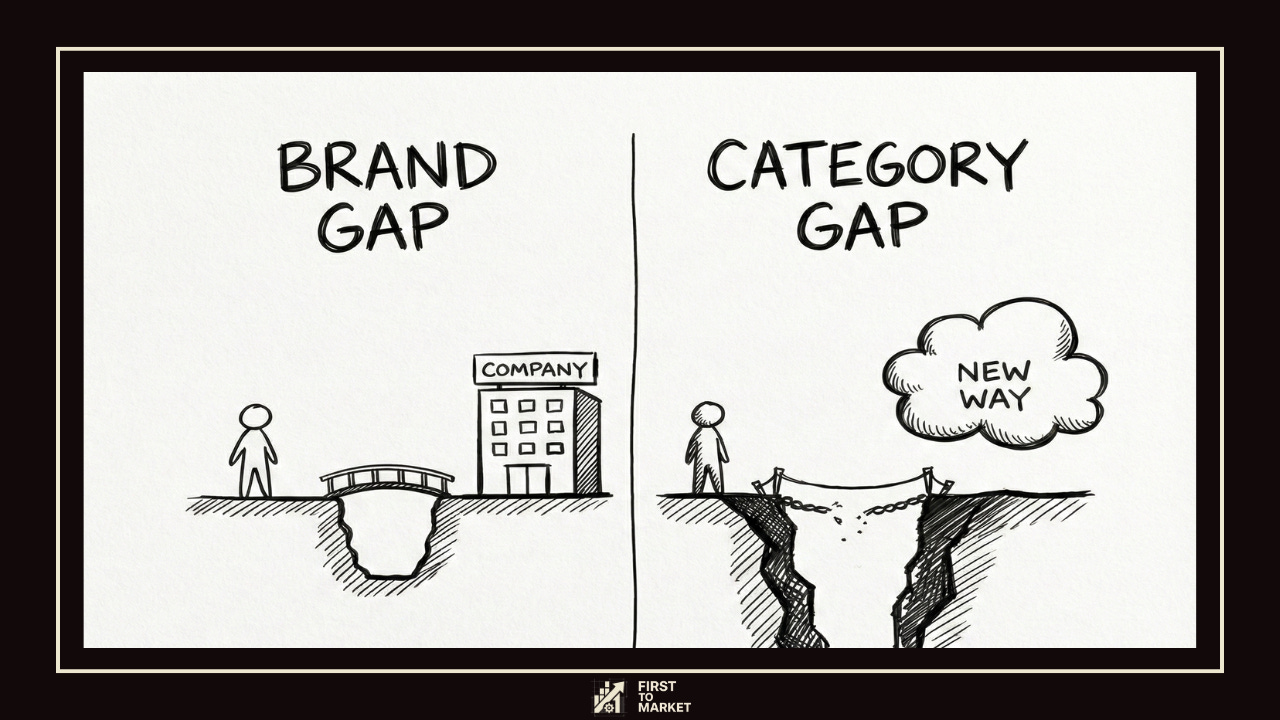
There are two common credibility gaps in emerging categories:
Prospects don’t trust your brand because you’re unknown or you’re competing against established players.
Prospects don’t trust your category (and solution) because the old way works fine or is less risky.
Brand gaps (#1) can be closed with traditional trust signals: customer logos, testimonials, social proof. You’re proving that your company is legit here.
Category gaps (#2) can’t be closed with traditional trust signals. You’re challenging someone’s beliefs, and those don’t budge for case studies or banner ads.
People who don’t trust the category need to be persuaded by their peers who:
They turn to for advice
Are one stage ahead in life or their career
Have a track record of seeing the future
We all have those people in our lives, and those are the ones who can change our stubborn beliefs.
Test it: Ask 5 prospects why they haven’t adopted a solution from your sector yet. Their responses will tell you whether you’re facing a brand or category credibility gap.
Common misstep: Throwing more brand-centric proof points (case studies, testimonials, etc.) at a category credibility gap sounds smart in a planning meeting but it never moves the metrics.
Real-world example: Cognism sells B2B buyer intent data. As GDPR and other legislation rocked the data players in the late 2010s / early 2020s, which I observed working in the analytics sector at the time, the default action among executives became “just wait” to see what happens.
The problem wasn’t whether their data was accurate. It was simply easier to do nothing than face the risk of the unknown in a strange new data landscape.
Step 2: Identify the Key Message
You’ve verified the gap. Now we need to isolate the specific belief holding back potential customers.
Test it: Complete this sentence. “If we could change one belief across our target market, it would be ___________.” That’s 95% of your key message. Every customer voice you amplify can help to reinforce this single point.
Insight: We’re searching for the market-level narrative that prevents broader adoption. It should make your entire category more credible.
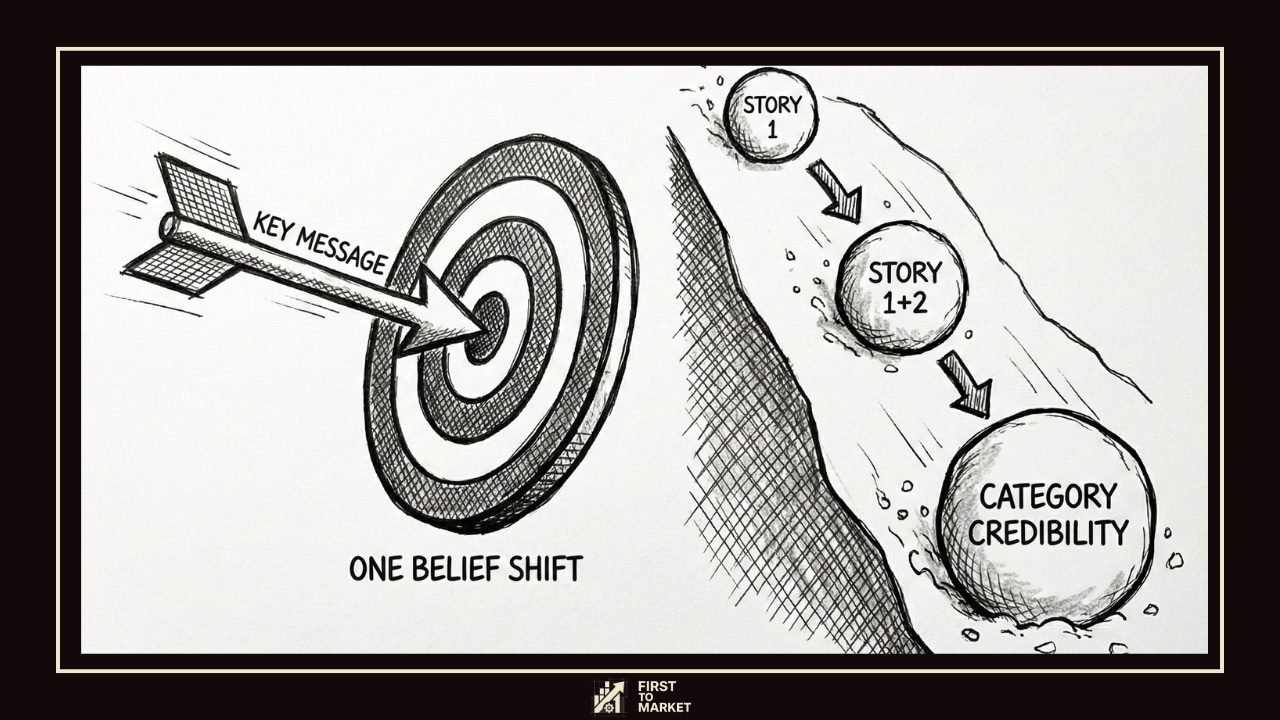
Real-world example: From what I’ve observed at Cognism, the key message was that sales professionals were still winning with outbound.
Shivan Pillay at Cognism created “Why Did It Fail?“ to give sales professionals a space to discuss failures openly. Instead of promoting Cognism‘s data products, the guests validated that failure was normal and that the path from failure to success was learnable.
The show directly addressed category skepticism. Successful sales leaders could prove that the category itself wasn’t broken, as long as their peers learned the right approach.
Step 3: Choose Your Format
Don’t ask yourself if you need a podcast. (You probably don’t.) Instead, focus on finding the medium that lets your customers educate their peers at scale.
These can take many shapes.
Episodic shows (podcast, video interviews)
Tutorials and walkthroughs (how > why)
Public discussions (conferences, webinars)
Co-marketing (1+1=3)
Test it: Ask customers where and when they learn. We never want to force them to adopt a new medium. For example, if I can’t absorb educational info (1) through earbuds (2) while washing dishes (3) after my toddler goes to bed, it’s not going to happen that day.
Common misstep: Choose a format based on what your ICP wants to consume, not what you are willing to create.
Real-world example: Cognism chose podcasting based on:
ICP consumption: Sales pros listen to podcasts during commutes, between meetings, while doing admin work
Content quality: Audio-only format helped guests open up about failure
Step 4: Make Everyone Win
The fastest way to kill customer voice amplification is losing sight of the value exchange. Every stakeholder must genuinely benefit and, arguably, the audience should benefit the most.
Test it: List every stakeholder and what they get from participating. “Exposure” or “tips” aren’t enough.
Lesson: The best customer education systems benefit the customer more than they benefit you.
Real-world example: The Cognism podcast helps sales professionals process failure, which I think is 95% of a seller’s day. The brand benefit is clear, but secondary.
Guests get space to process failure and a way to build a personal brand or connect with peers.
Listeners get unparalleled practical lessons from others’ mistakes, plus validation that struggle is part of the job.
Cognism gets audience growth and repurposable content.
The category gets a normalization of the failure-success ratio and a broadened perspective on selling strategies.
Step 5: Define Success Metrics
Define what success looks like upfront and commit to the time needed to achieve it. Most teams quit too early because they expect immediate ROI from something that is a long-term play.
Test it: Write down success metrics for several time horizons to be clear about objectives. (3, 6, 12, 24 months)
Common misstep: Evaluating a customer voice amplification program on monthly or quarterly timelines. If you need to fill the pipeline this quarter, this isn’t it.
Real-world example: Shivan Pillay told me that Cognism is only now, after 3 years, beginning to evaluate the podcast against numerical success metrics. That time horizon should be sobering for a lot of us living by quarterly campaigns and annual budgets.
Teacher of the Year Award
My biggest insight about customer voice amplification isn’t really about podcasts or formats or metrics.
It’s about respect.
When you systematically amplify customer voices, you’re saying: “The people using this product in the real world understand it better than we do. Let’s learn from them together.”
That’s a fundamentally different positioning than “Here’s why our product is great.”
Cognism’s podcast doesn’t say “buy our sales intelligence.” It says “let’s all get better at sales together.”
Giving your customers a platform to educate their peers is bigger than sales or market share. You’re building belief.
That’s something traditional marketing (and its associated metrics) can never buy.